By Jyoti Chauhan, Content Writer · Reviewed by Gurudev Shrie Kashyap, Founder, Bhartiya Institute of Vedic Science
Key Takeaways
- Mulank vs Bhagyank: your Mulank comes from the day you were born; your Bhagyank comes from your full date of birth. Neither "matters more"; they describe different layers of you.
- The Mulank (psychic number) is read as your instinctive personality and how you see yourself, often felt most strongly in the first half of life.
- The Bhagyank (destiny number) is read as your life direction, the lessons and work you grow into, often felt more clearly after about age 35.
- Many Indian numerologists judge harmony between the two using the natural planetary friendships of Parashari astrology.
- Both numbers take under a minute to calculate by hand, as the two worked examples below show.
Ask two numerologists "What is my number?" and you might get two different answers. One says 5, the other says 7, and both are right. That is because Indian numerology works with two core numbers from your date of birth: the Mulank and the Bhagyank.
This guide puts Mulank vs Bhagyank side by side: what each one means, how to calculate them, which one to look at for which question, and how numerologists read the two together. If you are completely new to numbers, start with our numerology for beginners guide, then come back here.
Mulank vs Bhagyank at a Glance
| Mulank | Bhagyank | |
|---|---|---|
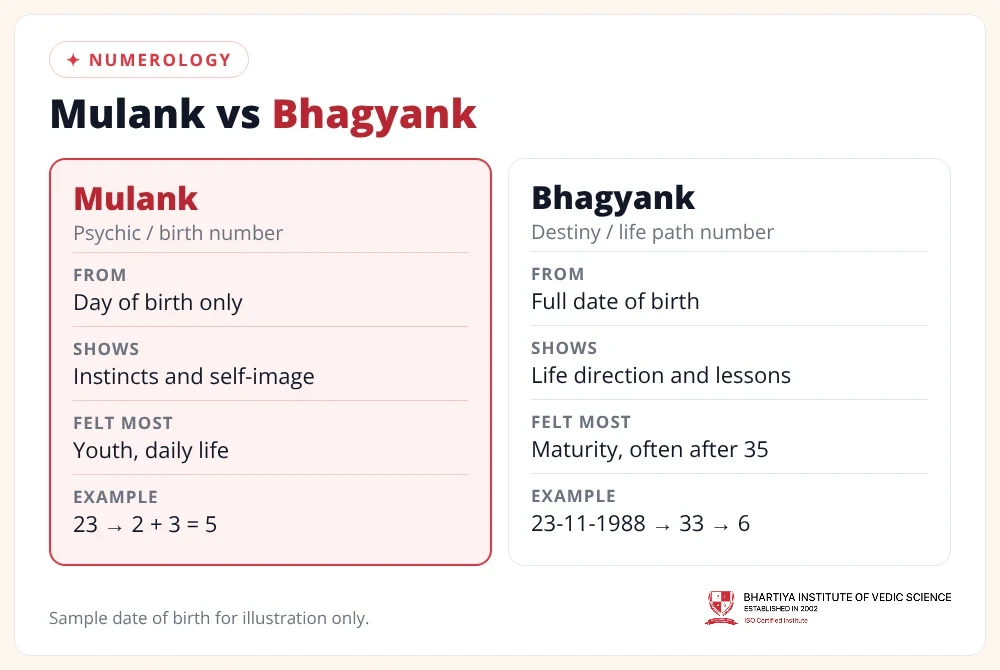
| Also called | Psychic number, birth number, root number | Destiny number, life path number, fortune number |
| Calculated from | Day of birth only | Full date of birth (day + month + year) |
| Describes | Instincts, self-image, everyday personality | Life direction, purpose, lessons, career themes |
| Felt most in | Youth and personal choices | Maturity, often more visible after about 35 |
| Used for | Personality, friendships, daily habits | Career, major decisions, name and number choices |
| Master numbers | Usually reduced (except 11, 22 for some) | 11, 22, 33 often kept unreduced |
What Is Mulank?
Mulank (मूलांक, "root number") is the single digit you get by reducing the day of the month you were born. It describes your instinctive nature: how you react, what you enjoy and how you see yourself.
Numerologists often compare the Mulank to the face you show in daily life. Two people with the same Mulank often share recognisable habits, even if their lives turn out very differently.
How to calculate Mulank
- Take only the day of birth.
- If it is a single digit (1-9), that is your Mulank.
- If it has two digits, add them and reduce: 23 → 2 + 3 = 5; 29 → 2 + 9 = 11 → 2.
| Mulank | Birth dates |
|---|---|
| 1 | 1, 10, 19, 28 |
| 2 | 2, 11, 20, 29 |
| 3 | 3, 12, 21, 30 |
| 4 | 4, 13, 22, 31 |
| 5 | 5, 14, 23 |
| 6 | 6, 15, 24 |
| 7 | 7, 16, 25 |
| 8 | 8, 17, 26 |
| 9 | 9, 18, 27 |
What Is Bhagyank?
Bhagyank (भाग्यांक, "fortune number") is the single digit you get by adding every digit of your full date of birth and reducing the total. It describes the broad direction of your life: the themes, lessons and kind of work you tend to grow into.
If the Mulank is the face you show, the Bhagyank is the road you walk. It is the number most numerologists use when someone asks about career direction or big decisions, and when they check whether a name or mobile number suits a person.
How to calculate Bhagyank
- Write the full date of birth as DD-MM-YYYY.
- Add every digit.
- Reduce the total to a single digit. Some numerologists stop at 11, 22 or 33; see our guide to master numbers 11, 22 and 33.
Two Worked Examples
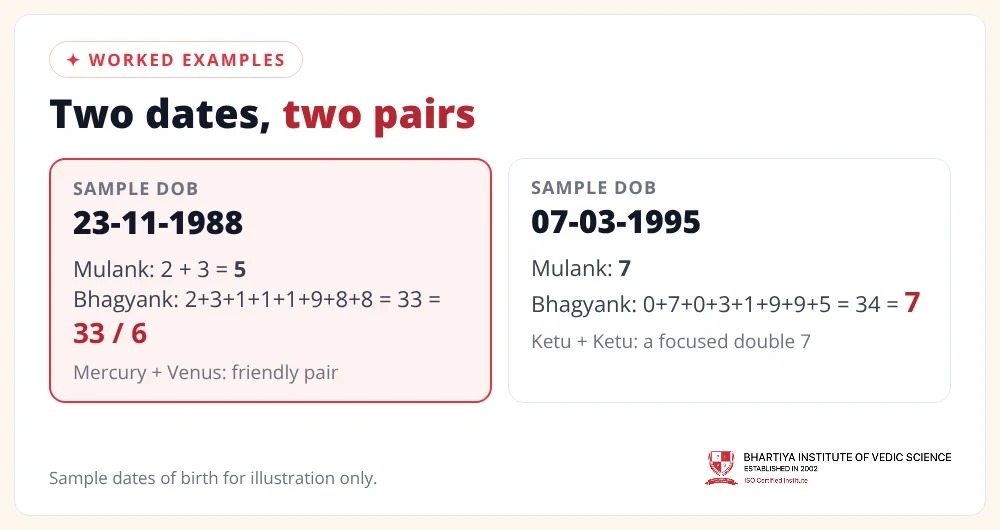
Example 1 (sample DOB: 23-11-1988)
- Mulank: 2 + 3 = 5 (Mercury)
- Bhagyank: 2 + 3 + 1 + 1 + 1 + 9 + 8 + 8 = 33 → master number 33, or 3 + 3 = 6 (Venus) if reduced
- Reading in brief: a quick, sociable, curious personality (5) on a life path linked with care, beauty, family and service (6/33).
Example 2 (sample DOB: 07-03-1995)
- Mulank: 7 (Ketu)
- Bhagyank: 0 + 7 + 0 + 3 + 1 + 9 + 9 + 5 = 34 → 3 + 4 = 7
- Reading in brief: a "double 7". The person's instincts and life direction point the same way: towards research, depth, intuition and some solitude. Double numbers usually make that number's traits very clear, both its gifts and its challenges.
Check your own numbers in seconds with our free numerology calculator.
Which Number Matters More?
The honest answer from most experienced numerologists: neither, because they answer different questions. A useful way to decide which to look at:
- Personality, habits, friendships, how you react under pressure: start with the Mulank.
- Career direction, long-term goals, major decisions: start with the Bhagyank.
- Choosing a name spelling, business name or mobile number: most Indian numerologists match it to the Bhagyank first, then check that it does not clash with the Mulank. Our guide to name numerology explains this in detail.
- Timing: neither; use the personal year number.
A common teaching is that the Mulank is felt more strongly in youth and the Bhagyank becomes more visible with maturity, often after about age 35. Treat this as a traditional observation rather than a fixed rule.
Mulank and Bhagyank Compatibility
Because each number is linked with a graha, many Indian numerologists judge harmony between your two numbers using the natural planetary friendships (naisargika maitri) described in the Brihat Parashara Hora Shastra. Rahu (4) is commonly treated like Saturn, and Ketu (7) like Mars.
| Number (planet) | Friendly numbers | Challenging numbers |
|---|---|---|
| 1 (Sun) | 2, 3, 9 | 6, 8 |
| 2 (Moon) | 1, 5 | None by nature |
| 3 (Jupiter) | 1, 2, 9 | 5, 6 |
| 4 (Rahu) | 5, 6, 8 | 1, 2, 9 |
| 5 (Mercury) | 1, 6 | 2 |
| 6 (Venus) | 5, 8 | 1, 2 |
| 7 (Ketu) | 1, 2, 3 | 5 |
| 8 (Saturn) | 5, 6 | 1, 2, 9 |
| 9 (Mars) | 1, 2, 3 | 5 |
Different schools publish slightly different friendship tables, so treat this as one common version. In Example 1, 5 and 6 (Mercury and Venus) are friends, so numerologists would call the combination harmonious. In Example 2, the double 7 is "same number", which most read as focused and intense.
A "challenging" pair is not a bad sign. It simply suggests that your instincts and your life direction pull in different directions, and that learning to balance them is part of your growth.
How the Two Numbers Work Together
- Same number (for example 3 and 3): strong, clear traits; the gifts and the blind spots of that number both show.
- Friendly numbers (for example 1 and 9): instincts support the life direction; people often describe life as flowing more easily.
- Neutral numbers: each number shows in its own area of life without much friction.
- Challenging numbers (for example 1 and 8): an inner tension between how you act and where life leads; growth comes from consciously balancing both.
Common Mistakes
- Using only the Mulank because it is easier to calculate. You miss half the picture.
- Adding month and year without the day for the Bhagyank. Every digit counts.
- Mixing up the two when choosing names or numbers. Most traditions match those to the Bhagyank.
- Treating challenging pairs as unlucky. They describe tension to work with, not misfortune.
What Mulank and Bhagyank Can and Cannot Tell You
Your two core numbers offer a simple framework for reflecting on your nature and direction, and many people find them a useful mirror. They cannot predict specific events, guarantee success in a career or marriage, or replace professional advice. Use them to ask better questions about yourself, not to make fixed judgements.
Go Deeper
Once you are comfortable with these two numbers, the next steps are the name number, the Lo Shu grid and the personal year. Our comparison of Chaldean vs Pythagorean numerology will help you choose a letter system for names. Bhartiya Institute of Vedic Science also teaches numerology in live classes in Hindi and English, from an Advanced course (about 2 months) to a Professional course (about 4 months).
Conclusion
In the Mulank vs Bhagyank question there is no winner: the Mulank shows who you are day to day, and the Bhagyank shows where your life tends to lead. Calculate both, read them together, and notice whether they support or balance each other. Ready to see your own pair? Enter your date of birth in the free numerology calculator at Bhartiya Institute of Vedic Science.
This article shares traditional numerology knowledge for educational purposes. It is not a substitute for professional medical, legal or financial advice.