Riya sat for her first Reiki session and watched the practitioner trace a small spiral in the air before touching her shoulders. She wondered, what was that shape? It was the cho ku rei reiki symbol, often called the Reiki power symbol. Practitioners believe it helps focus Reiki energy where it is needed. Here, you will learn its meaning, origin, uses, and mistakes to avoid.
What is the Cho Ku Rei Reiki Symbol and Why Do You Need It?
Cho ku rei (said "choh-koo-ray") is the first symbol taught in Usui Reiki. It is also written as the choku rei reiki symbol, and both spellings mean the same thing. Most Reiki teachers translate it as "place the power of the universe here." Because of this, it is widely known as the power symbol.
What Does it Look Like?
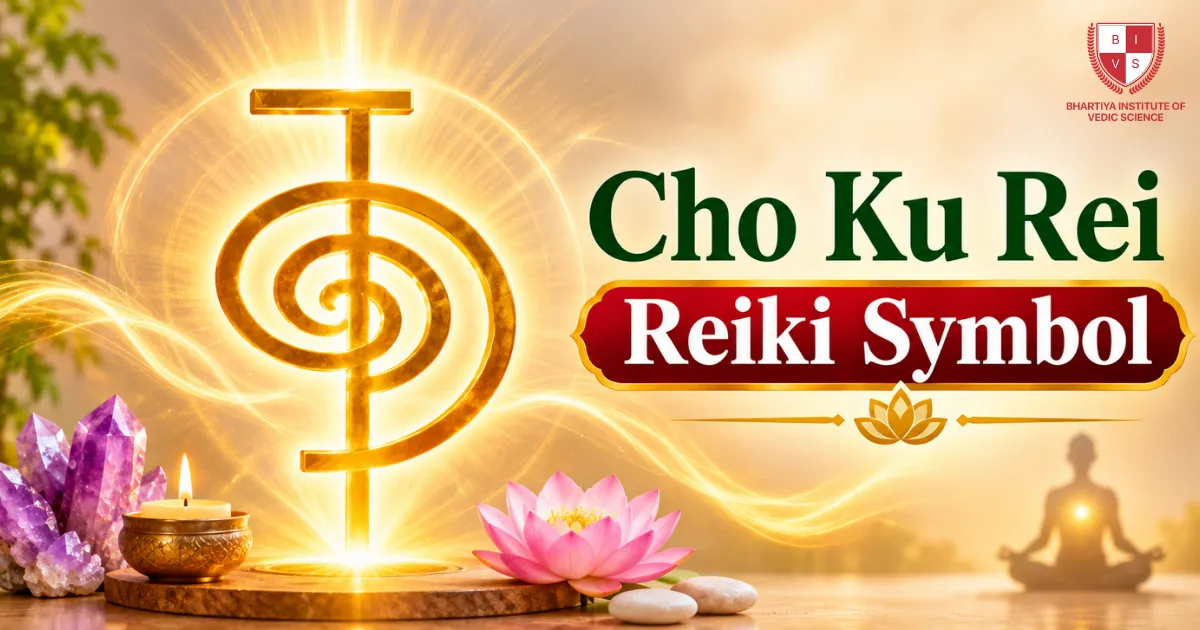
The symbol is simple to recognise. It has a straight line on top, with a spiral that curls down below it. Some teachers draw the spiral clockwise, and others draw it anti-clockwise. Both are taught, so you will see small differences between lineages.
What Does Each Part Mean?
Some Reiki teachers break the name into three parts:
- Cho: to bring, or to cut
- Ku: the void, or the universe
- Rei: spirit, or divine energy
Put together, the name is read as "draw the power of the universe and focus it here." Please note that the exact meaning is still debated. The name is written in kana, which shows sounds, not fixed meanings, so no one can be 100% sure what Mikao Usui, the founder of Reiki, intended.
Where Did it Come From?
The symbol is linked with Mikao Usui, who developed Reiki in early 1900s Japan. A popular story says Usui found the symbols in ancient Sanskrit texts. However, many researchers say the symbols are mainly Japanese in origin. As a Reiki student, you can respect both views and keep an open mind.
How Does it Fit With the Other Usui Reiki Symbols?
Usui Reiki has four main symbols. Cho ku rei is the power symbol, Sei He Ki is linked with emotional and mental balance, Hon Sha Ze Sho Nen is used for distance Reiki, and Dai Ko Myo is the master symbol. Cho ku rei comes first, and it is the base you build on. Once you are comfortable with it, the other symbols become easier to understand.
Why Do You Need it?
Think of it as a light switch. Practitioners often use it to begin a session, to switch on a steady flow of Reiki, and to bring their attention to one place. If you practise self-Reiki, the symbol may help you slow down, set an intention, and feel more centred. In most Usui Reiki lineages, you learn this symbol at Level 2 (Okuden), and a qualified Reiki master usually passes it on during that class.
How Can You Use the Choku Rei Reiki Symbol? Benefits and Steps
Key benefits of the choku rei reiki symbol
According to Reiki teachers, the power symbol is believed to help you in these ways:
- Boost energy flow: It may increase the Reiki energy you channel, much like switching on a bright lamp.
- Focus on one area: It may help you direct attention to a specific spot, such as the shoulders, back, or a chakra.
- Strengthen other symbols: Many practitioners draw it first to support Sei He Ki and Hon Sha Ze Sho Nen.
- Protect your space: It is often used with the intention of clearing and shielding a room, a seat, or a healing table.
- Ground and calm you: Many people feel a sense of steadiness while drawing and chanting.
These are traditional beliefs and personal experiences, not guaranteed results. Reiki is a complementary practice and does not replace medical care.
How to Draw the Cho Ku Rei Reiki Symbol Step by Step
You can learn the shape on paper first. Then you can draw it in the air with your palm or finger.
- Sit comfortably. Keep your back straight, relax your shoulders, and take three slow breaths.
- Set your intention. Silently say what you want, for example, "I ask for Reiki to flow for my highest good."
- Draw the straight line. Start with a horizontal line from left to right in front of you.
- Add the vertical line. Bring a line down from the middle of the first one.
- Draw the spiral. Many teachers begin at the top and curl the spiral clockwise, with about three to five turns. Some lineages teach it the other way, so follow your own teacher.
- Say the name. Chant "Cho Ku Rei" three times, softly or in your mind.
- Pause and feel. Rest your hands and notice any warmth, tingling, or calm. If you feel nothing, that is fine too.
Teachers often say that the exact number of spiral turns is less important than your focus and intention.
Simple Ways to Use It in Daily Practice
- Start of a session: Draw it in front of you, or on your palms, before you begin.
- On a body area: Draw it above the area you are about to treat, with the client's consent.
- Before other symbols: Draw it first, then add the next symbol on top.
- For your space: Visualise it on the walls and door of your room before meditation.
- End of a session: Some practitioners draw it again to close the session.
If you are new to Reiki, practise for five to ten minutes daily. A calm routine matters more than a perfect drawing.
A Simple 10-Minute Daily Routine
Here is an easy way to build the habit, without any pressure:
- Minutes 1 to 2: Sit quietly, close your eyes, and breathe slowly.
- Minutes 3 to 5: Draw the symbol in the air three times, saying the name each time.
- Minutes 6 to 9: Place your palms on your heart or belly, and let your attention rest there.
- Minute 10: Thank the energy, open your eyes, and write one line in a journal about how you feel.
After a few weeks, you may notice that you settle faster and focus better. Every person's experience is different, so treat this as a calming habit, not a promise.
What Should You Avoid While Using the Cho Ku Rei Symbol?
Even a simple symbol can be misused. Keep these points in mind:
- Don't treat it as a magic charm. The symbol does not work like a guarantee. It is a focus tool, and your intention and practice matter.
- Don't promise cures. As a practitioner, never tell a client that Reiki will cure an illness. Always suggest they see a doctor for any medical concern.
- Don't learn from random posts alone. Reading or watching a video is a good start, but traditional symbols are best learned from a qualified Reiki master with proper attunement.
- Don't argue over small differences. Clockwise or Anti-Clockwise, three turns or five, lineages vary. Follow your teacher and stay respectful of others.
- Don't use it carelessly. Avoid printing it on casual items or treating it like decoration. Traditionally, the symbols are drawn in the air or visualised with respect.
- Don't skip your own wellbeing. Rest, drink water, and ground yourself after a session. If you feel unwell, pause your practice.
- Don't rush the levels. Build a strong base with Level 1 before moving on, so the symbols make real sense to you.
Conclusion: Start Your Cho Ku Rei Journey the Right Way
To sum up, cho ku rei is the Reiki power symbol, a straight line with a spiral, that practitioners use to focus energy, set intention, and support the other symbols. It is simple to draw, easy to remember, and best practised with patience, respect, and guidance. Your intention and regular practice matter more than a perfect shape. For more guides, browse our Reiki blogs.
Want to master Reiki yourself? Join the Reiki Course at Bhartiya Institute of Vedic Science (BIVS) and learn the Usui Reiki symbols step by step from expert teachers. Enrol today and begin your healing journey.