By Jyoti Chauhan, Content Writer · Reviewed by Gurudev Shrie Kashyap, Founder, Bhartiya Institute of Vedic Science
Key Takeaways
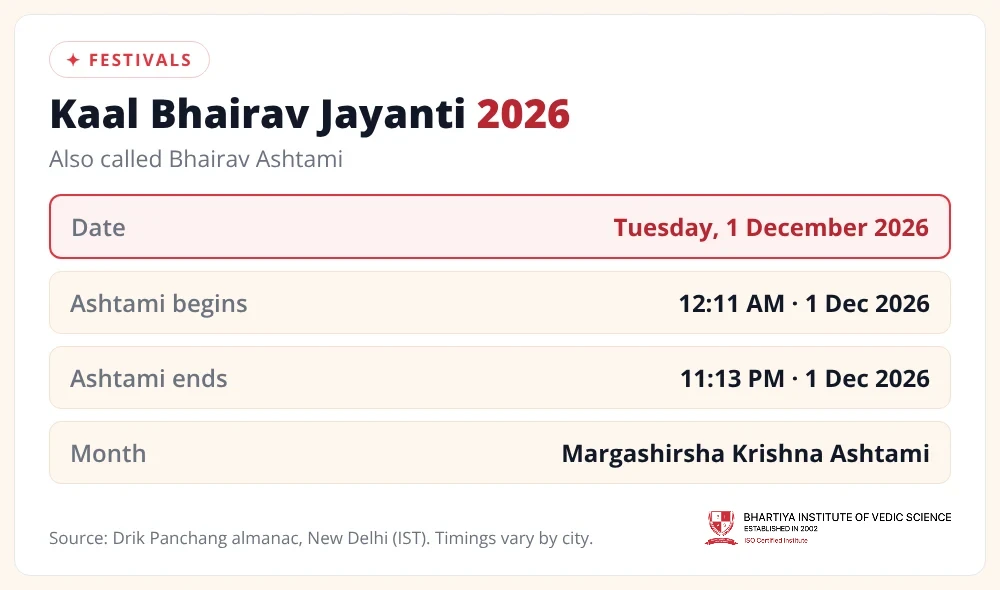
- Kaal Bhairav Jayanti marks the appearance of Lord Kaal Bhairav, a fierce form of Shiva. In 2026 it falls on Tuesday, 1 December.
- The Ashtami tithi runs from 12:11 AM to 11:13 PM IST on 1 December 2026 (New Delhi, as published in the Drik Panchang almanac).
- It is observed on the Krishna Paksha Ashtami of Margashirsha (in the purnimanta calendar), so it is also called Bhairav Ashtami or Kalashtami.
- Kaal Bhairav is revered as the guardian (kotwal) of Kashi and as the lord of time and discipline.
- Common observances are a fast, an evening or night puja, lighting a lamp, reciting the Kalabhairava Ashtakam and feeding dogs.
Walk through the lanes of Varanasi and you will hear that no pilgrimage to Kashi is complete without first visiting Kaal Bhairav, the city's protector. Once a year, on Kaal Bhairav Jayanti, that temple and Bhairav shrines across India see their biggest crowds.
This guide gives you the verified date and tithi timings for 2026, the story behind the festival as the Puranas tell it, its meaning, and how it is traditionally observed at home and in temples.
Kaal Bhairav Jayanti 2026: Date and Tithi Timings
| Detail | 2026 (New Delhi, IST) |
|---|---|
| Kaal Bhairav Jayanti | Tuesday, 1 December 2026 |
| Ashtami tithi begins | 12:11 AM, 1 December 2026 |
| Ashtami tithi ends | 11:13 PM, 1 December 2026 |
| Hindu month and paksha | Margashirsha, Krishna Paksha (purnimanta); Kartika in the amanta calendar |
Timings are as published in the Drik Panchang almanac for New Delhi. Tithi timings change by city, so check your local panchang. Because the Ashtami that prevails at night (ratri vyapini) is preferred for the fast, the observance in 2026 falls on 1 December.
Who Is Kaal Bhairav?
Kaal Bhairav is a fierce form of Lord Shiva, worshipped as the lord of time (kaal), the remover of fear and the protector of devotees and sacred places. He is usually shown with a dark complexion, a garland of skulls, a trident and a staff, accompanied by a dog, which is his vahana (vehicle).
His name carries both of his roles. Kaal means time and also death; Bhairav comes from bhaya (fear) and is read as "the one who removes fear". So Kaal Bhairav is understood as the power that even time obeys, and the protector who frees devotees from fear.
The Story Behind Kaal Bhairav Jayanti
The Puranas tell several versions of Bhairav's appearance. The most widely told one, found in the Kashi Khanda of the Skanda Purana and in the Shiva Purana, goes like this:
- Brahma, who then had five heads, grew proud and spoke disrespectfully of Shiva's supremacy.
- From Shiva's anger arose Kaal Bhairav, who severed Brahma's fifth head with his fingernail, humbling his pride.
- The severed head (kapala) stuck to Bhairav's hand. To atone for the act, he wandered the worlds as a mendicant carrying the skull.
- When he reached Kashi, the skull finally fell from his hand. The spot is still revered as Kapal Mochan.
- Shiva then appointed Bhairav as the kotwal (guardian) of Kashi, which is why pilgrims seek his blessing before anything else in the city.
The story is usually read as a teaching about ego: even the creator is humbled when pride takes over, and even a god accepts atonement for his actions.
Spiritual Significance
Devotees connect Kaal Bhairav with several qualities:
- Discipline and time: as the lord of time, he is associated with punctuality, order and respect for one's duties.
- Protection: he is worshipped as a guardian of homes, temples and cities, and of travellers.
- Freedom from fear: devotees pray to him for courage and inner steadiness.
- Humility: the story of Brahma's fifth head is a reminder to keep pride in check.
Astrologers sometimes link Bhairav worship with Saturn (Shani) and Rahu, the grahas of discipline and the unexpected. That is a later devotional association, not something you need to fear. If you are curious about the grahas, our guide to what Vedic astrology is explains them simply.
How Kaal Bhairav Jayanti Is Observed
Customs vary by region and family. These are the most common traditional practices:
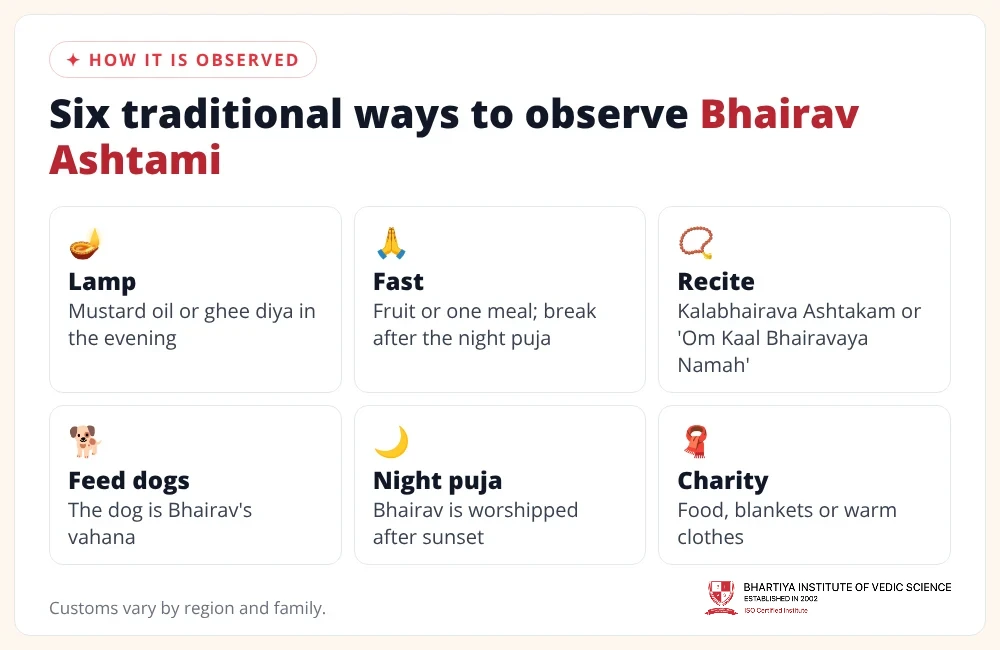
- Fast (vrat): many devotees fast from sunrise, eating only fruit or a single meal, and break the fast after the night puja or the next morning.
- Bath and sankalp: an early bath, clean clothes and a resolve (sankalp) to observe the day with devotion.
- Puja: offering flowers, incense, a lamp of mustard oil or ghee, black sesame, and sweets such as jalebi or imarti, which are traditional offerings to Bhairav in many regions.
- Recitation: chanting the Kalabhairava Ashtakam, the eight-verse hymn attributed to Adi Shankaracharya, or simply the name "Om Kaal Bhairavaya Namah".
- Night vigil: since Bhairav is worshipped at night, some temples and families hold a jagran with bhajans.
- Feeding dogs: because the dog is Bhairav's vahana, feeding street dogs is a much-loved custom.
- Charity: giving food, blankets or warm clothes, which suits the December season.
Some families also wear dark colours on this day out of respect. If you follow day-wise colour traditions, our guide to which colour to wear on which day explains the reasoning.
Famous Kaal Bhairav Temples
- Kaal Bhairav Temple, Varanasi: the guardian shrine of Kashi, the busiest on Jayanti.
- Kal Bhairav Temple, Ujjain: known for its unusual tradition of offering liquor to the deity.
- Batuk Bhairav Temple, New Delhi: one of the oldest Bhairav shrines in Delhi, near Purana Qila.
- Kala Bhairaveshwara, Adichunchanagiri (Karnataka): an important centre in South India.
Kalashtami vs Kaal Bhairav Jayanti
Every month's Krishna Paksha Ashtami is called Kalashtami and is dedicated to Bhairav. The Kalashtami of Margashirsha is the most important one, because it is considered his appearance day; that is Kaal Bhairav Jayanti. The rhythm of monthly and yearly festivals in the Hindu calendar is similar to other observances such as Pitru Paksha, Ganesh Chaturthi and Bhai Dooj, which are all fixed by tithi rather than by the Gregorian date.
A Calm Note on Bhairav Worship
Because Bhairav has a fierce form, you may come across scary claims online. Traditional worship of Kaal Bhairav is about devotion, discipline and protection. You do not need any paid ritual or special product to observe the day; a sincere prayer, a lamp and an act of kindness are at the heart of the tradition.
Conclusion
Kaal Bhairav Jayanti falls on Tuesday, 1 December 2026, with the Ashtami tithi lasting almost the whole day in New Delhi. It celebrates the guardian of Kashi and the lord of time, and its customs are simple: a fast, a night puja, the Kalabhairava Ashtakam and kindness to animals and people in need. If you would like to understand the panchang, tithis and the grahas behind festivals like this one, explore the astrology course at Bhartiya Institute of Vedic Science.
This article shares traditional knowledge for educational purposes. Dates and timings are for New Delhi; please check your local panchang.