By Jyoti Chauhan, Content Writer · Reviewed by Gurudev Shrie Kashyap, Founder, Bhartiya Institute of Vedic Science
Key Takeaways
- Kitchen Vastu traditionally places the kitchen in the south-east (agneya) zone, ruled by Agni, the fire element. The north-west is the most common second choice.
- The cook is traditionally advised to face east while cooking, so the stove sits along the east wall or in the south-east corner.
- Fire (stove) and water (sink) are kept apart, ideally not on the same straight line or directly opposite each other.
- Vastu teachers suggest warm, light colours such as orange, yellow, peach, cream and soft red for kitchens.
- Open-plan kitchens and small flats can follow 8 practical adjustments without any demolition.
In most Indian homes, the kitchen is where the day really starts: the first cup of chai, the pressure cooker whistle, the family drifting in to see what's cooking. Vastu Shastra treats the kitchen with great respect because it is the home of Agni, the fire element, and the source of the family's food.
This guide explains the traditional reasoning behind kitchen Vastu: the best direction for the kitchen, where to place the stove, sink, fridge and storage, which colours suit the room, and what to do if your kitchen is in the "wrong" zone. Every tip is practical enough for a modern flat.
What Is Kitchen Vastu?
Kitchen Vastu is the part of Vastu Shastra that guides where a kitchen should be located in a home and how its main elements, especially the stove, sink, storage and entrance, should be placed. It rests on the idea that each direction of a house is linked with one of the five elements (panch tattva), and that fire belongs in the south-east.
Classical architecture texts such as the Manasara and the Mayamata describe how a house should be divided into zones using the Vastu Purusha Mandala. You can read more about this framework in the introduction to Vastu-shastra and Indian architecture, or in our own beginner's guide to what Vastu Shastra is and how it works.
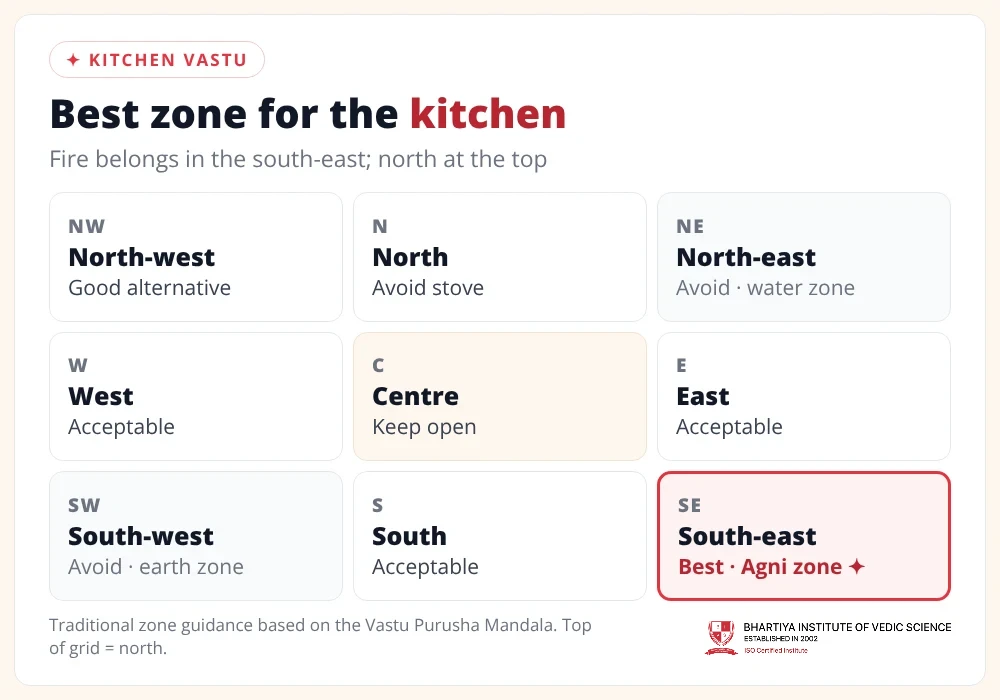
Best Direction for the Kitchen
| Zone | Traditional view | Why |
|---|---|---|
| South-east (agneya) | Best | Ruled by Agni, the fire element; matches the kitchen's purpose |
| North-west (vayavya) | Good alternative | Air zone; air supports fire, so many teachers accept it |
| East or south | Acceptable with care | Some schools allow these when south-east is not possible |
| North-east (ishaan) | Traditionally avoided | The water and prayer zone; fire here is considered a clash |
| South-west (nairitya) | Traditionally avoided | Earth zone kept heavy and stable, usually for the master bedroom |
| Centre (Brahmasthan) | Avoided | The centre is kept open and light |
The direction a house faces changes how zones are used in practice. If your home faces south-east, our guide to south-east facing house Vastu explains how the kitchen fits in.
Stove Placement and Cooking Direction
The stove (gas hob or chulha) is the heart of kitchen Vastu. The most common guidelines are:
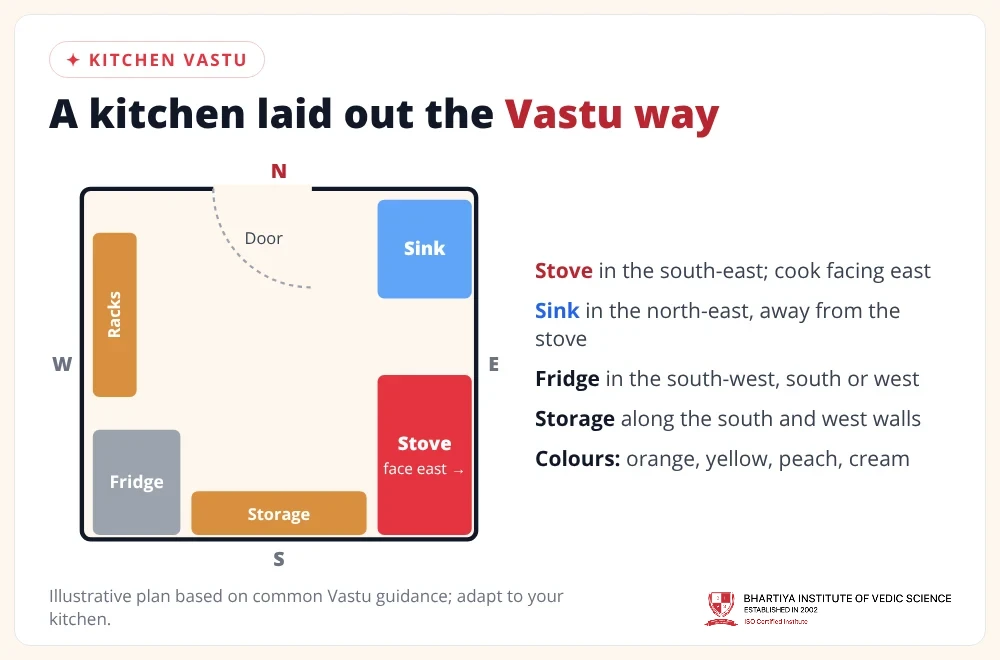
- Face east while cooking. This is the single most repeated rule of stove direction as per Vastu. East is the direction of the rising sun, and cooking facing it is considered auspicious and pleasant.
- Place the stove in the south-east corner of the kitchen, or along the east wall, a little away from the wall itself.
- Avoid facing south while cooking, which tradition discourages. West is a common second choice if east is impossible.
- Don't place the stove directly under a window where wind can affect the flame, or directly in line with the kitchen door.
- Keep the stove clean. Many families treat the stove with respect, avoiding placing dirty utensils on it.
Sink and Stove Placement: Keeping Fire and Water Apart
Fire and water are opposite elements. Kitchen Vastu therefore advises keeping the stove and the sink apart:
- Sink in the north-east part of the kitchen, the water direction, while the stove stays in the south-east.
- Not directly opposite each other and not side by side. If they must share a counter, keep at least an arm's length between them, or place a small chopping area or a divider between.
- Water storage (water purifier, drinking water pots) also goes towards the north-east or north.
Where to Place Other Kitchen Items
| Item | Suggested position |
|---|---|
| Refrigerator | South-west, south or west of the kitchen; avoid the north-east corner |
| Microwave, oven, toaster | South-east, near the stove (fire appliances) |
| Grain and heavy storage | South or west walls |
| Utensil racks and cabinets | South or west walls; keep the north and east lighter |
| Water purifier and drinking water | North-east or north |
| Dustbin | North-west or west, kept covered |
| Windows and exhaust | East for morning light; exhaust fan on the east or south side |
| Dining table | West of the kitchen or in the west zone of the house |
Kitchen Colours in Vastu
Because the kitchen is linked with fire, warm and light shades are preferred:
- Best: orange, yellow, peach, cream, soft red and light pink.
- Also fine: off-white, light brown and light green in a north-west kitchen.
- Traditionally avoided in large areas: black, dark grey and deep blue, which are linked with the water element.
Modular kitchens often come in greys and blacks. If you already have them, add warm tones through the wall paint, backsplash tiles or accessories.
Kitchen Entrance and Neighbouring Rooms
- Entrance: traditionally from the east, north or west. A kitchen door directly facing the main door is not preferred; our guide to main door Vastu explains why entrance lines matter.
- Toilet: a kitchen should not share a wall with, sit directly above or below, or open into a toilet. See our guide to toilet direction as per Vastu.
- Pooja room: traditionally not inside the kitchen. If space forces a small shrine in the kitchen, place it in the north-east and keep it separate from the cooking area. Our guide to pooja room direction has more detail.
- Bedroom: a kitchen directly below a bedroom is traditionally avoided. Our bedroom Vastu guide covers the bedroom side.
Kitchen Vastu for Flats and Open-Plan Homes
Most apartments are designed by builders, not Vastu consultants. Here is how good teachers adapt the rules:
- Kitchen in the north-east or south-west? Move what you can: place the stove in the south-east corner of the kitchen itself and face east while cooking. Keep the north-east corner of the kitchen clean and light.
- Can't face east? West is the usual second choice. Keep the stove clean and the area well lit.
- Open-plan kitchen? Treat the kitchen area as its own zone: stove towards its south-east, sink towards its north-east, and use a rug, island or change of flooring to define it.
- Sink and stove on one straight counter? Keep as much distance as possible and place a chopping board, plant or small divider between them.
- Rented home? Rearranging appliances, adding warm colours through accessories and keeping the kitchen clutter-free need no construction.
Everyday Kitchen Habits Vastu Encourages
- Keep the kitchen clean at the end of the day, especially the stove and sink.
- Repair leaking taps and broken appliances quickly.
- Store grains and spices in closed containers.
- Let in natural light and air; keep the exhaust working.
- Avoid keeping medicines on the kitchen counter.
Many of these habits are simply good housekeeping. That is part of Vastu's appeal: its guidance often lines up with common sense.
A Quick Kitchen Vastu Checklist
Stand in your kitchen with a phone compass and run through these ten checks. Each "yes" brings the room closer to traditional guidance; each "no" is a small, practical change you can consider.
| # | Check |
|---|---|
| 1 | Is the kitchen in the south-east or north-west of the house? |
| 2 | Does the cook face east (or at least west) at the stove? |
| 3 | Is the stove in the south-east part of the kitchen? |
| 4 | Are the stove and sink separated, not side by side or face to face? |
| 5 | Is drinking water kept towards the north-east or north? |
| 6 | Is the fridge in the south-west, south or west? |
| 7 | Are heavy storage and racks on the south or west walls? |
| 8 | Is there an east window or good natural light? |
| 9 | Are the walls in warm, light colours? |
| 10 | Is the kitchen clean and clutter-free at night? |
Most homes score somewhere in the middle, and that is completely normal. Focus first on the stove position and cooking direction, which are the easiest high-priority changes.
Common Kitchen Vastu Myths
- "A kitchen in the wrong direction must be rebuilt." No classical text demands demolition. Adjust placement inside the kitchen and avoid anyone who insists on expensive structural changes.
- "A black granite counter brings bad luck." Vastu prefers lighter colours, but a dark counter balanced with warm walls and good light is perfectly workable.
- "You must buy a Vastu product to fix the kitchen." Traditional guidance is about placement, cleanliness and light, not purchases.
What Kitchen Vastu Can and Cannot Do
Kitchen Vastu can help you plan a kitchen that feels orderly, bright and pleasant to work in, using guidance passed down through classical architecture texts. It cannot diagnose or treat health problems, guarantee wealth or fix family issues on its own. For any health concern, please consult a qualified doctor.
How to Learn Vastu Properly
Reading a kitchen properly means mapping the whole house first: finding the centre, marking the eight directions on the floor plan and then looking at each room. Bhartiya Institute of Vedic Science teaches Vastu Shastra in live interactive classes in Hindi and English, with floor-plan practice, doubt sessions, recordings and a certificate on completion.
Conclusion
Good kitchen Vastu rests on a few clear principles: the kitchen towards the south-east, the cook facing east, fire and water kept apart, warm light colours and a clean, well-lit space. Start with what you can rearrange today and leave construction aside. If you would like to read floor plans and apply Vastu with confidence, explore the Vastu course at Bhartiya Institute of Vedic Science.
This article shares traditional Vastu knowledge for educational purposes. It is not a substitute for professional medical, legal or financial advice.