By Jyoti Chauhan, Content Writer · Reviewed by Gurudev Shrie Kashyap, Founder, Bhartiya Institute of Vedic Science
Key Takeaways
- Missing numbers in the Lo Shu grid are the digits from 1 to 9 that do not appear in your date of birth. Numerologists read them as qualities you may need to develop consciously.
- Almost everyone has missing numbers: a date of birth has at most 8 digits, often with zeros and repeats, so 3 to 5 missing numbers is completely normal.
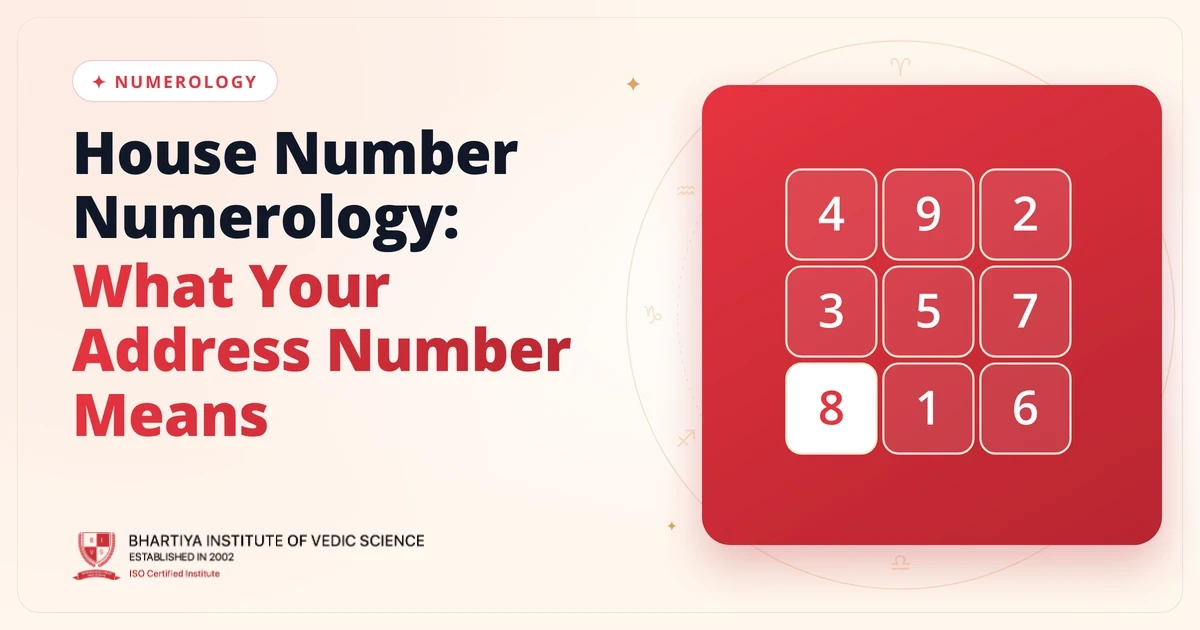
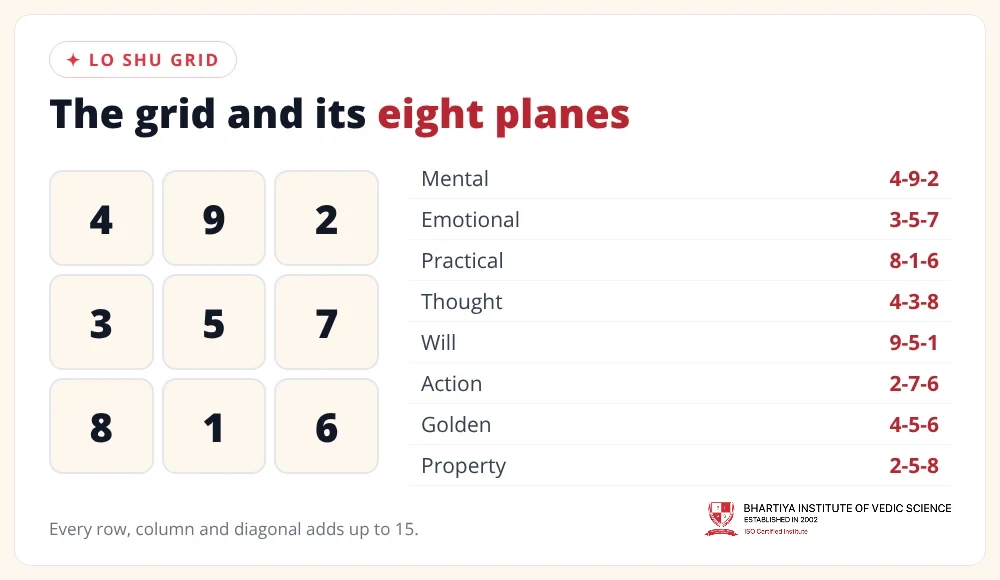
- The grid follows the 3×3 magic square 4-9-2 / 3-5-7 / 8-1-6, where every line adds up to 15.
- Many Indian numerologists also add the Bhagyank (and sometimes the Mulank) to the grid, which often fills one or two gaps.
- Traditional remedies for missing numbers are free habits, such as routines, journaling and service, not paid products.
The first time people draw their Lo Shu grid, they usually notice the empty boxes before anything else. "Mere grid mein 4 aur 8 missing hain, kya yeh bura hai?" (4 and 8 are missing from my grid, is that bad?) is one of the most common questions numerologists hear.
It is not bad. Missing numbers are a normal part of every grid, and in traditional numerology they point to areas of growth rather than fixed flaws. This guide shows you how to find your missing numbers in the Lo Shu grid with a worked example, what each missing number is traditionally said to mean, how planes and repeated numbers work, and the simple habit-based remedies numerologists suggest.
What Is the Lo Shu Grid?
The Lo Shu grid is a 3×3 magic square in which each box holds one number from 1 to 9, arranged so that every row, column and diagonal adds up to 15. Numerologists place the digits of your date of birth into their boxes to see which numbers are present, repeated or missing.
| 4 | 9 | 2 |
| 3 | 5 | 7 |
| 8 | 1 | 6 |
The square comes from ancient Chinese tradition and was adopted by Indian numerologists in the 20th century. It sits alongside the core numbers you met in our numerology for beginners guide.
How to Find Your Missing Numbers
- Step 1: Write your date of birth as DD-MM-YYYY.
- Step 2: List every digit, ignoring zeros (there is no box for 0).
- Step 3: Place each digit in its box. If a digit appears twice, write it twice.
- Step 4 (optional): Add your Bhagyank, and if your numerologist does so, your Mulank. Our guide to Mulank vs Bhagyank shows how to calculate both.
- Step 5: Note the empty boxes. Those are your missing numbers.
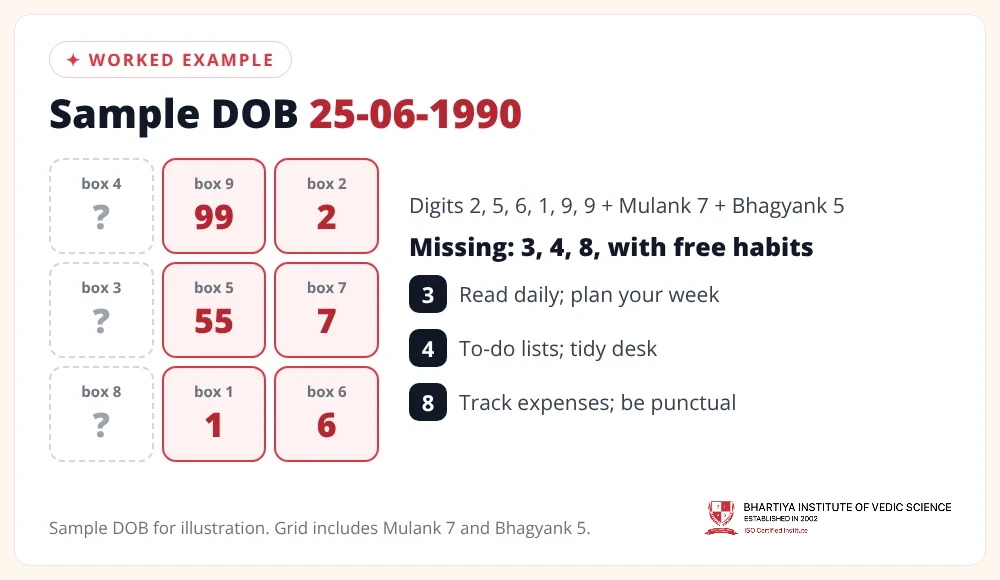
Worked example (sample DOB: 25-06-1990)
- Digits (zeros ignored): 2, 5, 6, 1, 9, 9
- Present: 1, 2, 5, 6, 9 (twice)
- Missing from the basic grid: 3, 4, 7, 8
- Mulank: 2 + 5 = 7. Bhagyank: 2 + 5 + 0 + 6 + 1 + 9 + 9 + 0 = 32 → 5.
- Adding Mulank 7 and Bhagyank 5: 7 is now present, and 5 is repeated. Missing numbers become 3, 4 and 8.
You can fill your own grid instantly with the free Lo Shu grid calculator.
Missing Numbers 1 to 9: Meanings and Simple Remedies
Each number is linked with a planet in Indian numerology. A missing number is traditionally read as a quality that does not come automatically and benefits from conscious practice.
| Missing | Planet | Traditional reading | Simple habit-based remedy |
|---|---|---|---|
| 1 | Sun | Hesitant self-expression, difficulty saying what you feel | Speak up once a day; journal; morning sunlight walk |
| 2 | Moon | Less patience or sensitivity to others' feelings | Practise active listening; regular family time |
| 3 | Jupiter | Imagination or planning may need effort | Read daily; plan your week every Sunday |
| 4 | Rahu | Organisation and practical follow-through | Write to-do lists; keep your desk tidy |
| 5 | Mercury | Balance and steadiness (5 is the centre of the grid) | Fixed daily routine; regular exercise |
| 6 | Venus | Home and family responsibilities may feel heavy | Take on one household duty; practise gratitude |
| 7 | Ketu | Lessons learned the hard way; less reflection | Short daily meditation or quiet time |
| 8 | Saturn | Detail, money management and patience | Track expenses; be punctual |
| 9 | Mars | Drive and finishing what you start | Exercise; finish one task before starting another; help others |
Notice that every remedy is something you can do for free. Traditional numerology focuses on building the missing quality through behaviour, not on buying objects.
Planes: When a Whole Line Is Missing or Complete
Numerologists also read the grid's eight lines, called planes or arrows:
| Plane | Numbers | Associated with |
|---|---|---|
| Mental (top row) | 4-9-2 | Thinking, memory, analysis |
| Emotional (middle row) | 3-5-7 | Feelings, intuition, spirituality |
| Practical (bottom row) | 8-1-6 | Material life, action, comfort |
| Thought (left column) | 4-3-8 | Planning and ideas |
| Will (middle column) | 9-5-1 | Determination and persistence |
| Action (right column) | 2-7-6 | Carrying ideas into action |
| Diagonal | 4-5-6 | Often called the golden or success plane |
| Diagonal | 2-5-8 | Often called the property or silver plane |
A complete plane (all three numbers present) is read as a strength in that area. A missing plane (all three absent) is read as an area to develop deliberately. In our sample (with Mulank and Bhagyank added), the will plane 9-5-1 is complete, suggesting determination, while the thought plane 4-3-8 is entirely missing, suggesting that planning and structure are the main growth area.
Repeated Numbers in the Lo Shu Grid
Repeated numbers matter as much as missing ones. A number that appears twice is read as a strong quality; three or more times as a quality that can tip into excess. In our sample, 9 appears twice (strong drive and idealism) and 5 appears twice once the core numbers are added (a strong need for balance and variety). Repeated numbers often explain why a person over-relies on certain strengths.
A Second Example: Many Repeats, Many Gaps
Dates with repeated digits produce very lopsided grids, which shows why missing and repeated numbers should be read together.
Sample DOB: 11-11-1981
- Digits: 1, 1, 1, 1, 1, 9, 8, 1 → the number 1 appears six times, plus one 8 and one 9.
- Mulank: 1 + 1 = 2. Bhagyank: 1+1+1+1+1+9+8+1 = 23 → 5.
- With the core numbers added, present: 1 (×6), 2, 5, 8, 9. Missing: 3, 4, 6, 7.
A numerologist would note that the overwhelming 1 (Sun) suggests strong self-expression and independence that can tip into stubbornness or speaking before listening. The missing 6 and 7 point to home responsibilities and quiet reflection as growth areas. The practical suggestions follow naturally: practise listening before replying (balancing the many 1s), take on a regular family duty (for the missing 6), and set aside ten quiet minutes a day (for the missing 7).
Notice that the reading never says the person "lacks" anything permanently. Traditional numerology treats the grid as a map of where effort pays off most.
Missing Numbers and Your Name or Mobile Number
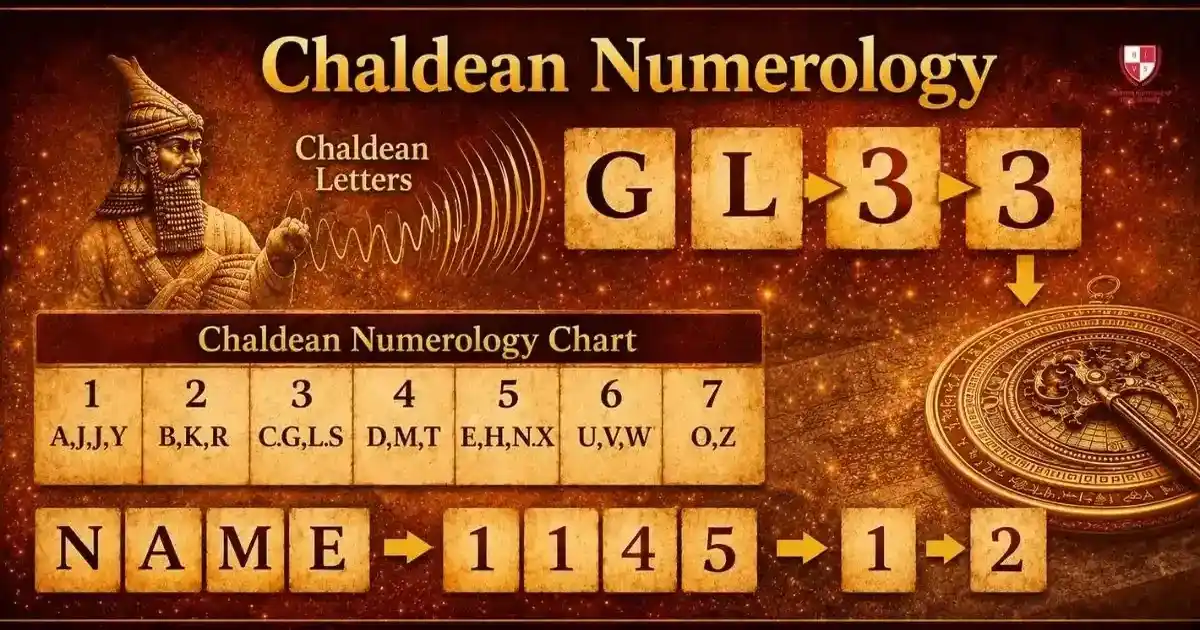
Some numerologists suggest that a name number or a mobile number can "supply" a missing number. For example, a name that totals 8 might be suggested for someone missing 8. Approaches differ widely, so if you explore this, start with our guides to name numerology and Chaldean numerology, and be cautious of anyone who charges large fees for "corrections".
Common Myths About Missing Numbers
- "Missing numbers mean bad luck." They describe qualities to develop, not misfortune. Almost every grid has three to five missing numbers.
- "You must wear a crystal or keep an object to fix a missing number." Traditional guidance is about habits and awareness. No product is required.
- "A missing 5 means an unstable life." The centre number is read as balance, and its absence simply points to routine and grounding as useful habits.
- "Master numbers fill the grid." Master numbers such as 11 and 22 (see our guide to master numbers) are read separately; most numerologists place their digits individually.
What the Lo Shu Grid Can and Cannot Tell You
The Lo Shu grid is a simple visual tool for reflecting on your strengths and growth areas. It cannot predict events, guarantee success or diagnose any condition. If a missing number reading feels true, use it as motivation to build a helpful habit; if it does not, let it go.
Conclusion
Missing numbers in the Lo Shu grid are a normal part of every chart. Find them by placing your date-of-birth digits in the 4-9-2 / 3-5-7 / 8-1-6 square, add your core numbers if you wish, then read each gap as a quality to practise through simple, free habits. Want to see your own grid in seconds? Try the free Lo Shu grid calculator at Bhartiya Institute of Vedic Science.
This article shares traditional numerology knowledge for educational purposes. It is not a substitute for professional medical, legal or financial advice.