By Jyoti Chauhan, Content Writer · Reviewed by Gurudev Shrie Kashyap, Founder, Bhartiya Institute of Vedic Science
Key Takeaways
- Signature analysis is the part of graphology that studies how your signature looks compared with your normal handwriting, as a prompt for self-reflection.
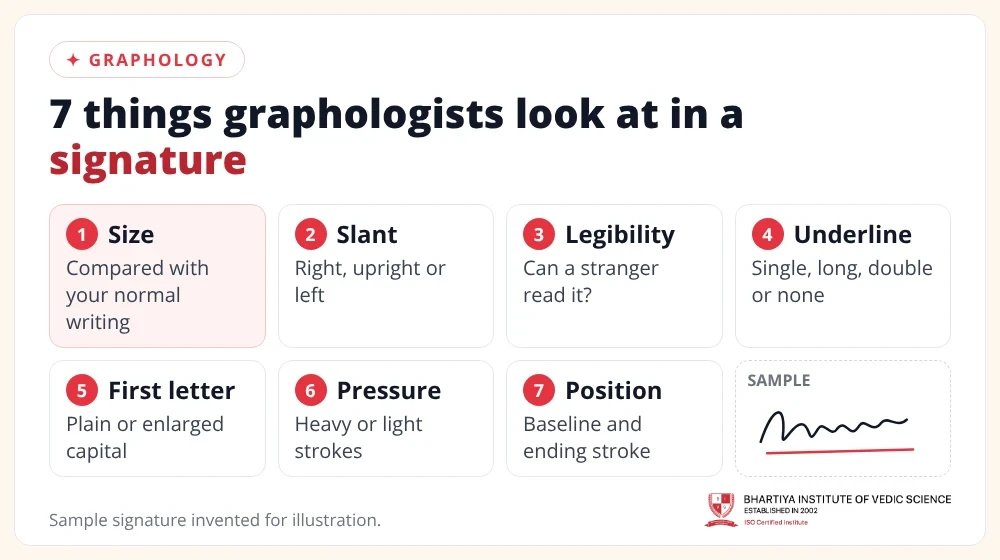
- Graphologists look at 7 main features: size, slant, legibility, underlining, the first letter, pressure and position on the page.
- The most meaningful clue is the difference between your signature and your everyday writing, often read as the gap between your public image and private self.
- Graphology is a personality-exploration tool. Research does not support using it for hiring, legal or medical decisions.
- You can try a simple 5-step self-check on your own signature in about ten minutes.
You sign your name dozens of times a year: on cheques, delivery slips, school diaries and office forms. Most people developed their signature as teenagers, practising it in the back of a notebook until it "looked right". So what does that little flourish say about you?
Graphologists believe a signature is a kind of personal logo: the way you choose to present yourself to the world. This guide explains how signature analysis works, what graphologists traditionally look for, what common features such as an underlined or illegible signature are said to mean, and, just as importantly, what signature analysis cannot tell you.
What Is Signature Analysis?
Signature analysis is the study of a person's signature, usually alongside a sample of their normal handwriting, to explore how they present themselves to others. It is one branch of graphology, the study of handwriting as an expression of personality.
A signature on its own is only half the story. Graphologists usually ask for a few lines of ordinary handwriting too, because the comparison between the two is where most insight comes from. If you are new to the subject, read our introduction to what graphology is first.
Why Signatures Are Read Differently From Handwriting
Everyday handwriting is mostly automatic: you are focused on what you are writing, not how it looks. A signature is different. It is practised, repeated and consciously designed, at least at first. That is why graphologists treat it as a "public face".
- Signature similar to handwriting: traditionally read as consistency; the person behaves much the same in public and private.
- Signature larger than handwriting: read as presenting a confident public image, which may or may not match how the person feels privately.
- Signature smaller than handwriting: read as modesty, or a preference for keeping a low profile in public.
- Signature very different in style: read as a deliberate separation between work persona and private life.
7 Features Graphologists Look At
1. Size
Size is judged relative to the person's own handwriting, not in absolute terms. A large signature is traditionally linked with self-confidence and a wish to be noticed; a small one with modesty, reserve or a focus on detail.
2. Signature slant
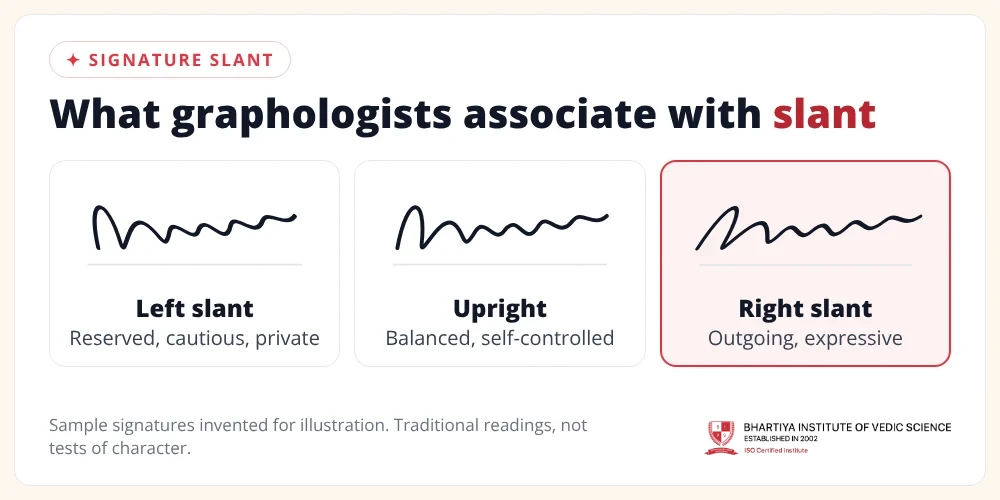
Signature slant is the angle of the letters:
- Right slant: traditionally associated with outgoing, expressive and future-oriented tendencies.
- Upright: associated with balance, self-control and a head-before-heart approach.
- Left slant: associated with reserve, caution or a more private nature.
A mixed slant within one signature is often read as changing moods or a person still settling into their style.
3. Legibility
Can someone read your name from your signature?
- Legible signature: traditionally read as openness and straightforwardness: "what you see is what you get".
- Partly legible (first name clear, surname a scrawl, or the reverse): read as which side of identity the person emphasises, personal or family.
- Illegible signature meaning: often read as privacy, speed or a busy life. Doctors and senior professionals who sign hundreds of times a day frequently develop illegible signatures for purely practical reasons, so context matters a great deal.
4. Underlining
The underlined signature meaning most often given is self-assurance and a wish to be taken seriously. Details vary:
- A single clean underline: confidence and self-respect.
- A long underline extending beyond the name: ambition or a strong drive to succeed.
- Two lines or heavy underlining: a strong need for recognition.
- A line through the name: some graphologists read this as self-criticism; others say it means little without other supporting signs.
5. The first letter
A large, decorated capital at the start is traditionally read as pride in one's identity or a strong sense of self. A first letter that is the same size as the rest suggests modesty.
6. Pressure
Heavy pressure (you can feel the indentation on the back of the paper) is linked with energy and intensity; light pressure with sensitivity and a gentler temperament. Pen type and paper affect pressure too, so graphologists compare several samples.
7. Position and ending stroke
Where you sign on a line and how you finish the last stroke are also noted. A rising baseline is commonly read as optimism, a falling one as tiredness at that moment, and a final stroke that sweeps back over the name as a protective, private tendency.
Common Signature Styles and Their Traditional Readings
| Feature | Traditional reading | Keep in mind |
|---|---|---|
| Large, legible, rising | Confident, open, optimistic | May simply reflect a job that needs authority |
| Small and neat | Modest, careful, detail-oriented | Small spaces on forms shrink signatures |
| Illegible scrawl | Private, fast-moving | Very common in people who sign often |
| Underlined | Self-assured, ambitious | Often copied from a parent or teacher |
| Initials only | Private, efficient | Sometimes a security habit |
| Circle or enclosure around name | Protective, guarded | Can be decorative habit from school days |
| Dot or full stop at the end | Decisiveness, a sense of finality | Some people add it to prevent additions |
A 5-Step Self-Check
Try this on your own signature, as a reflection exercise:
- Step 1: Write three lines about your day in your normal handwriting, then sign underneath three times.
- Step 2: Compare size. Is your signature larger, smaller or the same as your writing?
- Step 3: Check slant and legibility. Could a stranger read your name?
- Step 4: Look for underlines, enclosures, dots and the shape of the first letter.
- Step 5: Ask yourself: does this signature match how I want to come across? Is it the signature I designed at 15, or the person I am now?
Many people find that last question the most valuable part of the exercise.
Can You Change Your Signature?
Yes. Some graphologists practise "graphotherapy", the idea that deliberately changing handwriting habits can support a change in attitude, such as a more legible signature for someone working on openness. Evidence for this is limited, so treat it as a mindful habit rather than a cure. If you do change your signature, remember to update it with your bank and on official documents.
Interestingly, some people combine signature work with name numerology when they adopt a new spelling of their name. If that interests you, see our guide to name numerology.
What Signature Analysis Can and Cannot Tell You
Signature analysis can be a fun and thoughtful way to reflect on how you present yourself. It cannot reliably measure intelligence, honesty, job performance or health. Reviews of the research, and bodies such as the British Psychological Society, have found that graphology does not predict job performance, so it should not be used for hiring, legal or medical decisions. Signature analysis is also completely different from forensic document examination, which verifies whether a signature is genuine.
For the same reason, a responsible graphologist never analyses the signature of a named person without their consent. The sample signatures in this article are invented for illustration.
How to Learn Graphology
Graphology is learned by looking at many samples: different ages, professions and languages, including Hindi and other Indian scripts. Start by collecting signatures and handwriting from friends and family, with their permission, and noting patterns. You can browse more of our graphology articles, and if you are interested in a structured path, the numerology and graphology worlds often overlap, as our guide on how to become a numerologist shows. Bhartiya Institute of Vedic Science offers a graphology course taught live in Hindi and English, with practice samples, doubt sessions and a certificate on completion.
Conclusion
Signature analysis looks at size, slant, legibility, underlining, the first letter, pressure and position, and above all at how your signature compares with your everyday handwriting. Use it as a mirror for self-reflection, not as a test of character. If you would like to read handwriting yourself, explore the graphology course at Bhartiya Institute of Vedic Science and learn to read this yourself.
This article shares graphology knowledge for self-reflection and educational purposes. It is not a substitute for professional psychological, legal or employment advice.