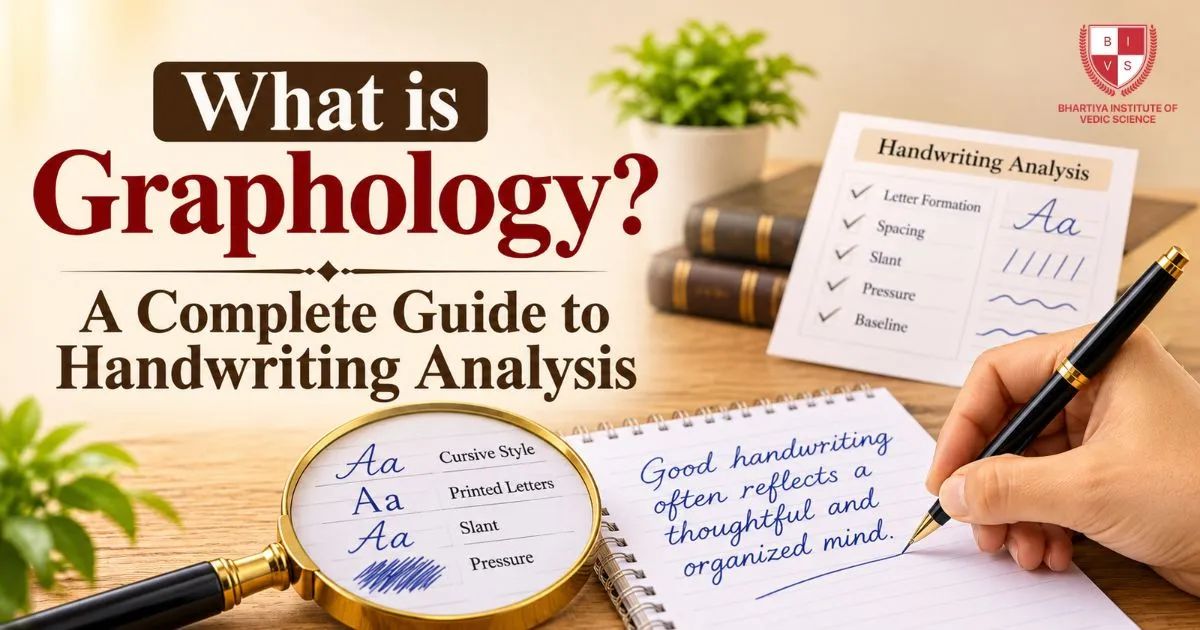
Handwriting defines your personality, and your signature tells about your nature. And all this comes under Graphology. Now a question comes to your mind: what is graphology? In simple words, graphology is the study and the analysis of handwriting in an attempt to evaluate your personality traits, psychological state and behaviour patterns. One who studies graphology is known as a 'graphalogist'.
Now many questions come to your mind, like, is graphology real? Which letters define your character, personality and many other things. Well, all of your queries have answers in this blog. Read it completely to get the answers.
What is Graphology?
Graphology is not just about handwriting analysis but also decoding the meaning of curves of letters, signature meaning and many other things. It is also used for analysing the handwriting of criminals, psychopaths etc. Also, it is one of the most searched terms, mostly for relationships, judgements, etc. Many people want to learn about it for checking their partner’s traits and character before a relationship, etc.
Wikipedia is known for describing graphology as one of the handwriting analyses as an attempt for understanding the personality traits, while also pointing out the scientific evidence which does not support its conclusion as established psychological facts.
You can understand it through an example, like imagining two people who write in large letters. One person can feel heavy pressure through narrow spacing, and another could have light pressure through wider spacing. Also, similarities can be observed in the size of writing, but patterns would be different overall. This is why graphology examines the combinations and not just one characteristic.
What are Key Elements for Hand-writing Analysis?
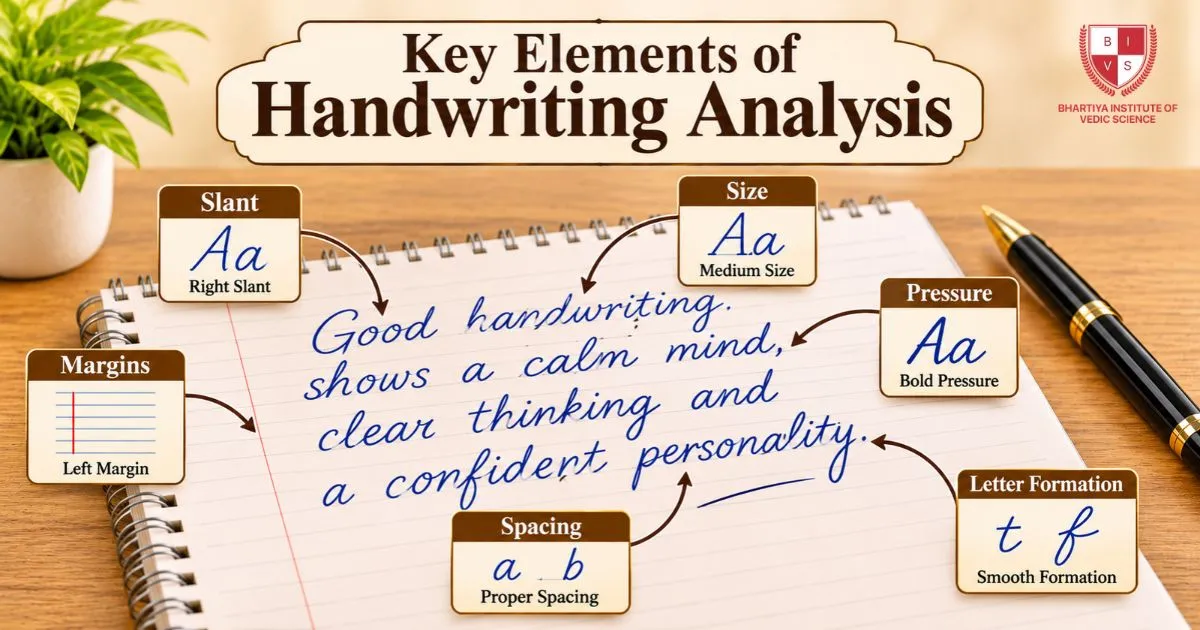
A graphologist is one who uses various handwriting analysis techniques for finding out the meaning:
Slant:
Through the angel of the letters (right, upright or left), it indicates communication style and emotional reserve.
Size:
Height and width of letters that show self-confidence, extraversion or attention to details.
Pressure:
How does the writer press the pen on paper that suggests the amount of tension, commitment or sensitivity?
Spacing and Margins:
The gaps between the words, lines and letter formations provide insights about social behaviour and organisation.
Zones:
The upper, middle and lower loops in the letters are read as the indicators of ambition, public ego or the physical/ material drives.
History Behind Graphology
There is a long history behind graphology, with an idea for studying the relationship between writer and handwriting for centuries. History tells about the earliest handwriting analysis in Carmilo Baldi’s book from 1622.
Modern graphology is connected with Jean-Hippolyte Michon, who developed the more organised system of handwriting signs in the nineteenth century, using the term 'graphology' for handwriting analysis. Later Jules Crepieus – Jamin expanded Michon’s work and developed the broader approach in which handwriting features are considered together rather than the isolated signs. And the development is one of the reasons that made graphology studied about the combination of the characteristics.
What is the Working Process of Graphology?
There are various graphology techniques that are involved in analysing the handwriting well and then giving the final verdict. Let us understand it through an example:
Does it appear in large or small letters? Does it also seem very cramped or spaced out? Do the letters also lean in a particular direction? Why are these lines straight, or why are they slanting upwards? Also, after observing the general pattern, the graphologist turns it into smaller details.
The basic analysis usually follows the pattern:
Overall page – main characteristics – individual formations – signature – and combined interpretations.
What Does Handwriting Suggest in Graphology?
The traditional approach to graphology, the handwriting, can suggest many things, like:
-
The emotional expressions
-
Communication style
-
Confidence and self-expression
-
The behavioural tendencies
-
Organisation and consistency
-
Way in which the signature presents itself.
This is where the phrase 'may suggest' is very important. The handwriting can change as per the tiredness, speed of writing, types of pen used, posture and the surface on which writing appears.
Some Points Considering Handwriting Analysis for Certain Emotions
Personality:
We have the question that most of the people ask when they begin studying graphology, like, 'What does my handwriting say about me?' or 'Should I change it? You will not get the single answer, but one can look at the connection between graphology and personality.
Confidence:
Graphology practitioners are known for examining the size, pressure, movements, capital letters and relationship between the ordinary handwriting and signature. Here the idea is not to look for one feature that is reflecting the confidence but to see if several characteristics support the same interpretations.
Emotional Expression:
It helps you understand your emotional expression, but with the pressure, spacing and consistency, which can modify or contradict the initial interpretations.
Communication:
Connections between letters, spacing and movement can be observed, but communication involves many factors and should not be reduced to a single characteristic.
Behavioural Patterns:
This is where repetition becomes important. Does the writing keep the same size, or does the pressure always change frequently, or is the single unusual formation appearing several times? The repetition is worth more than an isolated feature.
Is there any Scientific Evidence about graphology?
Graphology is one of the oldest systems which taught about the interpretation of handwriting, but research has not proven it as a tool for psychology personality tests. As per 2009 studies, in which two separate samples were taken and compared, graphologists' assessments with the Big Five personality measures and low agreements between graphologists in the first study,
The meaning says that it must be regarded as the traditional interpretation of graphology and also the psychological evaluations. Now you have got the clarity; let's move our attention towards writing itself.
Handwriting Features in Graphology
You need to place two pages of handwriting samples side by side. As you have never studied graphology before, you can see some differences.
One page has larger lettering, another has slanted writing, and the third has wide spacing between words. These noticeable differences are where handwriting analysis begins.
These noticeable differences are where handwriting analysis begins.
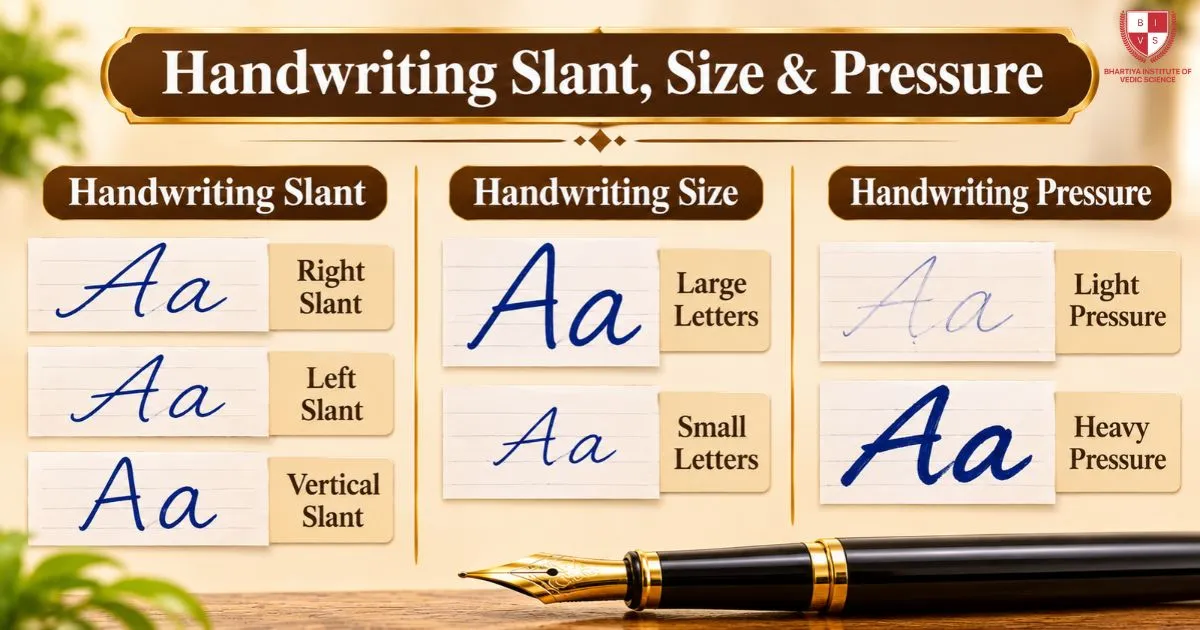
Handwriting Size:
-
Examining how large the letters are.
-
Expression, concentration and attention detail.
-
Wide spaces and small spaces between the letters.
Handwriting Slant:
You need to look at the direction of the letters:
|
Slant |
How to see |
|
Right |
Letters is leaning towards the right. |
|
Left |
Letters leaning towards the left. |
|
Vertical |
Letters remaining straight |
|
Mixed |
Directions keep on changing. |
Thus, graphology is observed as the slant in relation to the emotional response and the expression. The amount and consistency of the slant are taken into account, since a slight tilt must be regarded in the same way as a strong slant.
Handwriting Pressure:
Another important thing that comes to mind is the handwriting pressure against the page. Some people write with such light pressure that even the strokes are barely visible. While some press it so hard, marks appear on the other side:
Being a graphologist, you must observe:
-
Light pressure
-
Medium pressure
-
Heavy pressure.
-
Changing pressure.
With stronger pressure appearing in the traditional interpretations, but through pen, paper and written surfaces, which affect pressure, as it is worth remembering.
Letter Spacing:
You need to look inside the words, like how much is the space between one letter and the next? Which letters are touching, and why do others remain separated? No judgement of the unusual gap, as graphologists look for the same spacing repeatedly.
Look Inside the Words:
-
Seeing the space between one letter and the next.
-
Some letters touch, while others remain separated.
-
Rather than judging an unusual gap, graphologists turn for the same spacing repeatedly.
-
Strange-looking words result in writing quickly.
Spacing of Words:
Spacing indicates details about the writer’s communication style, while traditional graphology talks about the wider spacing through personal space or independence through narrower spacing with closeness.
Line Spacing:
Now moving away from the words, like, how much space is there between the lines? A graphologist is well known for how to study the use of line spacing, but a lined paper can automatically influence the distance between the lines. Also, the natural sample of handwriting on unmarked paper gives a better impression of line spacing.
Baseline:
Imagine a ruler placed underneath a sentence. Does the writing stay level, or does it rise, fall or repeatedly move up and down?
This is the baseline.
|
Baseline |
What it looks like |
|
Rising |
Writing is moving upward |
|
Falling |
Writing gradually moving downwards |
|
Straight |
Mostly level |
|
Wavy |
Repeatedly rising and falling. |
Traditional graphology has different interpretations for each of these patterns, but posture, tiredness and the slope of the paper can also affect the baseline.
Margins
-
Most of the people consciously think about the amount of space as they leave it on either side of the page, but margins appear automatically.
-
The graphologists can observe the left, right, top and bottom margins and see how the writer moves around the page.
-
Are the left margins getting wider, or is the writing slowly drifting towards one edge? Now observing what is happening and not attaching any meaning to it yet.
Letter Formation:
Now you can take a closer look at the letters. You can take the lowercase "t", for example.
-
One person can close it too high, another can use a small bar, and the third could create a long cross stroke.
-
Similar variations appear in loops, dots, curves and strokes at the end of letters.
-
The important thing to remember is that it is not just one unusual letter that is significant, but if the same formation appears more than once.
Writing Speed:
- People who are in a hurry write differently
- Faster writing has simple letter formation with long joining strokes, and slower writing has careful letter formation.
- Neither is better or worse, but speed, rhythm and the rest of sample is taken into account.
- The upper, middle and lower zones
Looking at the letters 'l', 'a' and 'g', one can see the tall part of 'I', which is moving upwards; the body of 'a', staying in the middle; and the lower part of 'g', moving below the writing line.
This creates three zones in handwriting:
|
Zone |
Example |
Studied in relation to |
|
Upper |
l, h, t |
Ideas, goals and relationships |
|
Middle |
a, e, m |
Behaviour and interaction |
|
Lower |
g, y, p |
Practical and physical behaviours |
Capital Letters:
The capital letters are naturally larger than the rest of the writing. The graphologists are known for observing the size, formation, decoration, pressure and relation with the lowercase letters. Learning handwriting style is also very relevant, since a decorated capital letter must simply be the result of a person's natural style of writing.
12 Main Handwriting Characteristics
Some of the common handwriting characteristics:
Now that you know why it is not sufficient to look at a single characteristic, let us examine the main ones that are commonly studied.
|
Characteristics |
What you observe |
|
Size |
Large, medium or the small letters. |
|
Slant |
Right, left, vertical or mixed |
|
Pressure |
Light, medium, heavy or changing. |
|
Spacing |
Distance between letters and the words. |
|
Baseline |
Rising, falling straight or irregular. |
|
Letter formation |
Shapes, loops and small-big strokes. |
|
Writing Speed |
The flow and movement. |
|
Connections |
Joined or the separate letters. |
|
Margins |
Spacing around the writing. |
Thus, you get the answer to the question, "What is graphology?" The above blog will help you understand everything about graphology, types of strokes, pressure, etc. Now you need to take the graphology course online from the Bhartiya Institute of Vedic Science. The course will be completed in 2 months only.