By Jyoti Chauhan, Content Writer · Reviewed by Gurudev Shrie Kashyap, Founder, Bhartiya Institute of Vedic Science
Key Takeaways
- Tarot card reading for beginners starts with one fact: a standard tarot deck has 78 cards, made of 22 Major Arcana and 56 Minor Arcana.
- The Minor Arcana has four suits of 14 cards each: Wands, Cups, Swords and Pentacles, linked to fire, water, air and earth.
- You can learn the system in about four weeks of short daily practice: the Major Arcana, then suits and numbers, then spreads, then real readings.
- A first reading needs only three cards, one clear question and a notebook.
- Tarot is a tool for reflection. It cannot prove or guarantee future events, and it should never replace medical, legal or financial advice.
You have a deck in your hands, or you are about to buy one, and the first question is always the same: where do I even start? Seventy-eight cards, dozens of spreads and hundreds of opinions can make a simple practice feel like a locked room.
It does not have to. Tarot is built on patterns: four suits, ten numbers and a short story told by 22 special cards. Learn those patterns once and every card begins to make sense.
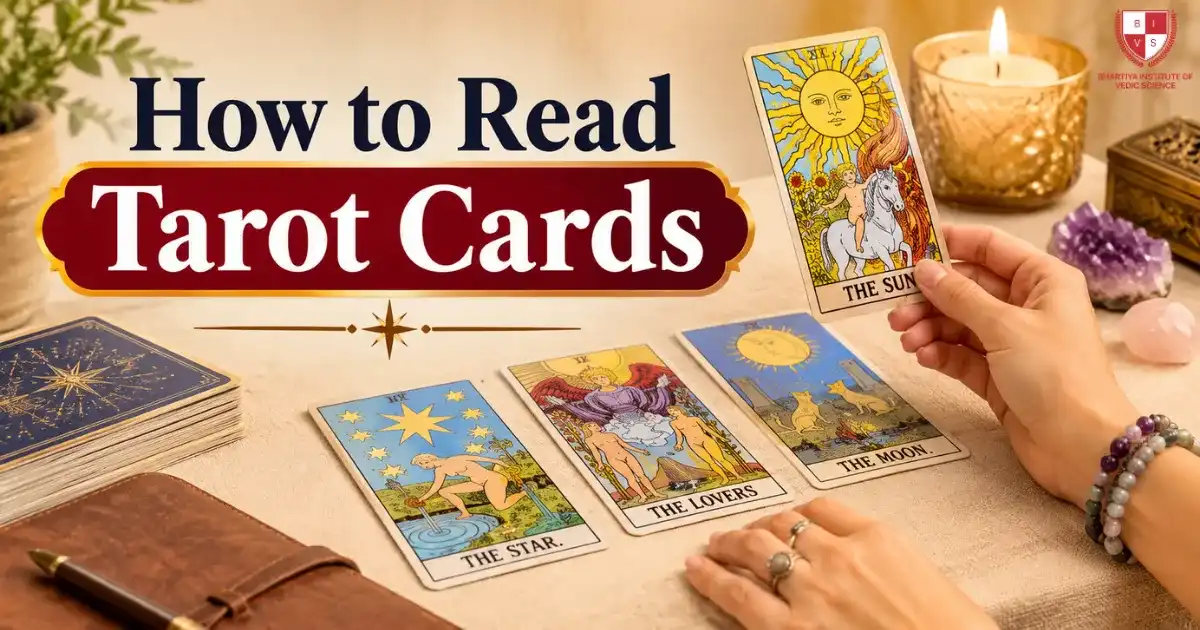
This guide is the complete map for tarot card reading for beginners. It covers where tarot comes from, how a deck is built, how to choose and prepare a deck, the main spreads, a worked sample reading and a four-week study plan. When you are ready for the card-by-card reading method, our step-by-step guide to how to read tarot cards goes deeper.
What Is Tarot Card Reading?
Tarot card reading is the practice of drawing cards from a tarot deck and interpreting their images and meanings to reflect on a question, a decision or a situation. Each card carries a set of symbols and traditional meanings, and the reader connects them to the question being asked.
Many readers see tarot as a mirror for thought. The cards give you a structured way to look at a problem from several sides, and the interpretation comes from the reader's own insight. Whether a reader also believes the cards carry intuitive or spiritual guidance is a personal matter.
A Short History of Tarot
Tarot began as a card game. The earliest known tarot decks were made in northern Italy in the 15th century, and the game was called tarocchi. These were playing cards with an extra set of illustrated trump cards.
The idea of using the cards for divination and symbolism came later, in the 18th century, when writers in France linked tarot to esoteric ideas. In 1909 the Rider-Waite-Smith deck was published in London, with images drawn by artist Pamela Colman Smith under the direction of A. E. Waite. Its illustrated scenes on every card, including the number cards, made it the model for most modern decks. Waite's own companion book, The Pictorial Key to the Tarot, is freely available online. A general background is also given in the Wikipedia article on tarot.
Today, tarot is practised worldwide, and many Indian learners come to it alongside astrology, numerology and other Vedic studies. If you are curious about how the older Indian systems read the chart behind a question, start with our guide to numerology for beginners.
How a Tarot Deck Is Built: The 78 Cards
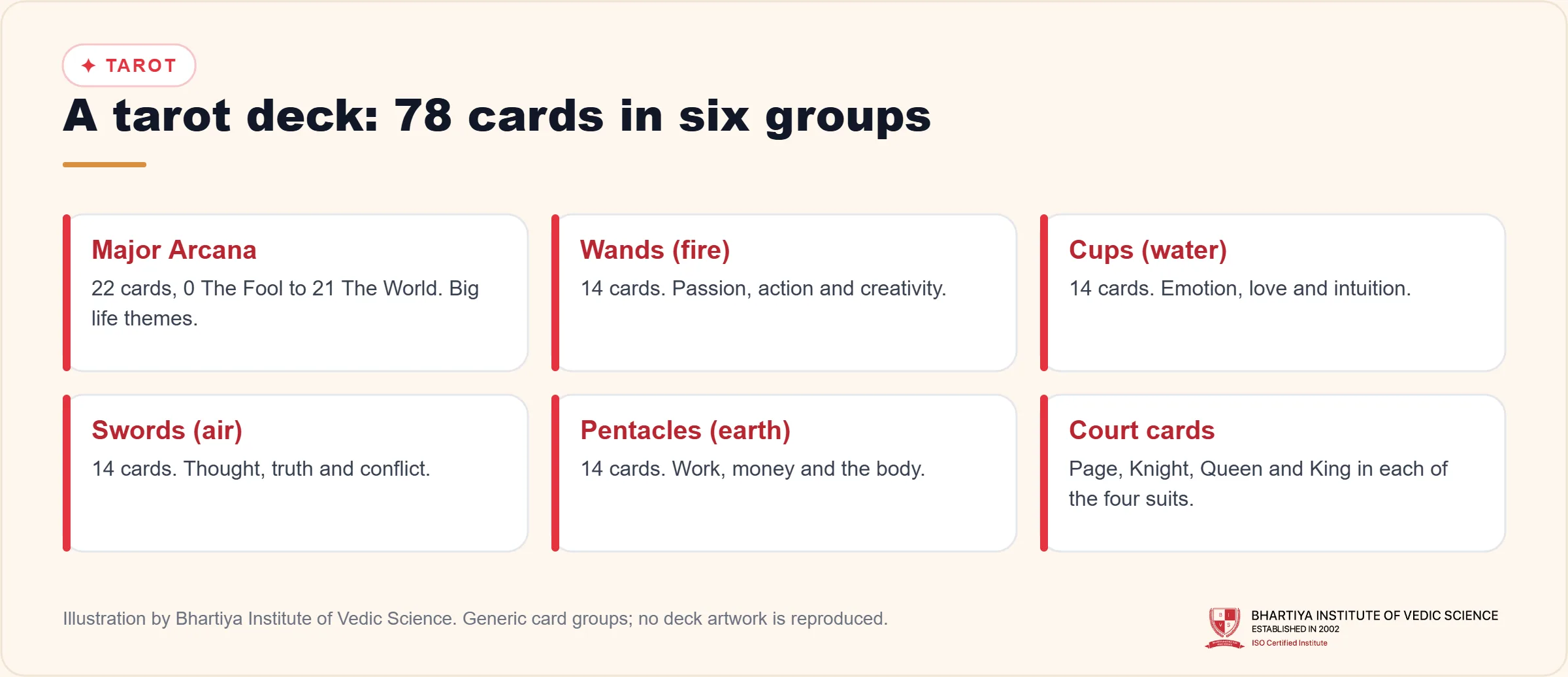
A standard tarot deck has 78 cards in two groups. Understanding the split is the single most useful thing a beginner can learn.
| Group | Cards | What it shows |
|---|---|---|
| Major Arcana | 22 (numbered 0 to 21) | Big life themes and turning points |
| Minor Arcana | 56 (4 suits of 14) | Everyday events, feelings and choices |
The word arcana means secrets, and major and minor simply mean larger and smaller. The Major Arcana cards are the ones with famous names such as The Fool, The Lovers and The World. They usually signal that a bigger theme is at work. The Minor Arcana cards describe the daily details around it.
The Major Arcana: 22 Cards of Life Themes
The Major Arcana runs from 0 (The Fool) to 21 (The World). A common way to learn it is to read it as a journey, often called the Fool's Journey, in which the Fool grows from innocence to completion. It helps to learn the cards in three groups:
- Cards 0 to 7: building the self. The Fool, The Magician, The High Priestess, The Empress, The Emperor, The Hierophant, The Lovers and The Chariot. These deal with identity, skills, relationships and early choices.
- Cards 8 to 14: testing the self. Strength, The Hermit, Wheel of Fortune, Justice, The Hanged Man, Death and Temperance. These deal with inner work, change, fairness, surrender and balance.
- Cards 15 to 21: facing the whole. The Devil, The Tower, The Star, The Moon, The Sun, Judgement and The World. These deal with attachments, upheaval, hope, uncertainty, joy, renewal and completion.
Cards with dramatic names, such as Death and The Tower, rarely mean what they sound like. Death usually stands for an ending that makes room for something new, and The Tower for a sudden shake-up of something unstable. A good beginner habit is to read the picture and the keywords together, and never the name alone.
The 22 Major Arcana at a glance
These are traditional keywords in the Rider-Waite-Smith system, where Strength is card 8 and Justice is card 11. Some older decks swap those two numbers, so check your own deck.
| No. | Card | Traditional keywords |
|---|---|---|
| 0 | The Fool | New beginnings, trust, taking a risk |
| 1 | The Magician | Skill, will, using your resources |
| 2 | The High Priestess | Intuition, inner knowing, patience |
| 3 | The Empress | Nurture, abundance, creativity |
| 4 | The Emperor | Structure, authority, stability |
| 5 | The Hierophant | Tradition, teaching, shared values |
| 6 | The Lovers | Choice, values, union |
| 7 | The Chariot | Drive, willpower, direction |
| 8 | Strength | Courage, patience, compassion |
| 9 | The Hermit | Solitude, reflection, guidance |
| 10 | Wheel of Fortune | Cycles, change, turning points |
| 11 | Justice | Fairness, cause and effect |
| 12 | The Hanged Man | Pause, surrender, a new view |
| 13 | Death | Endings, transformation |
| 14 | Temperance | Balance, moderation, blending |
| 15 | The Devil | Attachment, habits, restriction |
| 16 | The Tower | Sudden change, truth revealed |
| 17 | The Star | Hope, healing, renewal |
| 18 | The Moon | Uncertainty, dreams, illusion |
| 19 | The Sun | Joy, clarity, vitality |
| 20 | Judgement | Reckoning, calling, renewal |
| 21 | The World | Completion, wholeness |
The Minor Arcana: Four Suits
The 56 Minor Arcana cards are divided into four suits, and each suit speaks about one area of life. Each suit also has an element.
| Suit | Element | Area of life | Typical themes |
|---|---|---|---|
| Wands | Fire | Passion and action | Ambition, energy, creativity |
| Cups | Water | Emotion and relationships | Love, intuition, healing |
| Swords | Air | Thought and communication | Truth, conflict, decisions |
| Pentacles | Earth | Work, money and the body | Craft, security, health habits |
Some decks use different suit names, such as Coins or Discs for Pentacles, and Rods or Staves for Wands. The meaning stays the same.
Number cards: Ace to 10
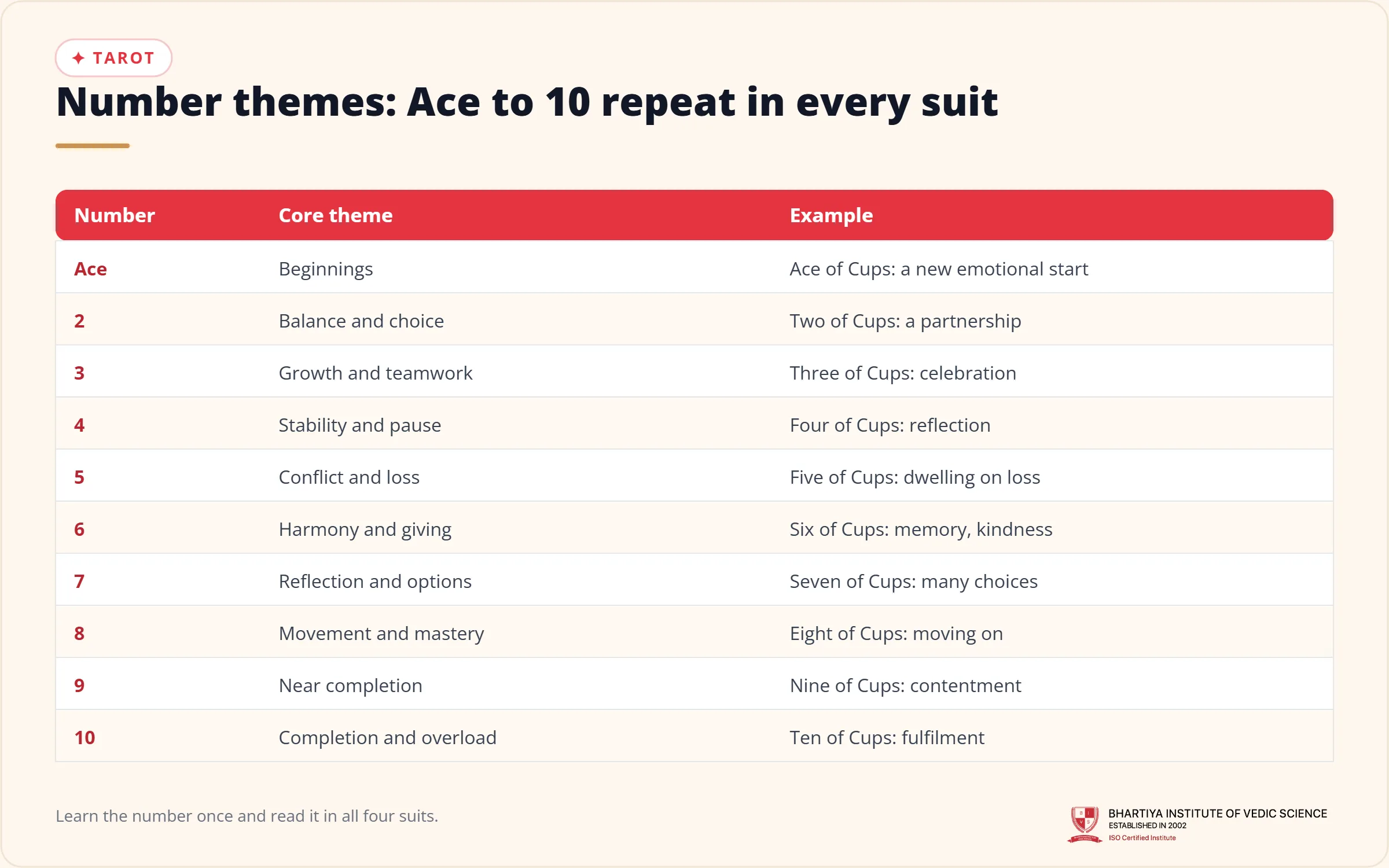
Every suit has ten number cards, from Ace to 10. The numbers carry the same basic idea in every suit, and this is the shortcut that makes the Minor Arcana easy to learn. For example, the Ace always means a beginning, and the 5 always means a challenge or loss. So the Ace of Cups is a new emotional beginning, and the Five of Swords is a conflict over ideas.
Court cards: Page, Knight, Queen and King
Each suit also has four court cards. They can describe people in your life, aspects of your own personality, or ways of approaching a situation.
- Page: a beginner, a student or a message.
- Knight: action and movement, sometimes a person who is rushing ahead or chasing a goal.
- Queen: inner mastery of the suit's energy, nurturing and expressive.
- King: outer mastery of the suit's energy, authority and responsibility.
Beginners often find court cards hardest. A good rule is to ask whether the card describes a person, a mood or a way to act. The answer usually depends on the question.
Upright and Reversed Cards
A card is upright when it appears the right way up, and reversed when it appears upside down. Whether to use reversals is a choice, and neither approach is better. You can start without them and add them later.
Readers who use reversals interpret them in different ways. Some read a reversed card as the opposite meaning. Others read it as a weaker, blocked or internal version of the upright meaning. Pick one method, keep it for a month, and note what feels natural.
Two Ways to Read: Traditional and Intuitive
Readers usually fall between two styles. A traditional reader leans on fixed meanings, positions and the structure of the deck, and checks the card against a guidebook. An intuitive reader starts from the picture, notices which figure or colour draws attention, and builds the meaning from that response.
As a beginner, borrow from both. Learn the traditional keywords so you have a stable base, and then spend a minute with each card's picture before you look anything up. Over time your own voice develops, and your journal will show you which style suits you.
A Second Sample: The One-Card Morning Draw
To see how small a useful reading can be, imagine drawing the Four of Swords on a busy morning, with the question "What do I need today?" This card is traditionally linked with rest, pause and recovery. A reflective reading might be: protect a quiet half hour, take a real break at lunch and avoid adding new commitments. There is nothing to predict here. The card simply prompts a sensible choice.
How to Choose Your First Deck
Choosing a deck is personal, but a few points help a beginner:
- Pick a Rider-Waite-Smith style deck. Its illustrated number cards make learning much easier than decks with only symbols. Most books and courses use this system.
- Look at the images in person or online. You should feel willing to look at them for long periods.
- Choose a clear card size. Large cards are easier to read, and small ones are easier to shuffle.
- Avoid decks with no guidebook. A small booklet helps when you are starting out.
Buy only what you need. A deck does not have to be expensive, and the best deck is the one you actually use.
How to Prepare for a Reading
- Find a quiet place. A table, a cloth and good light are enough.
- Write your question. Clear questions give clear readings. Open questions work best, such as "What should I focus on in my job search this month?" Questions that start with "Will" tend to produce confused answers.
- Shuffle and cut. Shuffle until it feels right, and cut the deck if you like. Some readers sit in silence for a minute first. Any ritual such as cleansing the deck with smoke or moonlight is a personal choice and not a requirement.
- Draw the cards. Lay them in the order of your spread, face up.
Which Questions to Ask and Which to Avoid
Good tarot questions are about choices, patterns and next steps. They begin with "how", "what" or "which". Responsible readers avoid some questions entirely: questions about a third person's private thoughts, about illness or death, about legal outcomes, and about money decisions that depend on professional advice. Tarot is a reflective tool and not an expert on those subjects.
Popular Tarot Spreads for Beginners
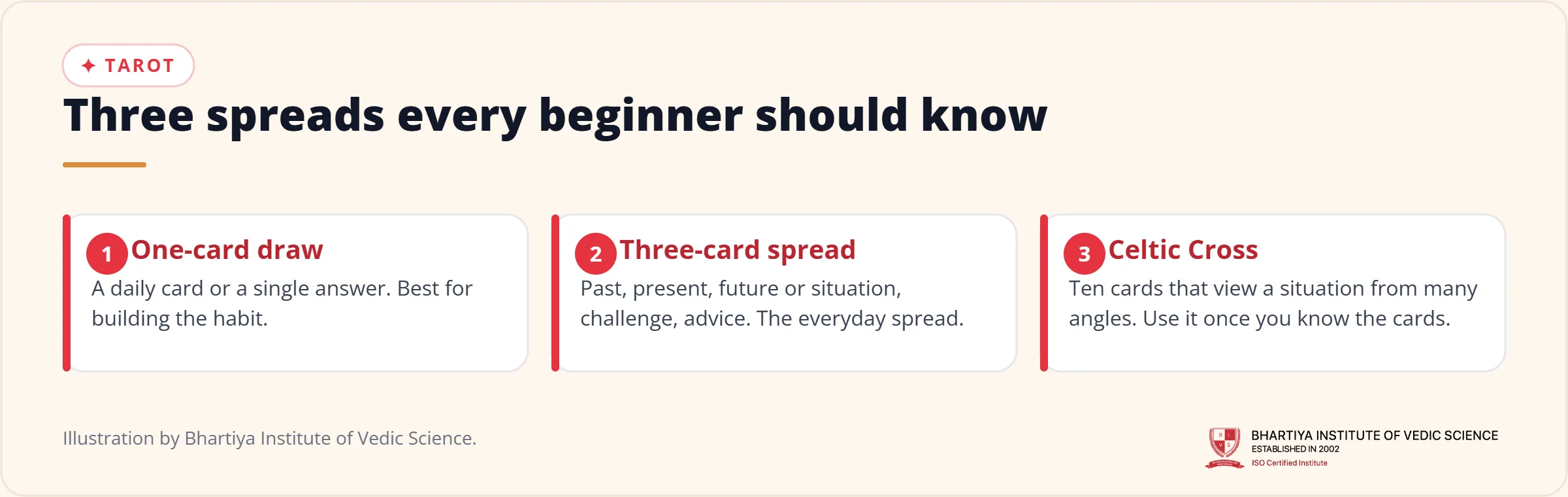
A spread is a layout that gives each card a position and a meaning. Beginners do well with three:
- One-card draw. One card for the day or one answer to a clear question. It builds the habit.
- Three-card spread. Three positions such as past, present and future, or situation, challenge and advice. It is the best everyday spread.
- Celtic Cross. Ten cards that look at the situation from many angles. Save it until you know the cards well.
A Worked Sample Reading
Here is a sample three-card reading, using the position meanings situation, challenge and advice. The question is "How should I approach my career change?" This is an illustration of method and not a prediction for anyone.
- Situation: Eight of Pentacles. This card is about learning a skill step by step. It suggests the person has been building experience and is ready to use it.
- Challenge: Five of Cups. This card is about focusing on what has been lost. The challenge may be dwelling on the old job instead of the new options.
- Advice: Ace of Wands. This card is a spark of new energy. The advice is to take the first small action towards the new direction.
Read as a story, the three cards say: you have built real skills, you may be looking back too much, and a small first step will help. Notice that the interpretation always connects the cards back to the question and avoids saying what will certainly happen.
How Suits and Numbers Combine
This is the step that turns 56 separate cards into one easy system. Take the suit's area of life and the number's theme, and join them in a sentence. The Three of Pentacles joins earth, which is work and skill, with the number three, which is teamwork. It reads as collaboration on something practical. The Nine of Wands joins fire, which is energy, with the number nine, which is near completion. It reads as being tired but almost there.
Try this with five random cards a day for a week. You will quickly find that you can read cards you have never studied by reasoning from the pattern.
When a Card Feels Unclear
Every reader meets cards that refuse to make sense. When that happens, check three things in order: the position the card is in, the cards on either side of it, and the question you asked. If the meaning is still unclear, draw one clarifying card, or simply note the confusion in your journal and come back to it later. Unclear cards are a normal part of learning, and they often make sense a week later.
Keep a Tarot Journal
A notebook is the fastest teacher. After every reading, write the date, the question, the cards, your first reaction and what happened afterwards. After a month you will see which meanings are becoming yours. After three months you will notice how often the cards helped you ask better questions, and how rarely they needed to predict anything.
A Four-Week Plan to Learn Tarot
A short, steady plan beats a long, irregular one. Ten to fifteen minutes a day is enough.
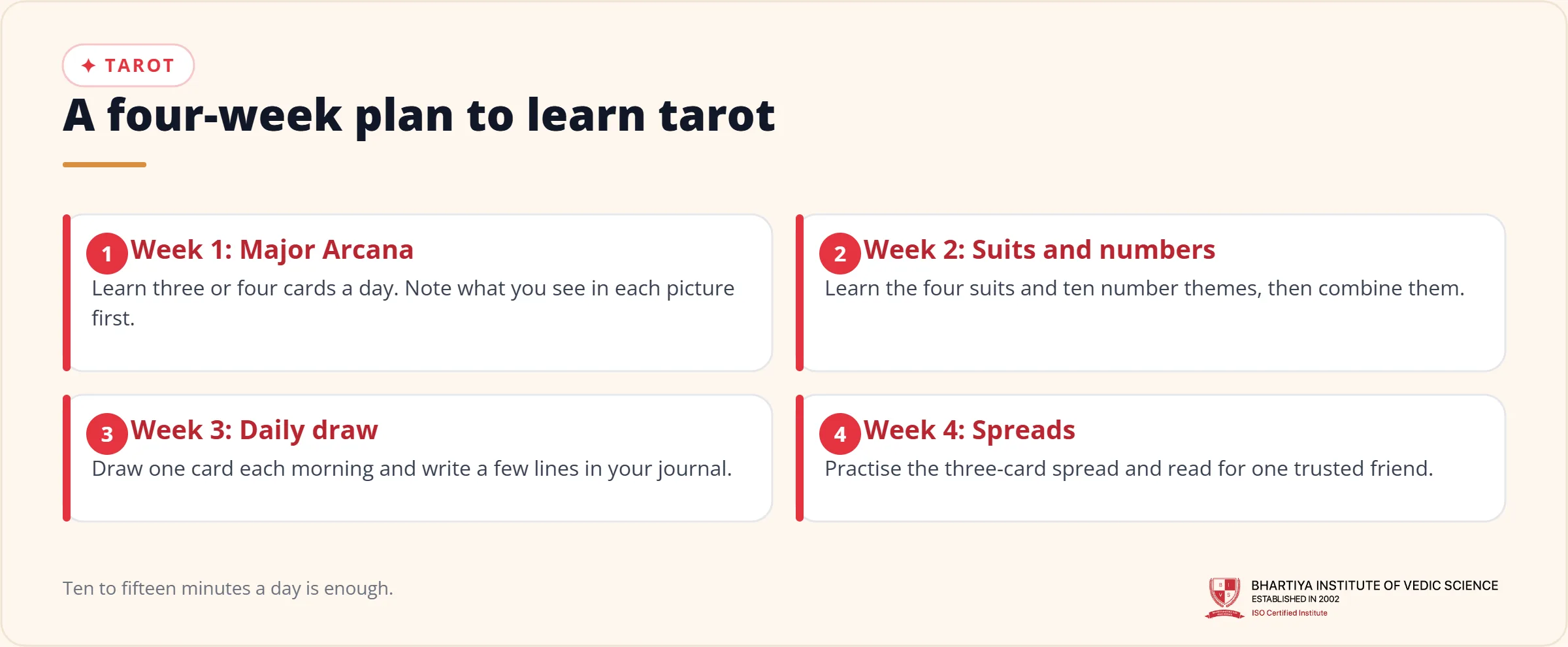
- Week 1: the Major Arcana. Learn three or four cards a day. Look at each picture and write what you notice before you read any guidebook.
- Week 2: suits and numbers. Learn the four suits and the ten number themes. Then read any Minor Arcana card by combining the two.
- Week 3: daily draw. Draw one card every morning and write a few lines in your journal.
- Week 4: spreads. Practise the three-card spread on yourself, then offer a reading to one trusted friend. Ask for honest feedback.
Common Beginner Mistakes
- Memorising meanings without looking at the pictures. The images carry most of the information.
- Asking the same question again and again. If you are not happy with an answer, change the question instead of redrawing.
- Reading Death or The Tower as a disaster. Look at the whole spread before you judge a card.
- Predicting health, legal or death outcomes. This is not responsible practice.
- Collecting many decks too early. Learn one deck well first.
A Reader's Code of Conduct
Even when you only read for friends, a few principles protect you and the person in front of you.
- Get consent. Read for someone only when they ask.
- Be honest about limits. Say that a reading offers perspective and not certainty.
- Do not frighten. Never tell anyone that a card means doom, death or a curse.
- Stay out of medical, legal and financial calls. Suggest a qualified professional.
- Keep confidences. What the person shares stays private.
Tarot, Astrology and Other Systems
Tarot is its own system, separate from Vedic astrology. Astrology reads planetary positions calculated from your date, time and place of birth. Tarot reads cards drawn in the moment. Some learners enjoy studying both, and for the astrology side you can begin with our guide on how to learn astrology or with palmistry basics. If you enjoy the quieter, meditative side of the Vedic and spiritual studies, you may also like our list of questions to ask in an Akashic Records reading.
Tarot as a Career: A Short Note
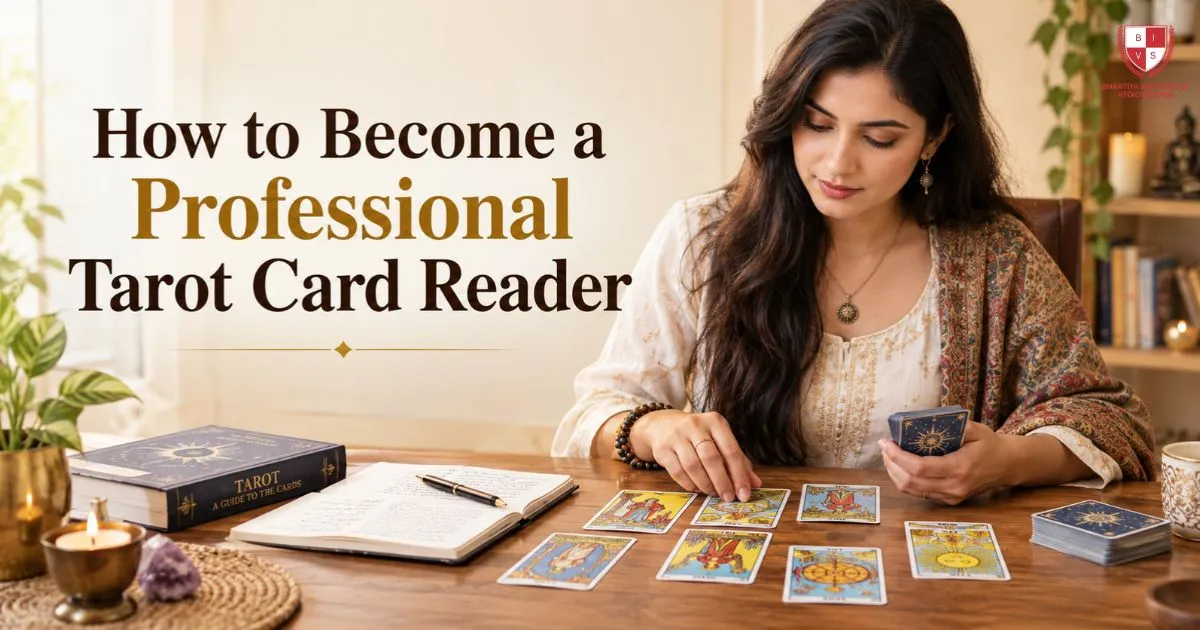
Many learners wonder whether tarot can become a profession. It can, but it takes practice, a clear code of ethics and honest communication about what a reading can offer. Our article on how to become a professional tarot card reader covers the skills, the practice and the responsibilities in more detail.
Learning Tarot With a Teacher
Books and videos are a good start, but a teacher helps you check your interpretations and build confidence with real questions. The tarot card reading course at Bhartiya Institute of Vedic Science teaches the cards, the spreads and reading practice in live online classes, in Hindi and English, with doubt sessions, lifetime access to class recordings and a certificate on completion. Bhartiya Institute of Vedic Science is an ISO Certified Institute, registered under NCT of Delhi, and has been teaching since 2002. More guides are in our tarot card reading category.
What Tarot Can and Cannot Tell You
Tarot can help you slow down, name your options and see a situation from another angle. It cannot guarantee what will happen, cannot diagnose illness, and cannot replace a doctor, a lawyer or a financial adviser. Studies have not shown that tarot can predict future events, so a thoughtful reader treats every reading as guidance for reflection and makes the final decision themselves.
Conclusion
Tarot card reading becomes simple once you see the pattern: 22 big cards for life themes, four suits for everyday areas, ten numbers that repeat in every suit, and a few clear spreads. Start with one deck, three cards and a notebook. The skill grows with every reading you write down.
If you would like a teacher to guide you through your first readings, you can book a free 15-minute demo call or look at the tarot card reading course. Which card from the Major Arcana do you want to understand first?
This article shares tarot knowledge for educational and reflective purposes. It is not a substitute for professional medical, legal or financial advice.