By Jyoti Chauhan, Content Writer · Reviewed by Gurudev Shrie Kashyap, Founder, Bhartiya Institute of Vedic Science
Key Takeaways
- Handwriting slant is the angle at which your letters lean: to the right, to the left, or straight up.
- Graphology traditionally reads three main slants: right (outgoing), left (reserved) and vertical (self-controlled).
- You can measure your own slant in four steps with a ruler or protractor and ten lines of natural writing.
- Slant changes with your hand, your schooling, your pen and your mood, so one sample is never a verdict.
- Treat slant as a prompt for self-reflection. Research does not support graphology for hiring or other decisions.
Look at the last note you wrote by hand. Do the letters lean forward as if in a hurry, lean back as if holding something in, or stand straight like soldiers? Most of us never notice, yet graphologists have paid attention to this one feature for over a century.
Slant is also the easiest part of handwriting to check yourself. This guide explains what handwriting slant means in graphology, how to measure it, what each direction traditionally suggests, and how much weight it deserves.
What Is Handwriting Slant?
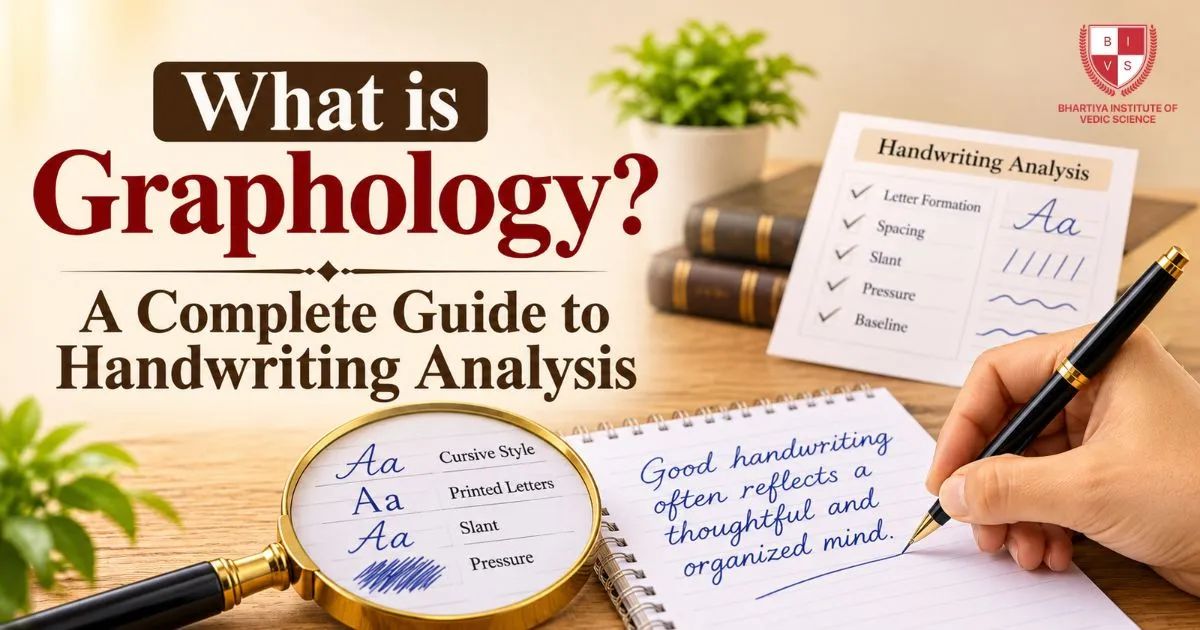
Handwriting slant is the angle between the upright strokes of your letters and the baseline, the imaginary line your writing sits on. In graphology, which is the study of handwriting as an expression of personality, slant is one of the main features read alongside size, pressure, spacing and baseline. You can learn the basics in our guide to what graphology is.
The Three Main Slants and What They Traditionally Suggest
These readings come from graphology tradition. They are starting points for reflection and not facts about any person.
Right slant (forward)
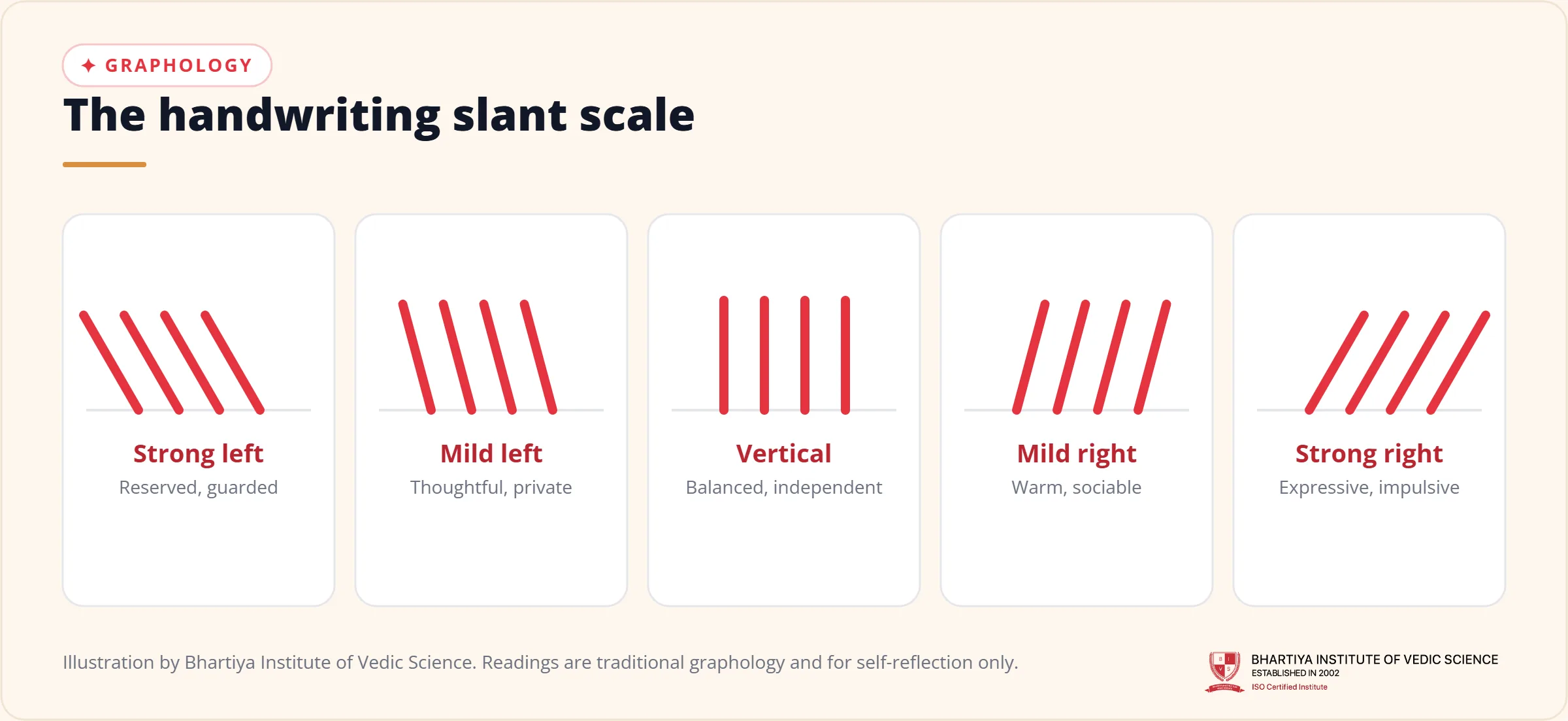
Letters lean to the right, towards the reader. Graphology associates this with an outgoing, expressive and future-oriented style. A mild right slant is described as warm and sociable. A very strong right slant is described as impulsive or emotionally intense.
Left slant (backward)
Letters lean to the left, back towards the writer. Graphologists link this with a reserved, private and cautious style, a person who thinks before sharing. A strong left slant is read as guarded or wary of closeness.
Vertical (upright) writing
Letters stand straight. This is traditionally read as balanced, self-controlled and independent, a person who keeps reason and feeling in step. Very rigid vertical writing is read as distant or overly controlled.
| Slant | Lean | Traditional reading | Possible excess |
|---|---|---|---|
| Strong right | Far forward | Expressive, energetic | Impulsive |
| Mild right | Slightly forward | Warm, sociable | Over-eager |
| Vertical | Upright | Balanced, independent | Distant |
| Mild left | Slightly back | Thoughtful, private | Hesitant |
| Strong left | Far back | Reserved, self-reliant | Guarded |
How to Measure Your Own Slant
- Write naturally. Use your everyday pen on plain paper and write about ten lines without thinking about neatness. Sign nothing and copy nothing.
- Pick the tall letters. Choose letters with clear upright strokes, such as l, t, b and d in English. Ignore flourishes and capital letters.
- Draw a vertical guide. Place a ruler straight up from the baseline through the base of a letter and compare it with the letter's stroke.
- Judge the pattern. Look across the whole page. If most strokes lean the same way, that is your main slant. If they vary, note how much.
A simple rule of thumb: a lean of up to about 10 degrees either way counts as near vertical, and a clear lean beyond that is a right or left slant. Graphology schools set their own ranges, so treat these numbers as a rough guide.
Why Your Slant Changes
Slant is not fixed. Several everyday factors move it, and none of them is about character.
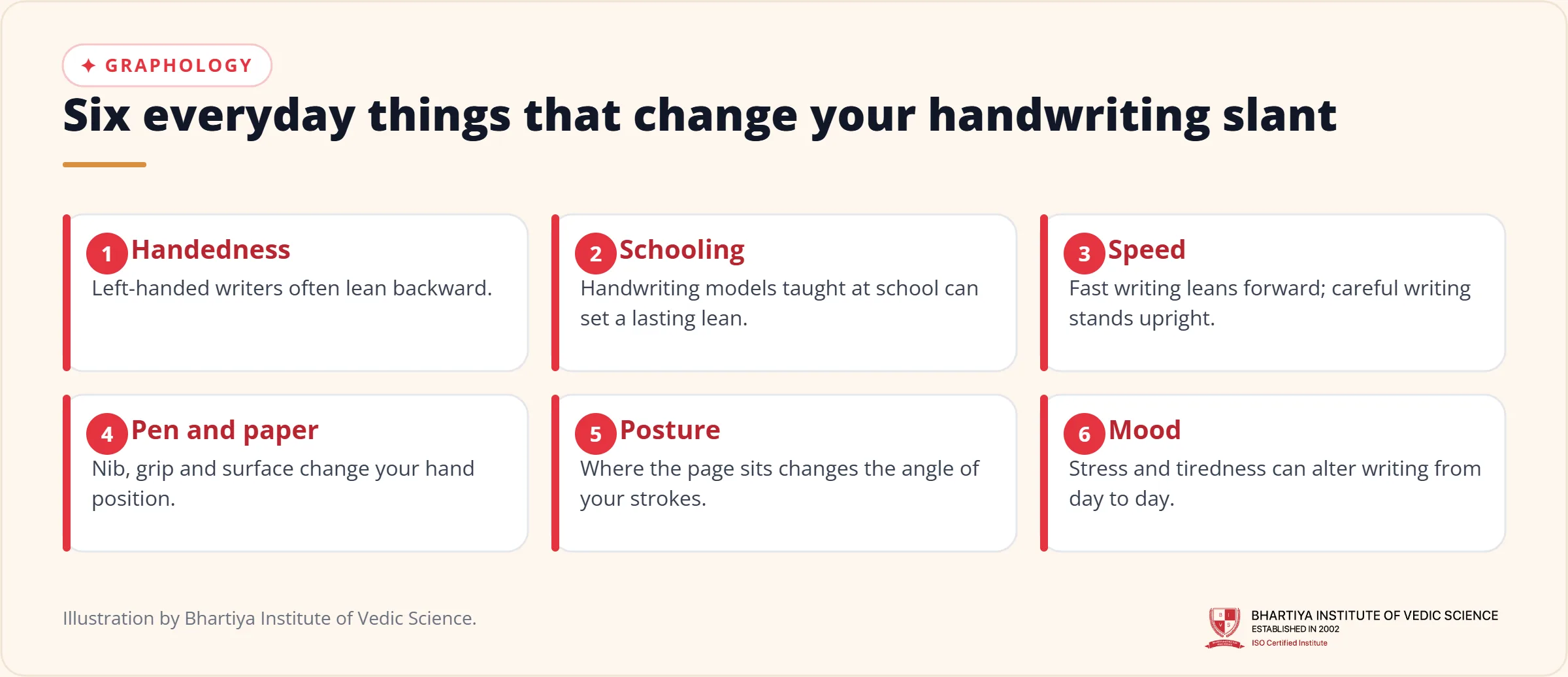
- Handedness. Many left-handed writers lean backward because of how the hand rests on the page.
- How you were taught. School handwriting models often set a forward lean that people keep for life.
- Speed. Fast writing tends to lean forward, and slow careful writing tends to stand upright.
- Pen and paper. A fountain pen, a rough page or a ruled line changes your hand position.
- Mood and tiredness. Graphologists note that emotional states can show up, which is why a single sample is weak evidence.
A Simple Self-Reflection Exercise
Try this over one week. On three different days, write the same short paragraph: once in a calm moment, once when you are in a hurry, and once when you are tired. Place the three samples side by side and compare the angle of the tall strokes.
Most people see the slant drift. The hurried page usually leans further forward, and the tired page may be more upright or uneven. That small experiment teaches the most useful lesson in graphology: handwriting reflects a state as much as a trait, so a single page can never describe a whole person.
Slant in Hindi and Other Scripts
Most graphology material was written for the Latin alphabet, so slant is easiest to judge in English. Devanagari has a horizontal headline, the shirorekha, that keeps letters upright and makes lean harder to read. In Hindi, graphologists usually look at the vertical strokes and the finishing curves instead. If you write in more than one script, compare your slant in each, and expect them to differ.
When the Slant Is Mixed
Many people write with a slant that wanders, leaning right in some words and upright in others. Graphology reads this as a flexible or changing mood, or as a sign that the writer is still developing a personal style. Teenagers often show mixed slants for exactly that reason. A consistent slant across the whole page is read as a stable habit.
Slant Is Only One Sign
No graphologist reads slant alone. It is read together with the size of the letters, the pressure of the pen, the spacing between words, the direction of the baseline and the way the writer signs. For the most personal feature of all, see our guide to signature analysis. If you enjoy reading patterns in names and numbers, our guide to name numerology shows a different way of reading the same name you write.
What Handwriting Slant Can and Cannot Tell You
Treat slant as a tool for self-reflection. Notice how your writing changes when you are rushed, relaxed or upset, and ask yourself what that tells you about your day.
It is important to be honest about the evidence. Studies that tested graphologists against personality questionnaires, including Furnham and Gunter (1987) and Dazzi and Pedrabissi (2009), did not find that handwriting predicted personality reliably, and the British Psychological Society has been reported as rating graphology as having "zero validity". A general overview is available in the Wikipedia article on graphology. For that reason we do not suggest using handwriting to judge a job applicant, a student, a partner or anyone else.
Learning Graphology Properly
If you enjoy this subject and want to study it in a structured way, the graphology course at Bhartiya Institute of Vedic Science teaches handwriting analysis in live online classes, in Hindi and English, with doubt sessions and certificate on completion. Bhartiya Institute of Vedic Science is an ISO Certified Institute, registered under NCT of Delhi, and has been teaching since 2002. More articles on this subject are in our graphology category.
Conclusion
Handwriting slant gives you a quick way to start noticing your own writing. Right, left and upright each carry a traditional meaning, but your hand, your schooling and your mood all shape the angle. Use it as a mirror and not as a verdict.
If you would like to learn to read handwriting properly, you can book a free 15-minute demo call and see how the course is taught. Which way does your handwriting lean?
This article shares traditional graphology knowledge for educational purposes. It is not a substitute for professional psychological, medical, legal or financial advice.