By Jyoti Chauhan, Content Writer · Reviewed by Gurudev Shrie Kashyap, Founder, Bhartiya Institute of Vedic Science
Key Takeaways
- You can learn the basics of numerology in 30 days with about 30 to 45 minutes of study a day, if you follow a fixed order.
- The core skills are four calculations: mulank (birth number), bhagyank (destiny number), name number and the Lo Shu grid.
- Learn one system first. The two most common are Pythagorean and Chaldean, and mixing them early causes confusion.
- Practise on real examples from the first week, such as your own date of birth and those of family members who agree.
- Numerology is a traditional system for reflection. It cannot guarantee outcomes or replace professional advice.
Most people meet numerology through a single question: "What is my lucky number?" They type their date of birth into a calculator, read a paragraph about themselves, and a month later they want to know how it works.
That is the right instinct. Numerology is easy to start and easy to get wrong, because dozens of videos and books give conflicting answers. A short, structured plan removes the confusion.
This guide gives you a 30-day plan to learn numerology at home: what to study each week, which system to choose, how to practise, which books and tools help and when it makes sense to learn with a teacher. If you have never studied numerology, our beginner's guide to numerology is the best companion to this plan.
Can You Really Learn Numerology at Home?
Yes, the basics can be learned at home. The calculations are simple arithmetic: you add digits and reduce them to a single number from 1 to 9, with special handling for master numbers such as 11 and 22. What takes time is not the arithmetic but the interpretation, the habit of reading numbers together instead of one at a time, and the judgement to say what a number can and cannot tell you.
A 30-day plan will give you the foundations and a first set of practice readings. Real fluency comes from months of practice, in the same way that learning any craft does.
Before You Start: Choose One System
Numerology has more than one system, and learning two at once is the most common beginner mistake.
- Pythagorean: assigns the letters A to Z the values 1 to 9 in order, repeating. Common in Western numerology and in many online calculators.
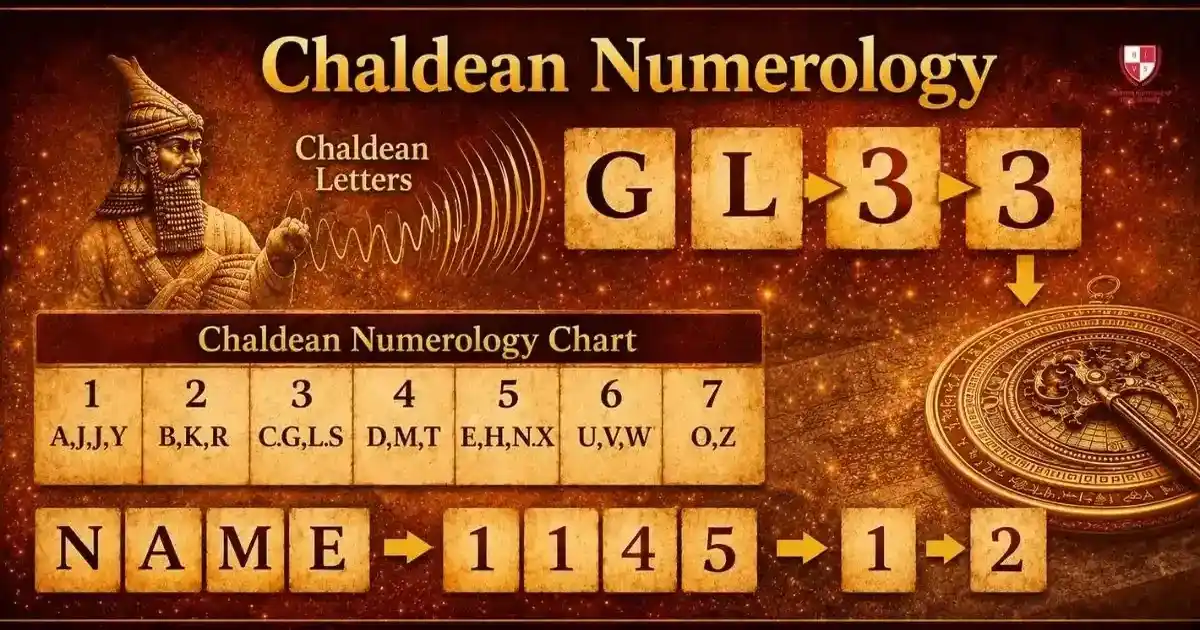
- Chaldean: uses the values 1 to 8 for letters, and keeps 9 apart as a special number. It is the system many Indian numerologists use for names. Our guide to Chaldean numerology explains it in full.
- Vedic or Indian numerology: connects each number from 1 to 9 with a planet and combines with Jyotish ideas.
For birth numbers, the method is the same in all systems. For names, choose Chaldean or Pythagorean and stay with it for the whole 30 days. If you want help deciding, see our comparison of Chaldean and Pythagorean numerology.
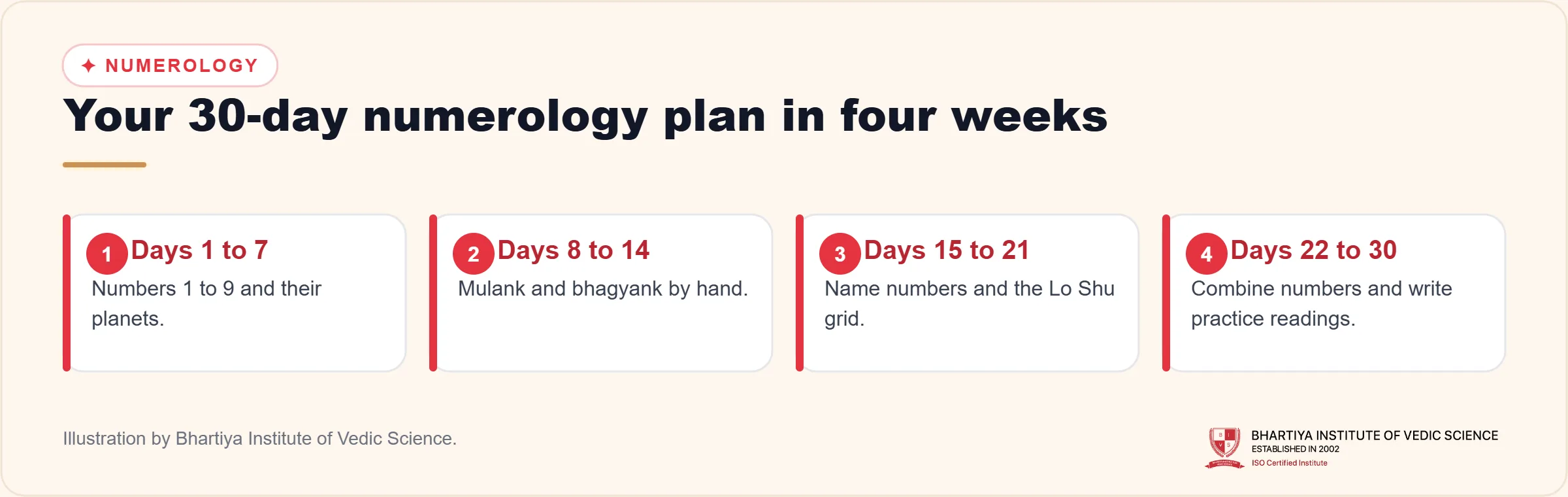
The 30-Day Numerology Study Plan
Week 1 (Days 1 to 7): Numbers 1 to 9 and their planets
Spend the first week learning the nine numbers and the planet traditionally linked with each in Indian numerology.
| Number | Planet | Core theme |
|---|---|---|
| 1 | Sun | Leadership, independence |
| 2 | Moon | Sensitivity, cooperation |
| 3 | Jupiter | Learning, expression |
| 4 | Rahu | Structure, unconventional thinking |
| 5 | Mercury | Communication, adaptability |
| 6 | Venus | Harmony, beauty, care |
| 7 | Ketu | Inquiry, introspection |
| 8 | Saturn | Discipline, patience |
| 9 | Mars | Energy, courage |
Write one line for each number in your own words. Do not copy long descriptions. The aim is to understand the theme, not to memorise paragraphs.
Week 2 (Days 8 to 14): Mulank and bhagyank
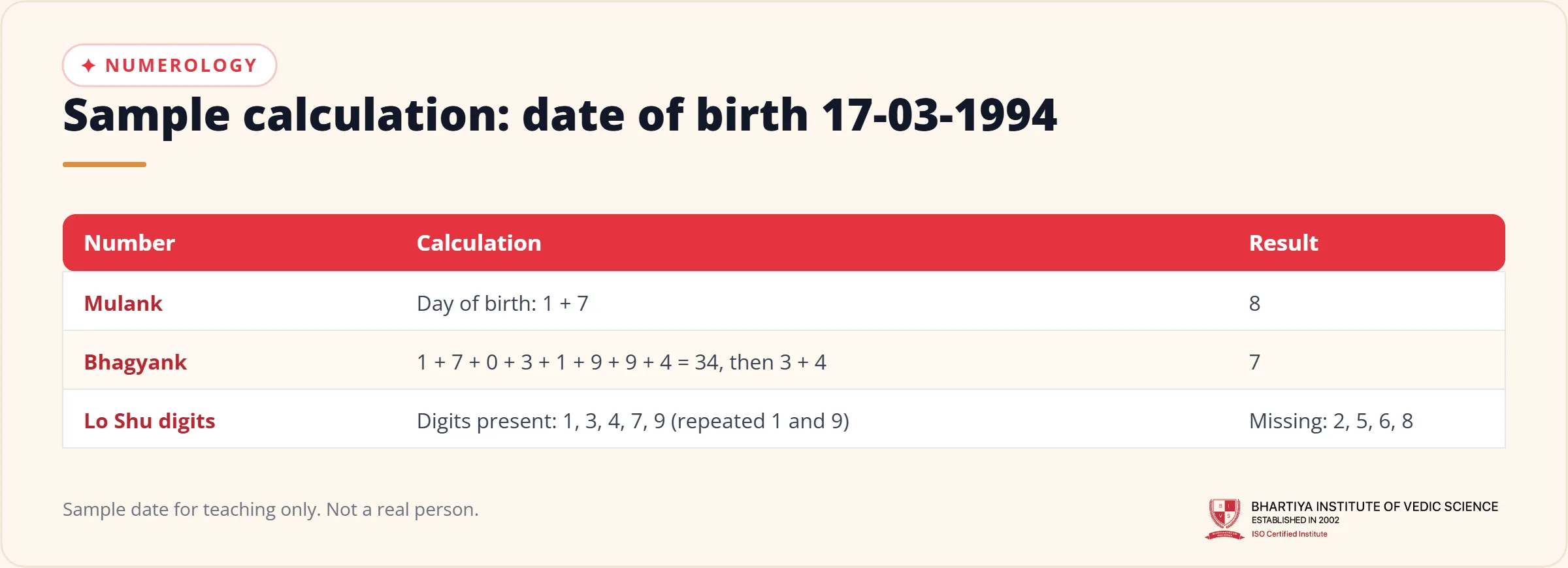
Now learn the two most important calculations. The mulank (birth number or psychic number) comes from the day of birth, reduced to a single digit. The bhagyank (destiny number) comes from adding every digit of the full date of birth and reducing it.
For a sample date of birth, 17-03-1994, the mulank is 1 + 7 = 8. The bhagyank is 1 + 7 + 0 + 3 + 1 + 9 + 9 + 4 = 34, and 3 + 4 = 7. Practise on ten dates before you move on. Our article on mulank vs bhagyank explains how the two numbers work together.
Week 3 (Days 15 to 21): Name numbers and the Lo Shu grid
Learn to find the value of a name using the system you picked. In Chaldean numerology, for example, A, I, J, Q and Y have the value 1, and the letter values total to a name number that is then reduced. Practise on your own name and on three friends' names, with their permission.
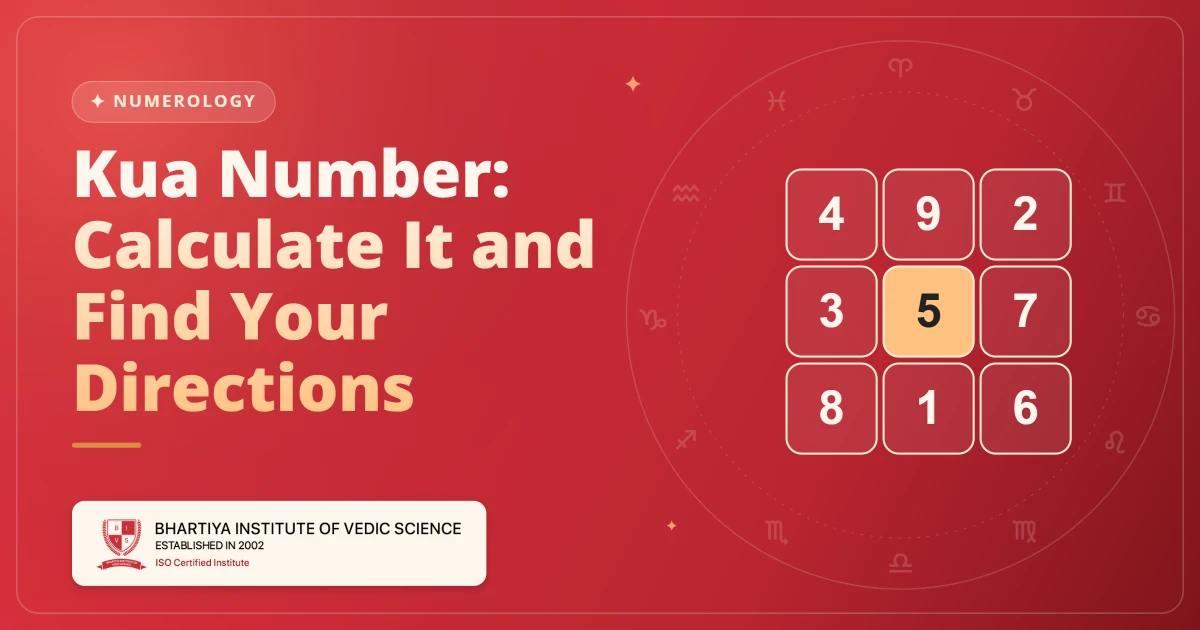
Then learn the Lo Shu grid, a three-by-three magic square in which you place the digits of your date of birth. Missing and repeated digits are read as themes to notice. Our guide to missing numbers in the Lo Shu grid shows how to read it, and the free Lo Shu grid calculator lets you check your work.
Week 4 (Days 22 to 30): Combining numbers and practising readings
In the last stretch, put the pieces together. Take a date of birth and a name, calculate mulank, bhagyank, name number and Lo Shu grid, and write a half-page summary that connects them. Learn the idea of the personal year number, which uses your birth day and month with the current year. Finish with three full practice readings, and ask your volunteers for honest feedback on what felt accurate and what did not.
Chaldean Letter Values: A Quick Reference
| Value | Letters |
|---|---|
| 1 | A, I, J, Q, Y |
| 2 | B, K, R |
| 3 | C, G, L, S |
| 4 | D, M, T |
| 5 | E, H, N, X |
| 6 | U, V, W |
| 7 | O, Z |
| 8 | F, P |
Keep this table beside you in week 3. In this system the number 9 is not given to any letter.
A Worked Name Example
Take the invented sample name Aman. In the Chaldean system, A = 1, M = 4, A = 1 and N = 5. The total is 1 + 4 + 1 + 5 = 11, and 1 + 1 reduces it to 2. Many teachers note both numbers: the compound number 11, which some traditions treat as special, and the single digit 2. Write both in your notes, and then read the single digit alongside the mulank and bhagyank rather than alone.
A Worked Personal Year Example
The personal year number shows the theme of a particular year. For the sample date of birth 17-03 and the year 2027, add the digits of the day (1 + 7), the month (0 + 3) and the year (2 + 0 + 2 + 7) to get 22, and then reduce it to 4. A year 4 is traditionally read as a year for structure, foundations and steady work. Treat it as a theme to plan around and not as a prediction.
A Five-Question Self-Test for Day 30
- What is the mulank for a person born on the 29th? (2 + 9 = 11, then 1 + 1 = 2)
- What is the bhagyank for 05-06-2000? (0 + 5 + 0 + 6 + 2 + 0 + 0 + 0 = 13, then 1 + 3 = 4)
- Which planet is linked with number 8 in Indian numerology? (Saturn)
- Which number is not given to any letter in the Chaldean system? (9)
- Name one mistake beginners make. (For example, switching systems or reading one number alone.)
If you can answer four out of five without looking, you have the foundations.
What to Study After Day 30
Once the foundations are in place, move on to master numbers, karmic and compound numbers, compatibility between two charts, house and mobile number numerology, and business name analysis. Study the topics one at a time, and keep your practice notebook going. A teacher can help you decide the next step and check your interpretations as they become more detailed.
A Daily Routine That Fits Into 30 to 45 Minutes
- 10 minutes: read or revise the day's topic.
- 15 minutes: do the calculations on paper, without a calculator at first.
- 10 minutes: write a short interpretation in your own words.
- 5 minutes: note one question you still have.
Writing by hand helps. Keep one notebook for the whole 30 days, and number the pages so you can see your progress.
Numerology Books and Tools for Beginners
- Cheiro's Book of Numbers: an early twentieth-century classic that is now in the public domain, useful for historical context.
- A good beginner book in your language, from an author who explains the method before the predictions.
- Free calculators: try our numerology calculator to check your arithmetic, and use it only after you have tried by hand.
- Your own notebook: the best resource of all.
Common Mistakes When Learning Numerology
- Switching systems. Pick one and stay with it for the first month.
- Memorising instead of understanding. Learn the theme of each number, and build from there.
- Reading one number alone. A reading comes from several numbers and the full context.
- Using a calculator from day one. You will not understand reduction until you do it by hand.
- Making health, money or marriage predictions. This is not responsible practice.
How Do You Know You Are Making Progress?
By day 30 you should be able to calculate all four core numbers for any date and name without help, explain each number in a few simple sentences, and write a short, balanced reading that avoids fear and avoids promises. You should also know what you do not know yet, which is a good sign of progress.
Self-Study vs Learning With a Teacher
Self-study is a good way to test whether numerology interests you. Its weakness is that nobody corrects your interpretation. A teacher gives you feedback, shows how professionals combine numbers and helps you avoid common errors. The numerology course at Bhartiya Institute of Vedic Science has two levels, listed on the course page as the Advanced course of about 2 months and the Professional course of about 4 months (as of November 2026). Classes are live and interactive, in Hindi and English, with doubt sessions, lifetime access to class recordings and a certificate on completion. Bhartiya Institute of Vedic Science is an ISO Certified Institute, registered under NCT of Delhi, and has been teaching since 2002.
If you are curious about where this can lead, read our guide on how to become a numerologist. You can try a class before you decide by booking a free 15-minute demo call.
What Numerology Can and Cannot Tell You
Numerology is a traditional system for exploring personality themes and personal cycles. It cannot guarantee outcomes, predict illness, or replace professional medical, legal or financial advice. A careful learner treats every reading as a prompt for reflection.
Conclusion
Thirty days is enough to learn the foundations of numerology if you follow a clear order: numbers and planets, mulank and bhagyank, names and the Lo Shu grid, then combined readings. Keep one system, practise by hand and stay modest in what you claim.
When you are ready for feedback from a teacher, you can book a free 15-minute demo call or see the numerology course. What is your mulank?
This article shares traditional numerology knowledge for educational purposes. It is not a substitute for professional medical, legal or financial advice.