By Jyoti Chauhan, Content Writer · Reviewed by Gurudev Shrie Kashyap, Founder, Bhartiya Institute of Vedic Science
Key Takeaways
- The Minor Arcana is the larger part of a tarot deck: 56 cards in four suits of 14, namely Wands, Cups, Swords and Pentacles.
- Each suit has an element: Wands are fire, Cups are water, Swords are air and Pentacles are earth.
- Every suit has ten number cards (Ace to 10) and four court cards (Page, Knight, Queen, King).
- Learn the suit's area of life and the number's theme, and you can read any of the 56 cards by combining them.
- Tarot is a tool for reflection. It cannot guarantee future events or replace professional advice.
Most beginners learn the famous Major Arcana cards first: The Fool, The Lovers, The Tower. Then they open the rest of the deck and feel their confidence disappear. Fifty-six cards, each with its own scene, can feel like too much to memorise.
The good news is that you do not have to memorise them one by one. The Minor Arcana follows a clear pattern of four suits and ten numbers, and once you see it, the deck starts to read itself.
This guide explains the Minor Arcana suits in plain language: what Cups, Wands, Swords and Pentacles stand for, the meaning of every card from Ace to 10, how to read the court cards, and how to use the suits in a spread. It is part of our beginner series that starts with tarot card reading for beginners.
What Is the Minor Arcana?
The Minor Arcana is the group of 56 tarot cards that describe everyday life: work, feelings, thoughts, conflicts and money. The word arcana means secrets, and minor only means smaller in scale than the 22 Major Arcana cards, which describe big turning points. The Minor Arcana cards carry the daily detail around those themes.
The Minor Arcana resembles a standard playing-card deck, with Wands, Cups, Swords and Pentacles matching clubs, hearts, spades and diamonds, and with an extra Knight in each suit.
The Four Suits and Their Elements
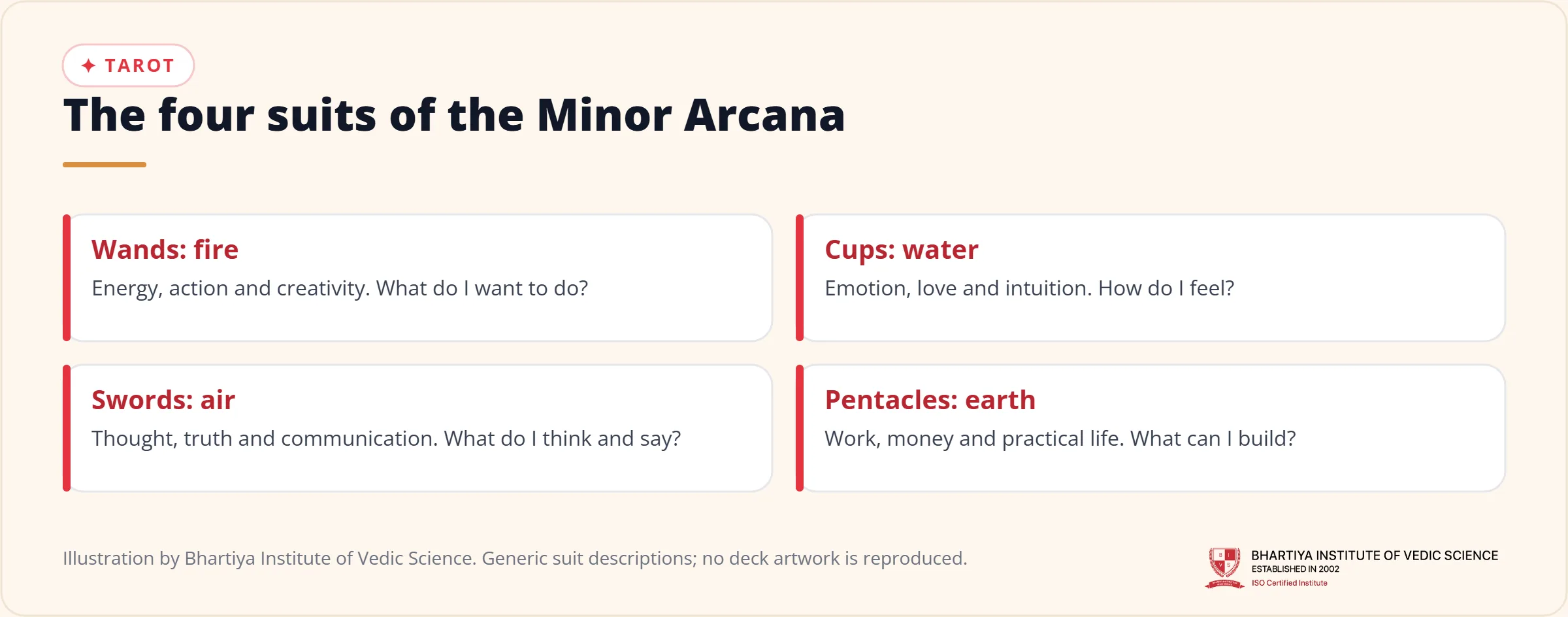
| Suit | Element | Area of life | Questions it answers |
|---|---|---|---|
| Wands | Fire | Energy, action, creativity | What do I want to do? |
| Cups | Water | Emotion, love, intuition | How do I feel? |
| Swords | Air | Thought, truth, communication | What do I think and say? |
| Pentacles | Earth | Work, money, body, practical life | What can I build? |
Some decks use different names. Wands may be called Rods, Staves or Batons, Cups may be called Chalices, and Pentacles may be called Coins or Discs. The meaning stays the same. Readers who study Indian traditions sometimes compare the four suits to four of the five elements of the Indian system, namely agni (fire), jala (water), vayu (air) and prithvi (earth). This is a learner's comparison and not a classical equivalence.
How to Read Any Minor Arcana Card
Use a simple two-step method:
- Take the suit: it tells you which area of life the card is about.
- Take the number: it tells you the stage of the story, from the Ace (a beginning) to the 10 (completion).
So the Three of Cups combines water and growth: emotions shared with others, often friendship or celebration. The Five of Swords combines air and conflict: a disagreement over ideas or words. Add the picture on your own deck, and you have a full reading of the card.
Suit of Wands: Fire
Wands are about drive, ambition and creativity. They show where your energy goes and what excites you. Many Wands cards relate to projects, careers and personal goals. Too many Wands in a reading can suggest restlessness or burnout.
| Card | Traditional keywords |
|---|---|
| Ace of Wands | A spark, inspiration, a new project |
| 2 of Wands | Planning, choosing a path |
| 3 of Wands | Expansion, looking ahead |
| 4 of Wands | Celebration, home, stability |
| 5 of Wands | Competition, friction |
| 6 of Wands | Victory, recognition |
| 7 of Wands | Defending your position |
| 8 of Wands | Speed, swift movement |
| 9 of Wands | Resilience, the last stretch |
| 10 of Wands | Burden, doing too much |
Suit of Cups: Water
Cups are about emotions, relationships and imagination. They show how you feel, how you connect with others and what your heart wants. A spread full of Cups often points to a situation where feelings matter more than facts.
| Card | Traditional keywords |
|---|---|
| Ace of Cups | A new feeling, an emotional beginning |
| 2 of Cups | Partnership, mutual attraction |
| 3 of Cups | Friendship, celebration |
| 4 of Cups | Apathy, re-evaluation |
| 5 of Cups | Grief, regret |
| 6 of Cups | Nostalgia, kindness |
| 7 of Cups | Many options, daydreams |
| 8 of Cups | Walking away, seeking more |
| 9 of Cups | Satisfaction, a wish fulfilled |
| 10 of Cups | Emotional fulfilment, family harmony |
Suit of Swords: Air
Swords are about thought, truth and communication. They can show clarity, but they also show conflict, worry and difficult decisions. Many people find Swords the hardest suit, because it often deals with stress. It is useful to remember that Swords describe the mind, and the mind can be changed.
| Card | Traditional keywords |
|---|---|
| Ace of Swords | Clarity, truth, a breakthrough |
| 2 of Swords | Stalemate, a hard choice |
| 3 of Swords | Heartbreak, sorrow |
| 4 of Swords | Rest, recovery |
| 5 of Swords | Conflict, a hollow win |
| 6 of Swords | Transition, moving on |
| 7 of Swords | Strategy, hidden motives |
| 8 of Swords | Feeling trapped, restriction |
| 9 of Swords | Anxiety, worry |
| 10 of Swords | A painful ending, then relief |
Suit of Pentacles: Earth
Pentacles are about work, money, health habits and the material world. They show how you build, save and care for your daily life. A spread with many Pentacles often points to practical matters and steady effort.
| Card | Traditional keywords |
|---|---|
| Ace of Pentacles | A new opportunity, resources |
| 2 of Pentacles | Juggling, finding balance |
| 3 of Pentacles | Teamwork, craft |
| 4 of Pentacles | Saving, holding on tightly |
| 5 of Pentacles | Hardship, feeling left out |
| 6 of Pentacles | Generosity, give and take |
| 7 of Pentacles | Patience, assessing growth |
| 8 of Pentacles | Practice, skill-building |
| 9 of Pentacles | Self-sufficiency, comfort |
| 10 of Pentacles | Legacy, long-term security |
Court Cards: Page, Knight, Queen and King
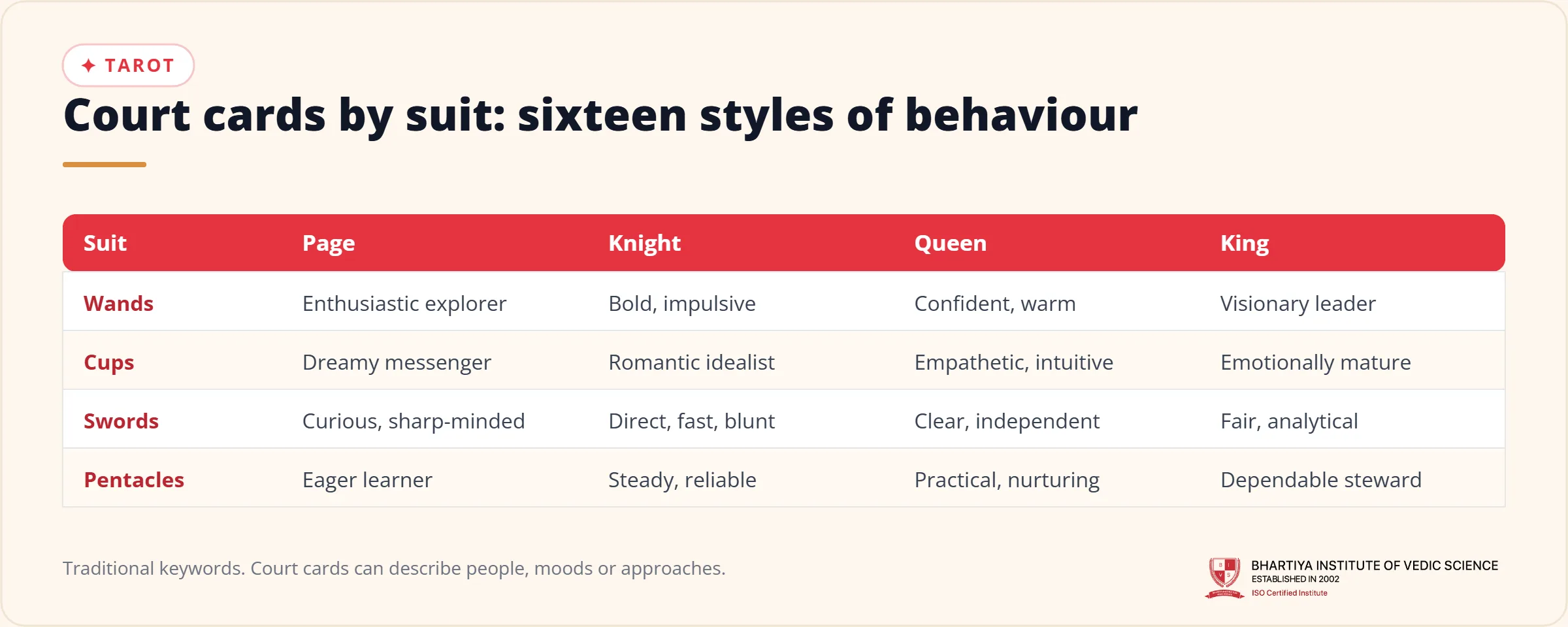
Each suit has four court cards, which can stand for people, personality styles or ways of acting. A court card can describe someone in your life, a side of yourself or the approach you should take. Pages are learners and messengers, Knights are active and sometimes extreme, Queens are inwardly mature, and Kings are outwardly mature.
How to decide who a court card is
Ask three questions: Is the question about a person? Does the card match how you or someone you know acts? Or does it describe the style you should adopt? If the answer is unclear, treat the court card as a style of behaviour and not as a prediction about a specific person.
Reading the Suits in a Spread
Once you know the suits, count them. If one suit dominates a spread, that suit's area of life is probably the heart of the question.
- Many Wands: a lot of energy and action, or restlessness.
- Many Cups: feelings and relationships are central.
- Many Swords: thoughts, conflict or decisions are central.
- Many Pentacles: practical matters, work or money are central.
- Many Major Arcana: a bigger life theme is at work.
Also notice the numbers. Many 5s may point to conflict or change, many 10s to completion, and many Aces to fresh starts.
A Worked Sample Reading
Take a three-card spread of situation, challenge, advice for the question "How can I handle a disagreement at work?". This is an example of method and not a prediction.
- Situation: Five of Swords. Air plus conflict. A disagreement where winning has a cost.
- Challenge: Nine of Swords. Air plus near completion. Worry at its highest, often before the matter is resolved.
- Advice: Six of Swords. Air plus harmony. A calm move forward, leaving the argument behind.
Three Swords cards mean the whole matter is about thought and communication, so the reading suggests calming your thinking and choosing a peaceful way to move on. The reading does not say what the other person will do.
How the Suits Work Together
When two cards from different suits sit side by side, many readers look at how their elements interact, an idea known as elemental dignities in the Western tradition. In this approach, fire and air are friendly because air feeds fire, and water and earth are friendly because water nourishes earth. Fire and water, and air and earth, are said to create tension.
For example, a Wands card next to a Swords card suggests that action and clear thinking support each other. A Wands card next to a Cups card suggests that passion and feeling are pulling in different directions. Treat this as an optional layer for when you are comfortable with the basics, and not as a rule you must use.
A Five-Minute Daily Practice
Draw one Minor Arcana card each morning and answer three questions in your notebook: which suit is it, which number is it, and what one sentence do the two give together? At the end of the day, add a line about whether the card matched anything that happened. After two weeks you will find that you no longer need the table for most cards.
Common Mistakes With the Minor Arcana
- Memorising 56 separate meanings. Learn the suit and the number and combine them.
- Treating Swords as bad. Swords describe the mind, and many Swords cards show relief and clarity.
- Reading the 10 of Swords as disaster. The picture shows a painful ending, but the dawn at the horizon points to relief.
- Using court cards only as people. They are also moods and approaches.
- Ignoring the question. A card means different things for a job question and a relationship question.
Where to Go Next
When you are comfortable with the suits, move on to the card-by-card method in our guide on how to read tarot cards. If you want to see where tarot can lead as a profession, read how to become a professional tarot card reader. For a quieter, meditative side of spiritual study, see our gentle method to access your Akashic Records, and for a number-based system see numerology for beginners.
Learning Tarot With a Teacher
A teacher helps you check your readings, practise on real questions and avoid common mistakes. The tarot card reading course at Bhartiya Institute of Vedic Science teaches the Major and Minor Arcana, spreads and reading practice in live online classes, in Hindi and English, with doubt sessions and certificate on completion. Bhartiya Institute of Vedic Science is an ISO Certified Institute, registered under NCT of Delhi, and has been teaching since 2002.
What the Minor Arcana Can and Cannot Tell You
The Minor Arcana can help you name what is going on in a situation and see choices more clearly. It cannot guarantee an outcome, diagnose illness or give legal or financial advice. Studies have not shown that tarot predicts future events, so use the cards as a prompt for thought and make your own decisions.
Conclusion
The Minor Arcana looks big, but it is only four areas of life and ten stages of a story. Learn the suit, learn the number, and combine them. With a few weeks of daily practice, most beginners can read any of the 56 cards with confidence.
To learn with a teacher, you can book a free 15-minute demo call or see the tarot course. Which suit feels the most natural to you?
This article shares tarot knowledge for educational and reflective purposes. It is not a substitute for professional medical, legal or financial advice.