By Jyoti Chauhan, Content Writer · Reviewed by Gurudev Shrie Kashyap, Founder, Bhartiya Institute of Vedic Science
Key Takeaways
- A north facing house has its main entrance on the north side. In Vastu, north is the direction of Kubera, the lord of wealth, and is linked with the water element.
- Vastu does not call any facing "bad". Each of the four main facings has its own layout rules, and the interior plan matters as much as the direction.
- Traditional texts divide each side of a plot into 8 entrance padas, and most teachers prefer the north-east half of the north wall for the door.
- Keep the north and north-east light, open and uncluttered, and place heavy structures in the south and south-west.
- Use a proper compass, measure on the floor plan and treat advice as tradition, not as a guarantee.
When someone buys a flat or a plot, the first question is often "Which direction does it face?" If the answer is north, the reaction is usually relief. North facing is widely called the best direction in Vastu, and many builders charge extra for it.
But the full picture is more careful than a one-line rule. A north facing house can have a poor layout inside, and a house with another facing can have an excellent one. The direction of the door is a starting point and not the whole story.
This guide explains north facing house Vastu in simple language: what the direction means, how to pick the entrance, where each room goes, which colours suit it and which myths to ignore. If you are new to the subject, start with our guide to what Vastu Shastra is and how it works.
What Is a North Facing House in Vastu?
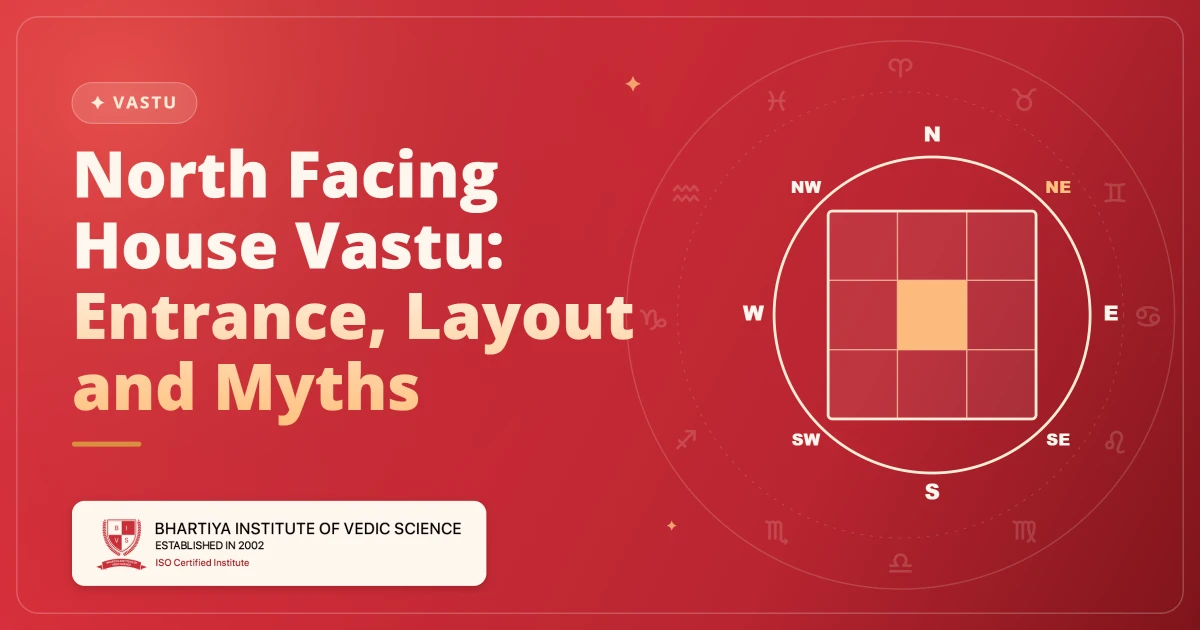
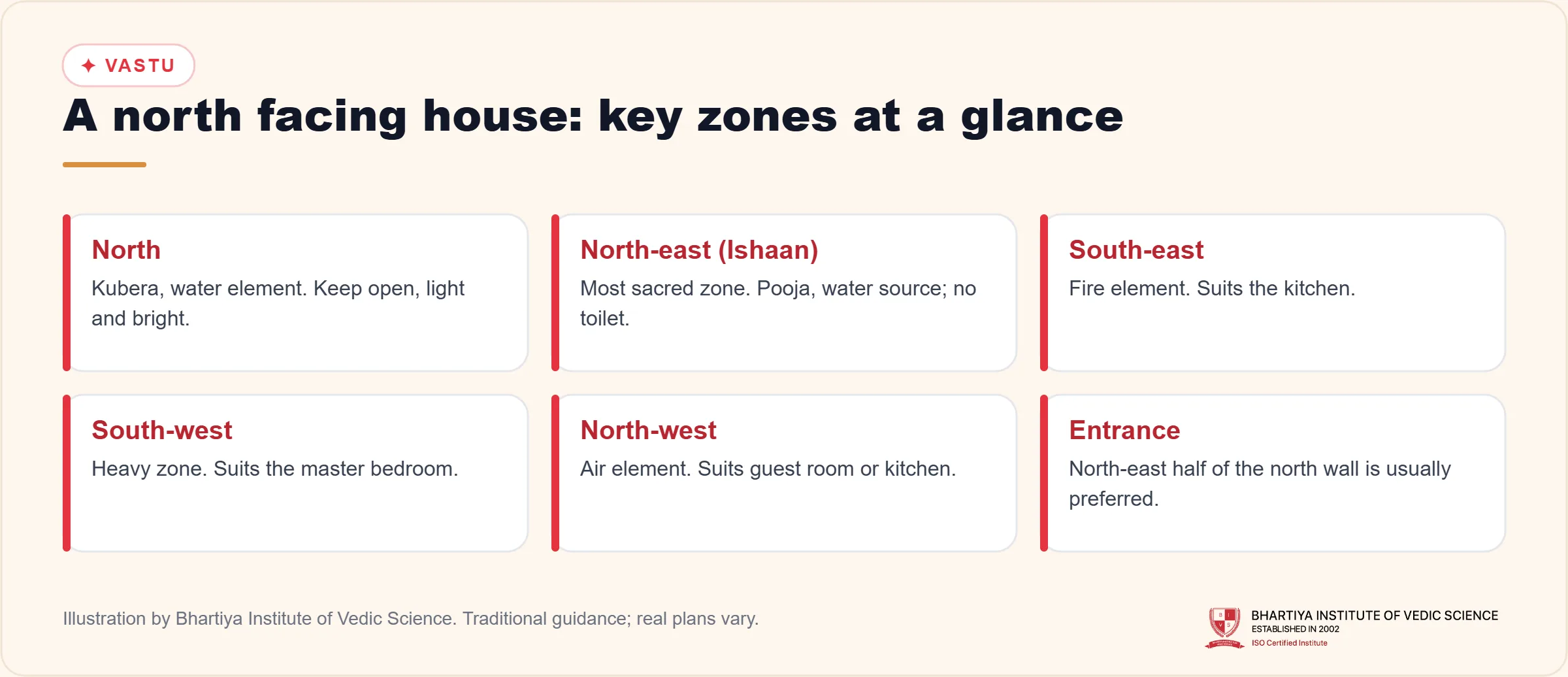
A north facing house is one whose main entrance opens towards the north. In Vastu Shastra, the traditional Indian science of space, north is ruled by Kubera, the god of wealth, and is linked with the water element. The north-east corner, called Ishaan, is the most sacred zone and is connected with clarity and calm.
Because of these associations, the north is traditionally seen as a direction of opportunity, openness and growth. This is the reason it is so popular. Vastu texts such as the Mayamata, the Manasara and the Vishwakarma Prakash describe how the directions relate to the plan of a building, though they differ on details.
Is a North Facing House Good?
Traditionally, yes, a north facing house is regarded as favourable, but it is not automatically perfect. Three points keep the picture honest:
- The entrance position matters. Not every point on the north wall is equally favoured.
- The interior plan matters. A toilet in the north-east or a kitchen in the wrong zone can undo the benefit of a good facing.
- Other facings are not bad. East, west and south facing houses all have their own recommended plans.
Choosing the Entrance: The Padas
In Vastu, the boundary of a plot is divided into 32 small divisions called padas, eight on each side. Each pada is linked with a deity or energy, and traditional texts say which are favourable for an entrance. For a north facing house, most teachers advise placing the door in the north-east half of the north wall, towards the Ishaan corner, and avoiding the extreme north-west end.
Because lists of pada names and their qualities differ between schools, do not choose a door position from a generic chart alone. A simple approach is to divide the north wall into eight equal parts on the floor plan, count from the north-east corner, and check the position with a qualified Vastu teacher. Our full guide to main door Vastu explains the entrance in more detail.
Room-by-Room Layout for a North Facing House
| Space | Traditionally suitable zone | Note |
|---|---|---|
| Living room | North, north-east or east | Keep it open and bright |
| Pooja room | North-east | Face east or north when praying |
| Kitchen | South-east or north-west | Cooking range in the south-east |
| Master bedroom | South-west | Heavy furniture suits this zone |
| Children's room | West or north-west | Study table facing east or north |
| Guest room | North-west | Suits temporary stays |
| Toilets | West, south or north-west | Avoid the north-east and centre |
| Staircase | South, west or south-west | Avoid the north-east and centre |
| Water tank or borewell | North-east | Overhead tanks go in the south-west |
For the kitchen and bedroom in detail, see our guides to kitchen Vastu and bedroom Vastu.
A Worked Floor-Plan Example
Take an invented sample plan for teaching: a 30 ft by 40 ft plot with the 30 ft side facing north. Dividing the north wall into eight parts of 3.75 ft each, the door would be placed in the 2nd to 4th part counting from the north-east corner. The living room sits just inside the north, the pooja corner in the north-east, the kitchen in the south-east and the master bedroom in the south-west. The toilet is kept on the west side and the staircase along the south wall. The north and east sides are left with more open space and larger windows.
This is only an illustration of the logic. A real plan depends on the size of the plot, the road, the neighbours and the family's needs.
Colours and Elements for the North
North is linked with water, so traditional guidance prefers light blue, white, green and soft cream in the north zone. Avoid very dark or red tones there. Keep the north-east especially light. These are general traditions. Choose colours that you find calm and comfortable.
Do's and Don'ts for a North Facing House
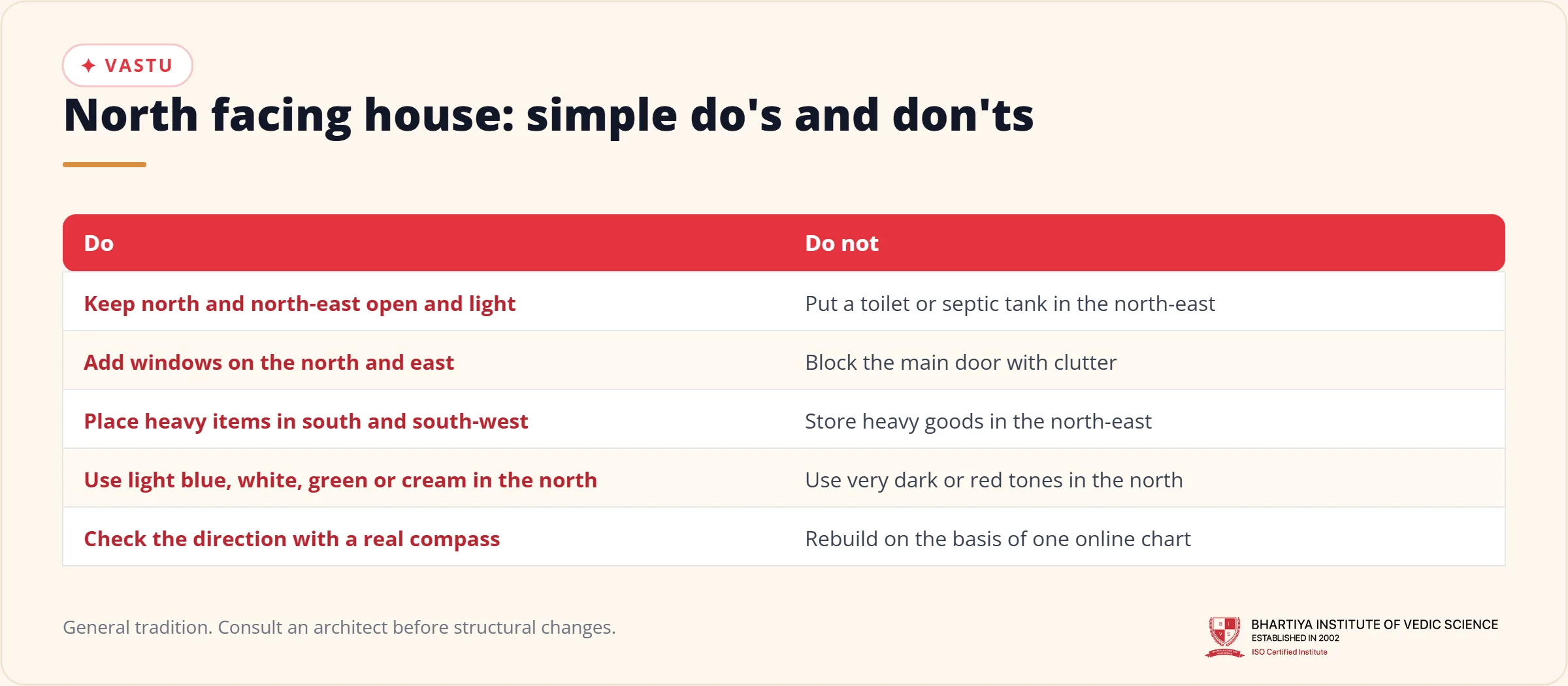
- Do keep the north and north-east free of heavy storage and clutter.
- Do allow more windows and open space on the north and east sides.
- Do keep the main door clean, well lit and easy to open.
- Don't place a toilet, a septic tank or a heavy store in the north-east.
- Don't block the entrance with shoe racks or dustbins.
- Don't make big structural changes on the strength of an online chart alone.
The North-East Corner: What to Keep There
In a north facing house the north-east corner needs special care because it joins the two most favoured directions. Tradition advises keeping it light, clean and open. A small pooja space, a water source such as a clean drinking-water pot, a few plants or simply open floor are all suitable. Avoid a toilet, a heavy cupboard, a store full of old items or a staircase in this corner. If the corner is cut or missing in the plan, teachers consider it a feature to review with an architect, because the north-east is meant to be complete.
Plot Shape, Slope and Open Space
Vastu prefers a square or rectangular plot with clean corners. For a north facing plot, tradition favours a ground level that slopes gently towards the north and east, and leaving more open space on those sides than on the south and west. Taller structures, compound walls and heavy trees are preferred on the south and west. These ideas have a practical side too: light and ventilation come from the open north and east, while the heavier side gives shade and privacy.
Buying a North Facing Flat
In an apartment you cannot choose the plot, but you can read the flat. Check three things before you decide:
- The direction of the flat's own door, not only the building's facing.
- The position of the kitchen and toilets in the flat plan, especially any toilet in the north-east.
- Light and cross-ventilation, which matter in every tradition and every climate.
If a flat has a good position but one weak zone, a few simple changes inside, such as moving furniture or changing what a room is used for, are usually enough. Avoid paying extra for a flat only because of its facing. Compare the whole plan, the price and the neighbourhood first.
Common Myths About North Facing Houses
- "North facing guarantees wealth." No direction guarantees an outcome. Vastu describes traditional preferences, and money depends on many practical factors.
- "A south facing house is always bad." Vastu gives separate layout rules for each facing. Many families live happily in south facing homes.
- "A bad entrance cannot be fixed." Teachers usually suggest simple adjustments to the interior, not demolition.
- "You must pay for expensive items." Good Vastu is mostly about layout, light and tidiness. If anyone insists on costly products, take a second opinion.
How to Check Your Direction Properly
- Use a proper compass and stand at the centre of the entrance, facing outwards.
- Note the direction you face, and keep metal objects away from the compass.
- Cross-check with the floor plan or a satellite map, because phone compasses can be inaccurate indoors.
- Check the road side. The plot facing may differ from the building facing, which a teacher can explain.
If your home faces a different direction, our guide to a south-east facing house shows how another facing is read.
Learning Vastu Properly
If you want to learn how to read a plan with a teacher, the Vastu course at Bhartiya Institute of Vedic Science teaches the zones, the padas and plan reading through live classes, in Hindi and English, with doubt sessions and certificate on completion. Bhartiya Institute of Vedic Science is an ISO Certified Institute, registered under NCT of Delhi, and has been teaching since 2002.
What North Facing House Vastu Can and Cannot Tell You
Vastu is a traditional framework for arranging space in a calm and balanced way. It cannot guarantee wealth, health or happiness, and it should not be used to make costly structural decisions without practical and professional advice. Consult an architect or engineer for any construction change.
Conclusion
A north facing house carries good associations in Vastu, but the best results come from a thoughtful entrance and a clear, open interior. Check the direction carefully, place the rooms by zone, and ignore any claim that sounds like a promise.
To learn to read floor plans yourself, you can book a free 15-minute demo call. Which direction does your main door face?
This article shares traditional Vastu knowledge for educational purposes. It is not a substitute for professional architectural, medical, legal or financial advice.