By Jyoti Chauhan, Content Writer · Reviewed by Gurudev Shrie Kashyap, Founder, Bhartiya Institute of Vedic Science
Key Takeaways
- Panchang basics: a panchang (panchanga) is the daily Hindu almanac, and its name means five limbs: tithi, vara, nakshatra, yoga and karana.
- A lunar month holds 30 tithis, the Moon passes through 27 nakshatras, and 60 karanas fill the month, so no two days read exactly alike.
- One tithi is 12 degrees of gap between Moon and Sun, and its length varies from roughly 19 to 26 hours, which is why festival dates can shift.
- Read a panchang in order, tithi, then weekday, nakshatra, yoga and karana, and always check the city and time zone printed on it.
- This guide teaches you to read the almanac. It does not predict your future.
Every year the same question comes up in homes across India: is Diwali on the 8th or the 9th? One family says the 8th, a neighbour says the 9th, and both are looking at a calendar. The answer sits in the panchang, the almanac that quietly decides when festivals, fasts and ceremonies fall.
Most people only glance at the date and tithi. The rest of the panchang looks like a block of Sanskrit names and clock times. It is not hard once you know what each line measures.
This guide explains the panchang basics in plain language: the five limbs, how each one is calculated, a worked example with sample numbers, and how to read a daily panchang without feeling lost.
What Is a Panchang?
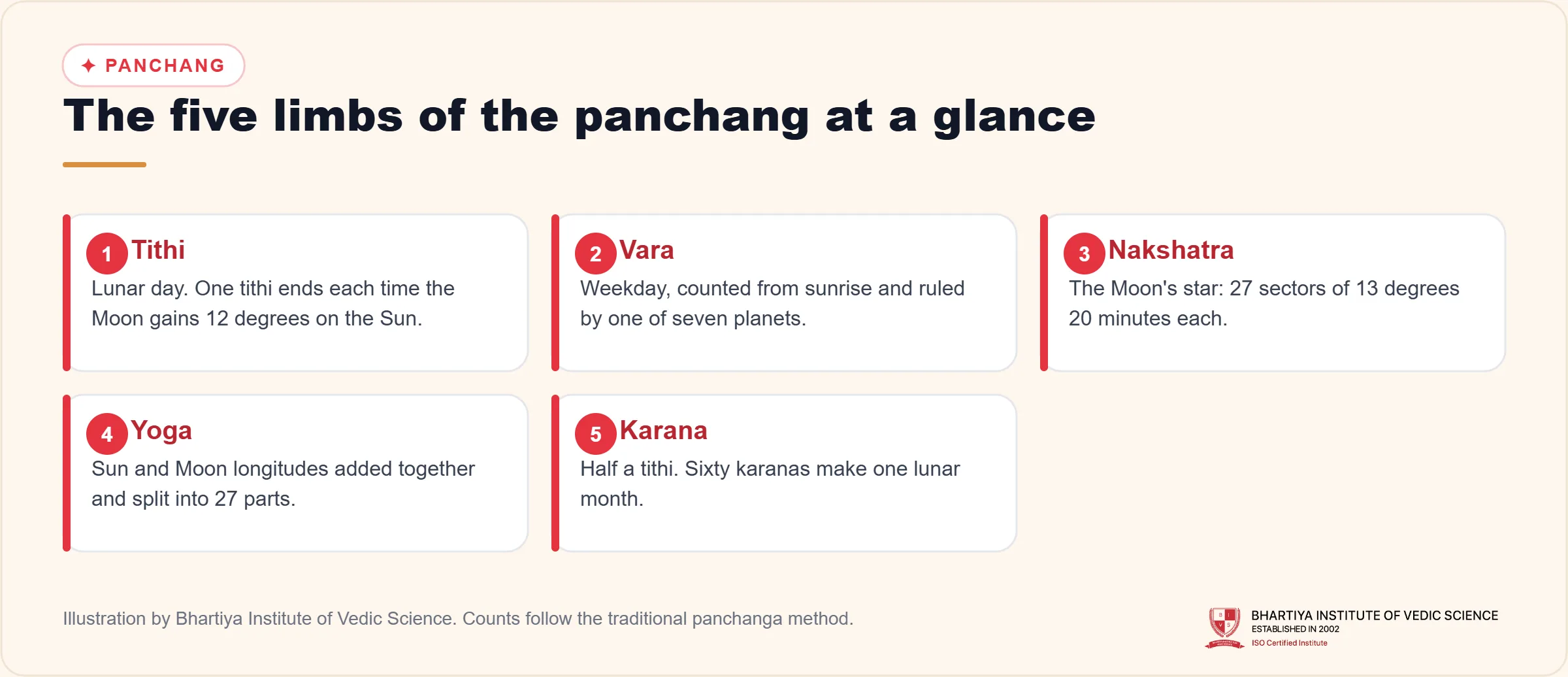
A panchang (also spelled panchanga) is a Hindu almanac that records the position of the Sun and Moon for each day. The word comes from Sanskrit: pancha means five and anga means limb. The five limbs are tithi (lunar day), vara (weekday), nakshatra (the Moon's star), yoga (a Sun-Moon combination) and karana (half a tithi).
Astronomical calculation methods for these limbs appear in old Indian texts such as the Surya Siddhanta, and the use of the panchang for choosing timings is discussed in the Jyotish literature, including the Brihat Parashara Hora Shastra and the Muhurta Chintamani. Modern panchangs apply the same ideas with precise astronomical software.
The panchang sits at the heart of Jyotish, the Vedic study of time. If you are new to the subject, our guide to what Vedic astrology is gives the wider picture.
The Five Limbs at a Glance
Think of the five limbs as five clocks running together. Each clock tracks the Sun and Moon in a different way, and each one changes at its own time during the day.
- Tithi tracks the Moon's phase.
- Vara tracks the weekday and its ruling planet.
- Nakshatra tracks the Moon's position against 27 star groups.
- Yoga tracks the combined movement of Sun and Moon.
- Karana tracks half-tithis in a fixed repeating pattern.
Because all five change at different moments, a single day in the panchang usually lists more than one value for several of them, each with an end time. That is normal, not an error.
Tithi: The Lunar Day
A tithi is a lunar day. It is defined by the angle between the Moon and the Sun. Every time the Moon gains 12 degrees on the Sun, one tithi ends and the next begins. Since a full circle is 360 degrees, a lunar month has 360 ÷ 12 = 30 tithis.
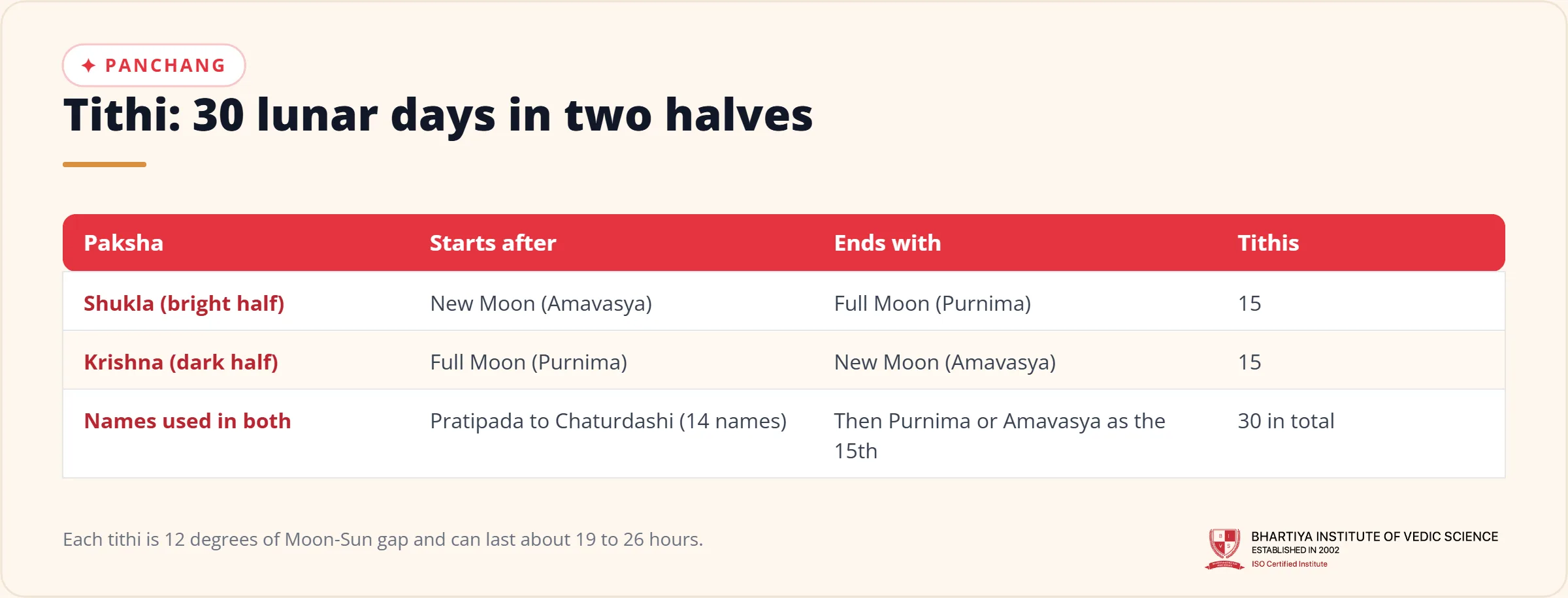
The 30 tithis are split into two halves called pakshas:
- Shukla paksha (bright half): from new Moon to full Moon, 15 tithis, ending with Purnima.
- Krishna paksha (dark half): from full Moon to new Moon, 15 tithis, ending with Amavasya.
Both halves use the same names: Pratipada, Dwitiya, Tritiya, Chaturthi, Panchami, Shashthi, Saptami, Ashtami, Navami, Dashami, Ekadashi, Dwadashi, Trayodashi and Chaturdashi, followed by Purnima or Amavasya as the fifteenth.
Why a tithi does not last 24 hours
The Moon does not move at a steady speed, and the Earth's own path around the Sun is not a perfect circle. So the time the Moon takes to gain 12 degrees changes through the month. A tithi can run from about 19 hours to about 26 hours. It can begin at any hour, which is why the panchang prints a start and end time for each one.
Which tithi counts for the day?
For ordinary use, many almanacs name the tithi that is active at sunrise. But observances differ. Some fasts and pujas are tied to the tithi at midday, at sunset or at midnight. That is the main reason two calendars can give different dates for the same festival. If you want to see this in action, compare how our guides on Ganesh Chaturthi, Pitru Paksha and Bhai Dooj state the tithi window and not just a date.
Vara: The Weekday
Vara is the weekday. Each of the seven days is ruled by one of the seven visible planets, and the day names in many Indian languages come from them. In the panchang the day is counted from one sunrise to the next, not from midnight.
| Weekday | Sanskrit name | Ruling planet |
|---|---|---|
| Sunday | Ravivara | Surya (Sun) |
| Monday | Somavara | Chandra (Moon) |
| Tuesday | Mangalavara | Mangal (Mars) |
| Wednesday | Budhavara | Budh (Mercury) |
| Thursday | Guruvara | Guru (Jupiter) |
| Friday | Shukravara | Shukra (Venus) |
| Saturday | Shanivara | Shani (Saturn) |
Traditional practice links each weekday to a colour and a deity. If you are curious, see which colour to wear on which day, written as tradition and not as a rule.
Nakshatra: The Moon's Star
The zodiac is a 360-degree circle. Dividing it into 27 equal parts gives 27 nakshatras, each 13 degrees 20 minutes wide. The nakshatra in the panchang is the one the Moon is passing through at that time. The Moon takes a little over a day in each, so a nakshatra usually changes once a day.
The 27 are: Ashwini, Bharani, Krittika, Rohini, Mrigashira, Ardra, Punarvasu, Pushya, Ashlesha, Magha, Purva Phalguni, Uttara Phalguni, Hasta, Chitra, Swati, Vishakha, Anuradha, Jyeshtha, Mula, Purva Ashadha, Uttara Ashadha, Shravana, Dhanishta, Shatabhisha, Purva Bhadrapada, Uttara Bhadrapada and Revati.
Each nakshatra is also split into four quarters called padas, each 3 degrees 20 minutes wide. The nakshatra in which the Moon stood at your birth is called your janma nakshatra, and it plays a large role in dasha calculations. You can see how that fits into a chart in our step-by-step guide to reading a kundali.
Yoga: The Sun-Moon Combination
Here the word yoga has a technical meaning that is different from the yoga of postures. In the panchang, a yoga is found by adding the longitudes of the Sun and the Moon and dividing the total into 27 parts of 13 degrees 20 minutes each. Each part has a name, such as Vishkambha, Priti, Ayushman, Saubhagya and Shobhana, and the cycle ends with Vaidhriti.
Yogas appear in muhurat texts as an extra layer when choosing timings. Many are described as supportive and a few as demanding, but most people only need to know what the term is and where to find it on the page.
Karana: Half a Tithi
A karana is exactly half a tithi, or 6 degrees of Moon-Sun gap. A lunar month therefore holds 60 karanas. There are 11 karana names, arranged in two groups:
- Seven repeating karanas: Bava, Balava, Kaulava, Taitila, Gara, Vanija and Vishti (also called Bhadra). They cycle eight times through the month, which uses 56 karanas.
- Four fixed karanas: Shakuni, Chatushpada, Naga and Kimstughna. They occupy the last four half-tithis near the new Moon and the first half-tithi after it.
Vishti, or Bhadra, is the karana that muhurat texts usually advise avoiding for the start of new work. You will see it flagged in many daily panchangs for that reason.
A Worked Example: From Longitudes to the Five Limbs
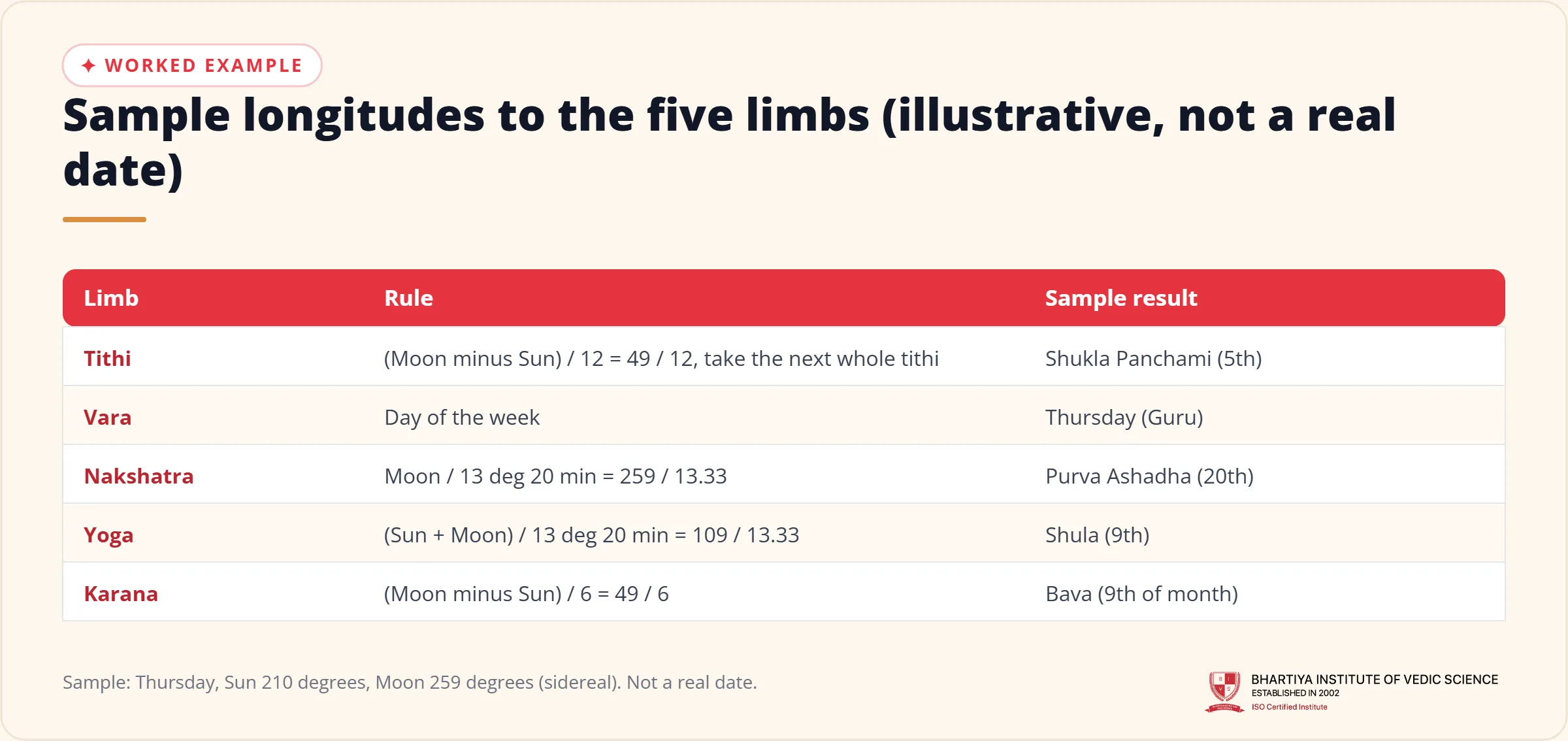
To see how the limbs connect, take sample numbers. These figures are illustrative, not a real date. Suppose that on a Thursday at a given moment the Sun is at 210 degrees and the Moon is at 259 degrees of the sidereal zodiac.
- Tithi: Moon minus Sun is 259 − 210 = 49 degrees. Divide by 12 and take the whole number: 4. The tithi is the next one, the 5th, which is Shukla Panchami.
- Vara: The day is Thursday, so the ruling planet is Guru (Jupiter).
- Nakshatra: 259 ÷ 13.333 is about 19.4. The Moon is in the 20th nakshatra, Purva Ashadha.
- Yoga: 210 + 259 = 469, which is 109 degrees after removing one full circle. 109 ÷ 13.333 is about 8.2, so the 9th yoga applies, Shula.
- Karana: 49 ÷ 6 is about 8.2, so this is the 9th karana of the month, which falls on the repeating cycle at Bava.
The panchang entry for that moment would read: Thursday, Shukla Panchami, Purva Ashadha, Shula yoga, Bava karana. Real panchangs do this for the whole day and list the time at which each limb changes.
How to Read a Daily Panchang
Open any trusted daily panchang. Drik Panchang is widely used and lets you choose your city. Then read in this order:
- Check the city and time zone. Sunrise, tithi end times and muhurats change with location. Always read the entry for your own city, in Indian Standard Time if you are in India.
- Note sunrise and sunset. The panchang day runs from sunrise to the next sunrise.
- Read the tithi and its end time. Check whether the paksha is Shukla or Krishna.
- Read the weekday, nakshatra, yoga and karana with their end times.
- Look at the month name. Two systems exist. In the amanta system the month ends on Amavasya, and in the purnimanta system it ends on Purnima. This changes how a Krishna paksha date is named across regions.
- Scan the time windows. Many panchangs also list Rahu Kaal, Abhijit Muhurat and similar periods. They are derived from sunrise and sunset, so they move every day.
Why Dates Differ Between Calendars
When two panchangs disagree, the cause is usually one of four things:
- Different location. A tithi may end before midnight in one city and after it in another.
- Different rule for the festival. Some observances use the sunrise tithi, others the tithi at midday, evening or night.
- Different zodiac or month system. Amanta and purnimanta, or regional solar calendars, name the same day differently.
- Different calculation method. Traditional formulas and modern ephemeris software can differ by minutes.
When in doubt, follow the panchang your family or temple tradition has always followed, and use a location-based source such as Drik Panchang for the exact timings. Our festival guides, such as Kaal Bhairav Jayanti, list the date, the tithi window and the city used.
Panchang Basics at a Glance
| Limb | What it measures | Count | Size |
|---|---|---|---|
| Tithi | Moon-Sun angle | 30 per lunar month | 12 degrees |
| Vara | Weekday | 7 | Sunrise to sunrise |
| Nakshatra | Moon's position among star groups | 27 | 13 deg 20 min |
| Yoga | Sun longitude plus Moon longitude | 27 | 13 deg 20 min |
| Karana | Half a tithi | 60 per lunar month (11 names) | 6 degrees |
Common Mistakes When Learning the Panchang
- Memorising names before the logic. Learn what each limb measures first. The names follow easily.
- Treating a tithi as a 24-hour day. Always check the end time.
- Ignoring the city. A panchang for another city can be off by hours.
- Mixing Gregorian dates with panchang days. A panchang day starts at sunrise, not midnight.
- Reading it as fate. A panchang is a timekeeping tool. It does not tell you what will happen to you.
Learning the Panchang Properly
The panchang is the foundation for muhurat, festival dates, dashas and transits. Students of Jyotish usually learn to calculate it by hand once, and then rely on software. If you want to learn it with a teacher, the astrology course at Bhartiya Institute of Vedic Science covers the panchang along with charts, houses, nakshatras and dashas, in live classes in Hindi and English, with certificate on completion. Bhartiya Institute of Vedic Science is an ISO Certified Institute, registered under NCT of Delhi, and has been teaching since 2002.
What a Panchang Can and Cannot Tell You
A panchang tells you the state of the Sun and Moon at a given time, and the traditional timings built from it. It cannot tell you your future, and it is not a substitute for professional medical, legal or financial advice. Auspicious and inauspicious timings are traditional guidelines, and practice differs between families and regions.
Conclusion
The panchang looks complicated, but it is only five measurements of the Sun and Moon: the lunar day, the weekday, the Moon's star, a Sun-Moon yoga and half a tithi. Once you know the logic, any daily almanac becomes easy to read, and festival dates stop feeling like guesswork.
If you would like a teacher to take you from the panchang to full chart reading, you can book a free 15-minute demo call or look at the astrology course. Which of the five limbs surprised you most?
This article shares traditional Vedic knowledge for educational purposes. It is not a substitute for professional medical, legal or financial advice.