By Jyoti Chauhan, Content Writer · Reviewed by Gurudev Shrie Kashyap, Founder, Bhartiya Institute of Vedic Science
Key Takeaways
- Sade Sati is the roughly 7.5-year period when Saturn (Shani) transits the 12th, 1st and 2nd signs from your Moon sign. The name literally means "seven and a half".
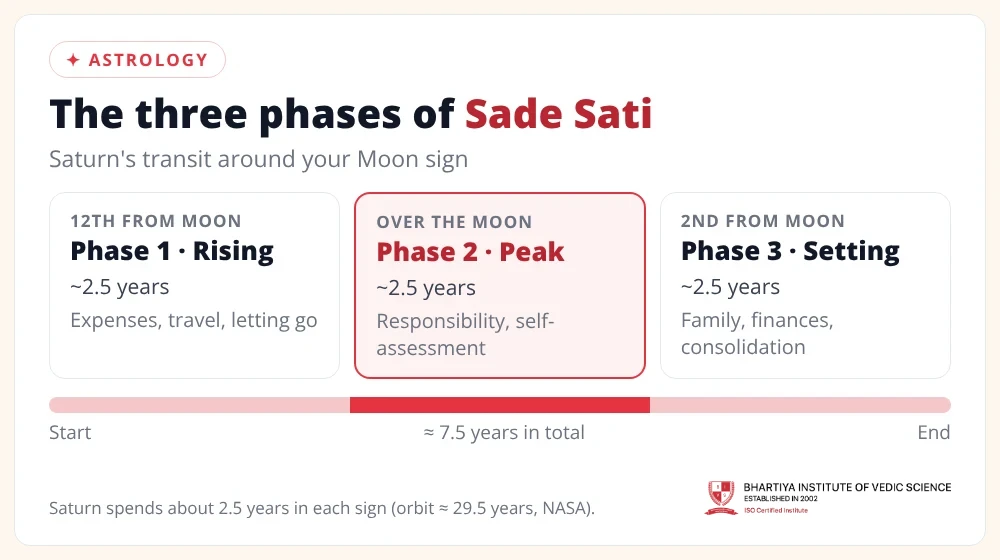
- It has three phases of about 2.5 years each: rising, peak and setting.
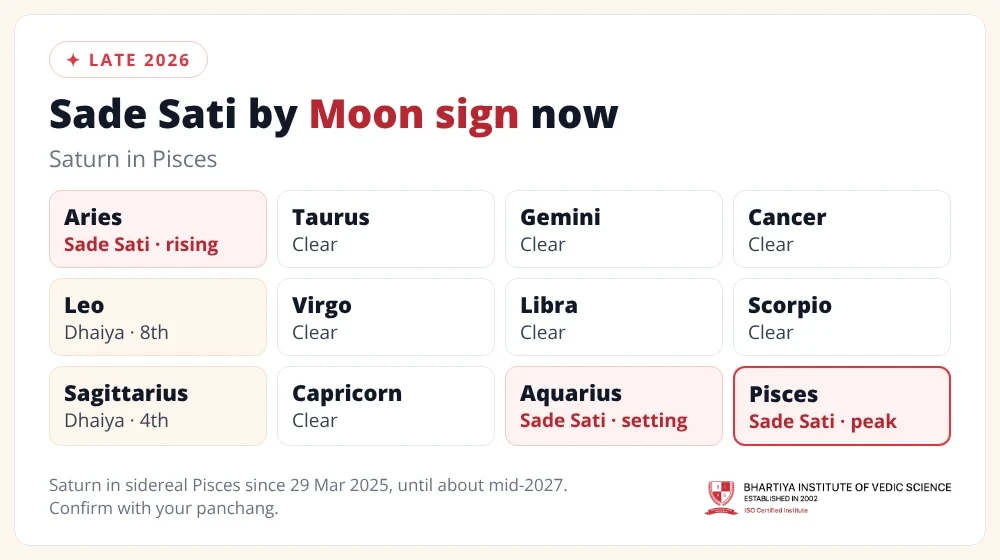
- Saturn has been in sidereal Pisces since 29 March 2025, so in late 2026 Sade Sati is running for Aquarius (final phase), Pisces (peak phase) and Aries (first phase) Moon signs.
- Because Saturn takes about 29.5 years to circle the zodiac, most people experience Sade Sati two or three times in a lifetime.
- Traditional texts frame Saturn as a teacher of discipline, not a punisher. Sade Sati is not a curse, and free, simple practices are all tradition asks for.
Few words in Indian astrology cause as much worry as "Sade Sati". Someone loses a job, a relative falls ill, a business slows down, and a family elder says quietly, "Shani ki Sade Sati chal rahi hai" (Saturn's Sade Sati is running). Before you know it, the period becomes a scapegoat for everything.
The truth is calmer. This guide explains what Sade Sati actually is, how to check whether you are in it, what each of its three phases is traditionally associated with, which Moon signs are in it now, common myths, and the simple traditional practices that help you use the period well.
What Is Sade Sati?
Sade Sati is the period of about seven and a half years during which Saturn transits the sign before your Moon sign, your Moon sign itself and the sign after it. Since Saturn spends about two and a half years in each sign, three signs add up to roughly 7.5 years.
In Vedic astrology the Moon represents the mind and emotions, so Saturn's slow passage around it is traditionally linked with a period of pressure, responsibility, hard work and maturing. If you are new to signs, houses and transits, our guide to what Vedic astrology is covers the basics.
The timing comes straight from astronomy: Saturn takes about 29.5 years to orbit the Sun, as NASA's Saturn overview notes. Divide that by 12 signs and you get roughly 2.5 years per sign.
The Three Phases of Sade Sati
| Phase | Saturn's position | Duration | Themes traditionally associated |
|---|---|---|---|
| 1. Rising (first dhaiya) | 12th sign from the Moon | ~2.5 years | Expenses, travel, sleep and rest, letting go of old patterns |
| 2. Peak (second dhaiya) | Over the Moon sign | ~2.5 years | Pressure on the mind, responsibilities, health discipline, self-assessment |
| 3. Setting (third dhaiya) | 2nd sign from the Moon | ~2.5 years | Family, finances, speech; consolidating lessons learned |
Many astrologers say the peak phase feels the most intense, while the setting phase often brings the rewards of the effort made earlier. Every chart is different, though, and some people barely notice their Sade Sati.
How to Check If You Are in Sade Sati
- Step 1: Find your Moon sign (chandra rashi) from your birth chart. This is not the same as your Sun sign from newspaper horoscopes.
- Step 2: Find the sign Saturn is currently transiting. In late 2026 it is Pisces (sidereal).
- Step 3: If Saturn is in the sign before your Moon sign, in your Moon sign, or in the sign after it, you are in Sade Sati.
Sade Sati by Moon Sign: Who Is in It Now?
Saturn entered sidereal Pisces on 29 March 2025 and stays there until around mid-2027, when it moves into Aries (with a brief return to Pisces during its retrograde later that year). That gives this picture for late 2026:
| Moon sign | Status in late 2026 |
|---|---|
| Aquarius (Kumbha) | Sade Sati, final (setting) phase |
| Pisces (Meena) | Sade Sati, peak phase |
| Aries (Mesha) | Sade Sati, first (rising) phase |
| Leo (Simha) | Ashtama Shani (Saturn in the 8th), a 2.5-year "dhaiya" |
| Sagittarius (Dhanu) | Kantaka Shani (Saturn in the 4th), a 2.5-year "dhaiya" |
| All other Moon signs | Not in Sade Sati or dhaiya |
When Saturn moves into Aries, Aquarius completes its Sade Sati and Taurus begins its rising phase. Exact dates depend on which ayanamsa your almanac uses, so confirm with your own panchang.
What Classical Texts Say About Saturn
Texts such as the Brihat Parashara Hora Shastra describe Saturn as the planet of time, discipline, service, patience and justice. It is slow, serious and demanding, but it is also the planet that rewards steady, honest work over the long term.
The "7.5 years" concept itself is a transit rule that grew up in the later tradition rather than a central teaching of the oldest texts. That is worth knowing, because it puts Sade Sati in perspective: it is one transit among many, read alongside your full chart.
Why Sade Sati Feels Different for Everyone
Astrologers check several factors before saying anything about a person's Sade Sati:
- Saturn's strength in your birth chart: a well-placed natal Saturn often means a more constructive Sade Sati.
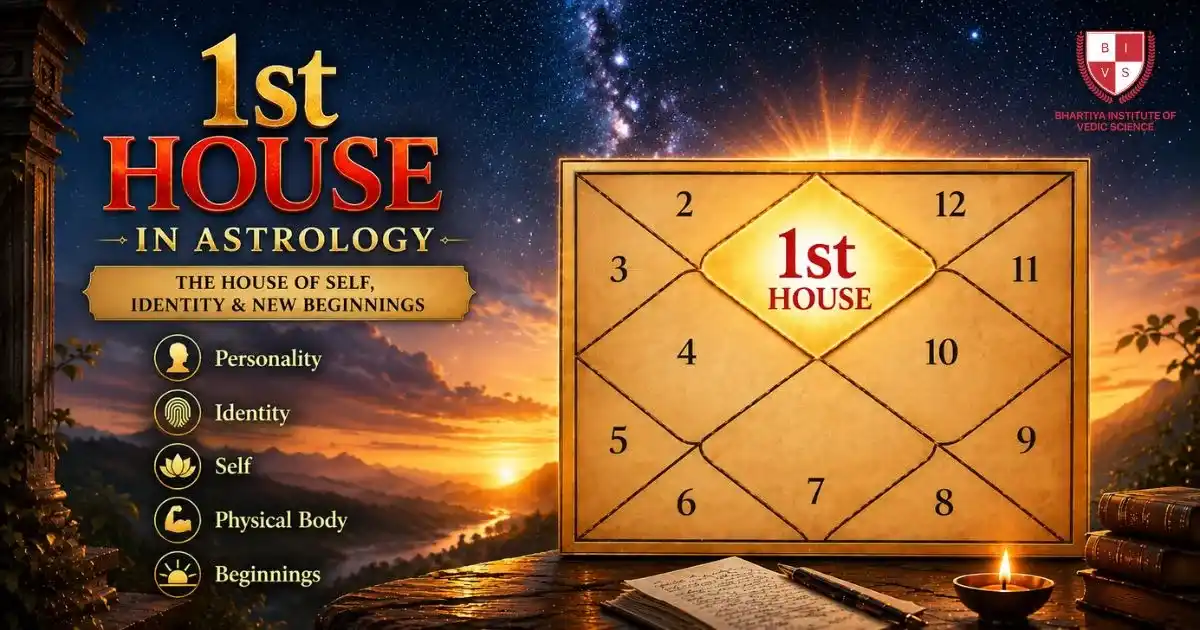
- Your ascendant (lagna): for Taurus and Libra ascendants, Saturn is a yogakaraka (highly beneficial planet), and Sade Sati can bring real progress. Our guide to the 1st house in astrology explains the ascendant.
- Your running dasha: the mahadasha and antardasha often matter more than the transit itself.
- Other transits: Jupiter's position, and the nodes. For example, the Rahu-Ketu transit of late 2026 changes the background for every sign.
- Ashtakavarga scores: a technique that scores how supportive each sign is for Saturn in your chart.
Common Myths About Sade Sati
- "Sade Sati ruins everyone's life." No classical text says this. Many people marry, buy homes, get promoted or start businesses during Sade Sati.
- "You shouldn't marry during Sade Sati." Marriage timing is judged from the whole chart and compatibility, not this one transit. Our guide to the 7th house in astrology explains what astrologers actually look at for partnership.
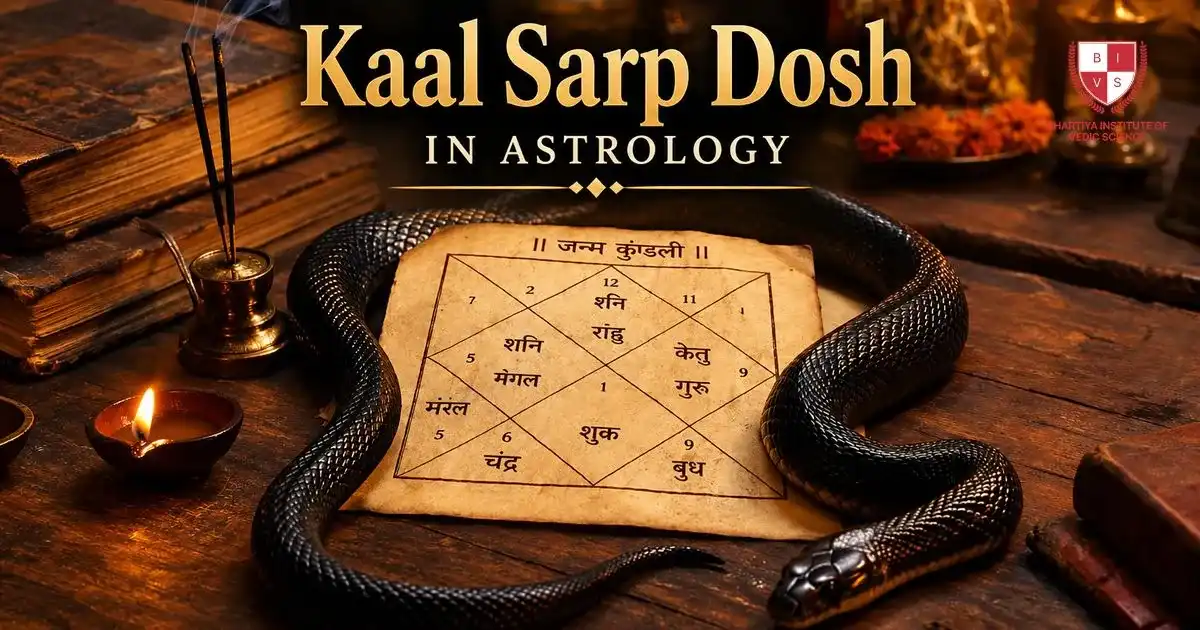
- "It is the same as Kaal Sarp Dosh." They are unrelated: one is a Saturn transit, the other a birth-chart pattern involving Rahu and Ketu. See our calm explainer on Kaal Sarp Dosh.
- "You need a blue sapphire." Gemstones are never a must, and a blue sapphire is a powerful stone that traditional astrologers recommend only after careful study, if at all. No paid remedy is required for Sade Sati.
Simple Traditional Practices During Sade Sati
Traditional guidance for Saturn is about discipline and service. None of it costs money:
- Keep a steady routine: regular sleep, work and exercise. Saturn is linked with consistency.
- Serve others: help elders, workers, the disabled and people in need. Service is Saturn's favourite remedy in the tradition.
- Prayer or mantra, if it suits your belief: the Hanuman Chalisa on Tuesdays and Saturdays, or the Shani mantra "Om Sham Shanaishcharaya Namah".
- Saturday charity: donating food, black sesame, mustard oil or warm clothes, according to family custom.
- Honesty and patience: avoid shortcuts in work and money. Saturn rewards integrity.
- Look after your health: see a doctor for any health concern; do not blame or "treat" illness with astrology.
Sade Sati at Different Ages
Because Sade Sati returns about every 30 years, astrologers often describe each cycle by the stage of life it meets:
- First Sade Sati (childhood or youth): often linked with studies, changes of school or home, and early lessons in responsibility. Children usually feel it through family circumstances rather than directly.
- Second Sade Sati (roughly 30s to 40s): commonly associated with career pressure, financial planning, family duties and building something lasting. Many people describe this as the cycle that "made" them.
- Third Sade Sati (60s onwards): traditionally linked with health awareness, simplifying life, spiritual interests and passing on experience to the next generation.
These are broad traditional observations, not predictions. They are useful mainly because they remind us that the same transit means very different things at different ages, which is why a careful astrologer always reads it in the context of a real life, not a generic list.
Using Sade Sati Well
Many astrologers describe Sade Sati as a period of "earning your stripes": responsibilities grow, shortcuts stop working, and real foundations get built. People often look back on it as the time they became more mature, disciplined and self-reliant. Approaching it with planning rather than fear makes a real difference.
What Sade Sati Can and Cannot Tell You
Sade Sati tells you that a slow, serious planet is moving around your Moon, and that themes of responsibility and discipline may be in focus for a few years. It cannot predict specific losses, illnesses or events, and it is never the whole story of a chart. Anyone who uses Sade Sati to frighten you into buying expensive rituals is not following the tradition.
How to Learn to Read Saturn Transits
Reading Sade Sati properly means combining the Moon sign, natal Saturn, the ascendant, dashas and ashtakavarga. Bhartiya Institute of Vedic Science teaches these techniques in its astrology courses, in live interactive classes in Hindi and English with doubt sessions, recordings and a certificate on completion.
Conclusion
Sade Sati is Saturn's roughly 7.5-year passage around your Moon sign, in three phases of about 2.5 years. In late 2026 it is running for Aquarius, Pisces and Aries Moon signs. Treat it as a season of discipline and growth, keep your routine steady, serve others, and look at your full chart before drawing conclusions. If you would like to read Saturn's transits yourself, explore the astrology course at Bhartiya Institute of Vedic Science and learn to read this yourself.
This article shares traditional astrology knowledge for educational purposes. It is not a substitute for professional medical, legal or financial advice.