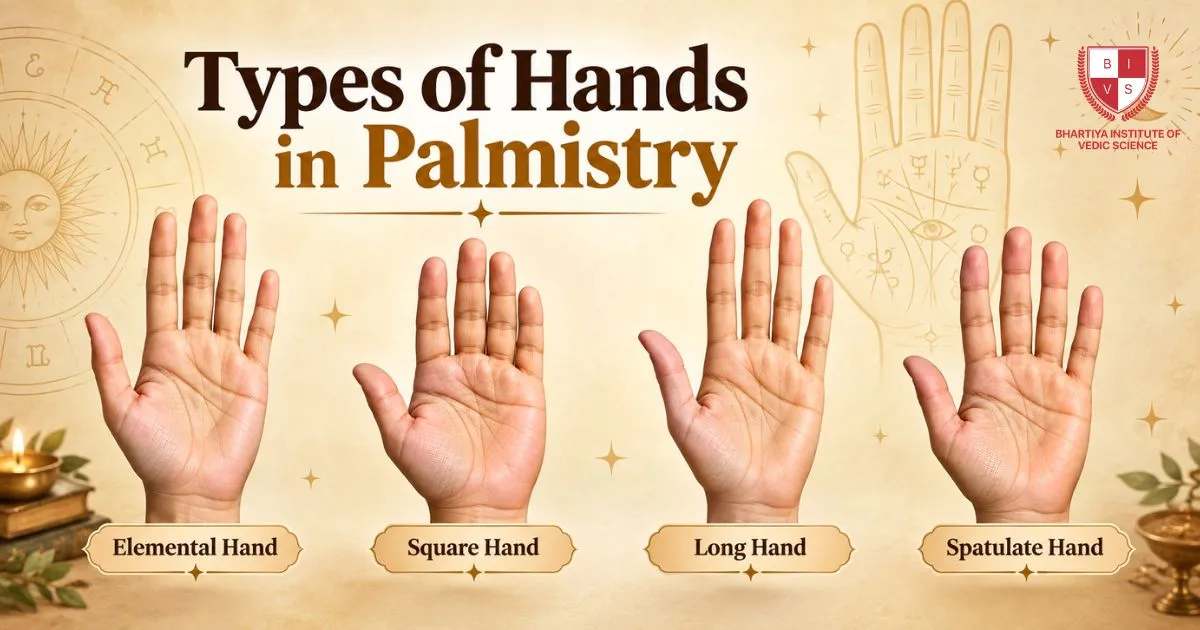
You have probably looked at your palm at least once. Perhaps while searching for your marriage line, life line, career line, or maybe the "M" people get. While studying your hand, perhaps you have never paid attention to something that, in palmistry, is equally important.
The whole point of palmistry is to study various features of the hand, including the lines, to determine the nature, tendencies and different aspects of a person's life. Hence, the shape of the hand, including the fingers, thumb and mounts, play an equally important role in determining the meaning of the complete reading. That's where different types of hands come into the picture. So let's find out what different types of hands are classified under different traditions and determine which one looks similar to yours.
What is Palmistry?
Palmistry, also known as palm reading, is the traditional practice of studying different features of the hand to understand a person's nature, tendencies, strengths, and life patterns.
Most beginners immediately look for the major palm lines in their hand but a complete palm reading can involve much more than just major marriline, life and heart line..
A palmist may observe:
-
Shape of the palm
-
Length and shape of the fingers
-
Thumb
-
Mounts on the palm
-
Texture and flexibility of the hand
-
Major and minor palm lines
-
Different signs and markings
And their understanding begins with understanding what type of hand type you have.
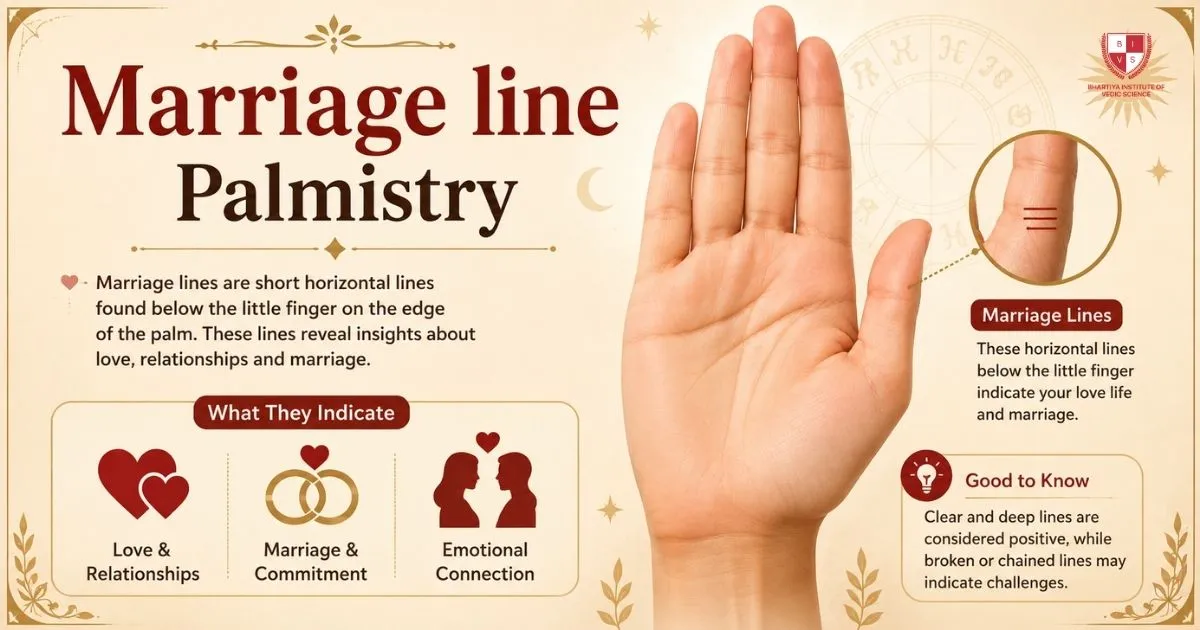
Read More: Marriage Line in Palmistry
Why Do Hand Types Matter in Palmistry?
Let's say there are two people with a similar Head Line. Does it mean that both of these people are going to think and act in the same manner?Well, not necessarily. One might have broad palms and short fingers and the other might have narrow palms and long fingers
The whole point of determining different types of hands in palmistry is to get a general idea of a person's characteristics and how aspects of their life could intertwine. In short, the shape of the hands and the position of the lines are studied to give a person's complete reading.
So, let’s move to understanding the kinds of hands in palmistry.
How Many Types of Hands are there in Palmistry?
This question does not have one fixed answer, A widely used elemental system contains four hand types: Earth, Air, Fire and Water. Classical Western Palmistry also describes seven types: Elementary, Square, Spatulate, Philosophical, Conic, Psychic and Mixed. Chinese Palmistry uses another system based on five elements: Metal, Wood, Water, Fire and Earth. When searching for types of hands in palmistry, it helps to keep in mind that not every system classifies based on elements. Let's start with the 4 most common elemental types of hands:
4 Main Types of Hands in Vedic Palmistry
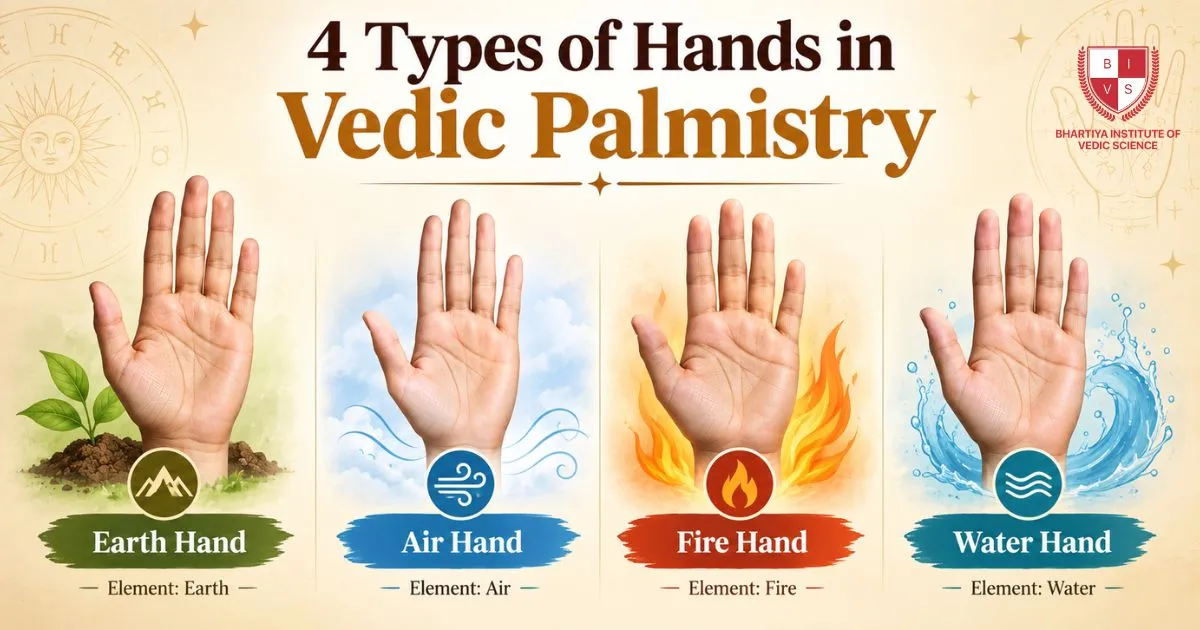
Determining your elemental type of hand is quite simple. First of all, you need to observe the shape of your palm. Is it more square-shaped or is it long? Next, take a look at your fingers. Do they look short compared to your palm or are they long? This tells you about your type of hand, let’s understand the meaning of this with a short table:
|
Hand Type |
Palm Shape |
Finger Length |
Common Meaning |
|
Earth Hand |
Broad or square-shaped |
Short |
Practical, stable, dependable |
|
Air Hand |
Square or rectangular |
Long |
Curious, thoughtful, communicative |
|
Fire Hand |
Long or rectangular |
Short |
Energetic, confident, action-oriented |
|
Water Hand |
Long or narrow |
Long |
Sensitive, creative, intuitive |
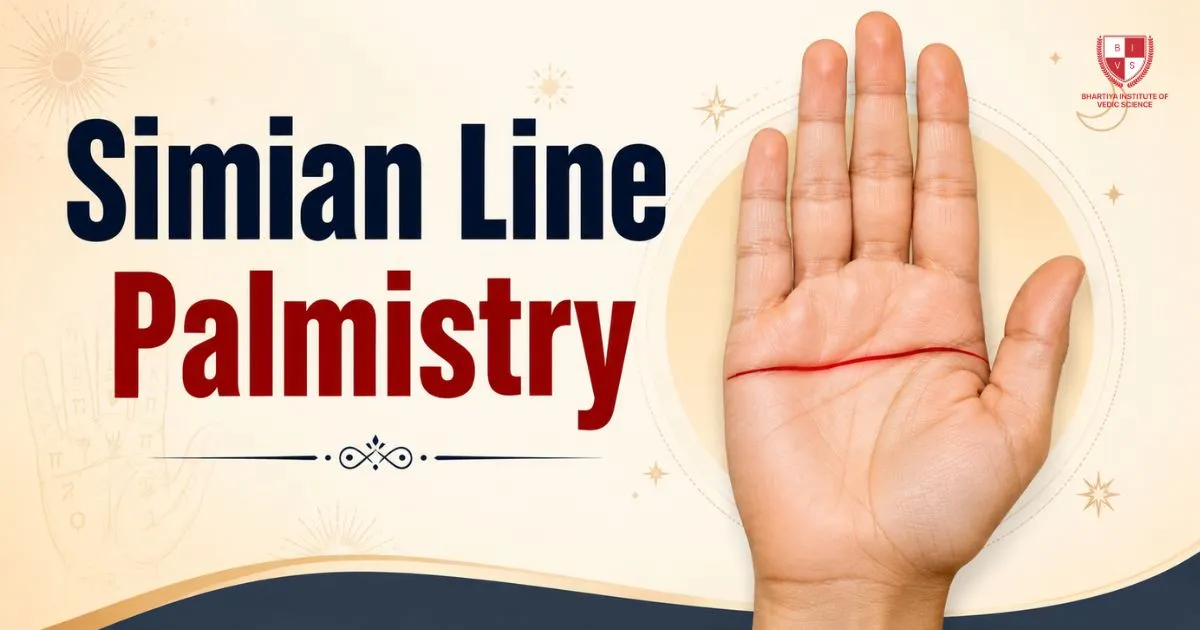
Read More: Simian Line Palmistry
Now, let’s understand each sign briefly:
1. Earth Hand
If your palm is broad/ square-shaped and your fingers are comparatively short, you most likely have an Earth hand.
-
Earth hands are generally associated with practicality, stability and dependability in palmistry.
-
If you have an Earth hand, chances are, you are more likely to find practical solutions rather than thinking of solutions that do not stand a chance in real life.
-
You are likely to stick to your knowledge of things instead of taking risks.
-
Once you make a decision, you stick to it rather than changing your mind often.
-
These are all positive attributes, but at times, the strong need for stability can also prevent you from adapting to change.
Career: In palmistry, Earth hands are often associated with careers that require patience, structure and practical decision-making, such as management, administration, engineering or finance.
2. Air Hand
A square or slightly rectangular-shaped palm with long fingers is generally classified as an Air hand.
-
Air hands are generally associated with being curious, communicative and having a sharp mind in palmistry.
-
You must have a friend in your life who always wants to know how everything works and why everything is happening this way, basically, lots of questions regarding everything… these are the traits of an Air hand.
-
Most Air hands are excellent in conversation and can find a way to communicate with almost anyone.
-
They are also great at finding a unique perspective to view a situation from.
-
On the flip side, a sharp mind can sometimes turn into overthinking.
-
Air hands often find themselves overcomplicating simple things and dwelling on things that are already over.
Whereas Earth asks if something will work, Air is more concerned with how and why it works.
Career: Their curiosity and communication skills are traditionally linked with fields such as writing, teaching, research, marketing, technology and communication.
3. Fire Hand
If you have a long or rectangular-shaped palm with comparatively shorter fingers, you most likely have a Fire hand.
-
Fire hands are traditionally associated with confidence, passion, energy and quick actions in palmistry.
-
If you are the kind of person who gets bored waiting for things to happen and would rather take risks than be predictable, you most likely have a Fire hand.
-
They are ambitious by nature.
-
Fire hands often find themselves in the middle of action rather than taking a step back and observing the situation.
-
At times, it can be extremely beneficial to think before you do. Quick actions without proper observation can lead to mistakes.
Career: Fire hands are traditionally associated with fast-moving careers where initiative and confidence matter, such as entrepreneurship, leadership, sales or management.
4. Water Hand
A hand that is more narrow or elongated with long, slender fingers is traditionally known a a water hand.
-
Water hands are traditionally associated with being sensitive, creative, imaginative and intuitive in palmistry.
-
Most Water hands can pick up on emotions in a room without even trying.
-
Whereas other people will say "I'm okay", a Water hand will most likely detect that something is not right.
-
They are also highly creative and like to think outside the box.
-
However, sometimes being sensitive to everything that happens around you can become overwhelming.You most likely need more time than other people to process things and get a grip on a certain situation.
Career: Their creativity and emotional understanding are traditionally linked with fields such as art, design, counselling, writing and other people-focused or creative careers.
Read More: Broken Heart Line Palmistry
What If Your Hand Looks Like Two Types?
What if your palm looks similar to an Earth hand, but your fingers are a bit too long? What if your fingers look similar to a Fire hand, but your palm shape looks more like an Air hand?
That is completely okay. It is entirely possible that you get characteristics of two types of hands. Instead of trying to classify yourself into one type of hand, observe which characteristics are more dominant. Don't worry as much about the less dominant traits. As mentioned before, palmistry is not just about the lines on your palm. Let's take a look at another popular system of classifying hands in palmistry.
7 Classical Types of Hands in Western Palmistry
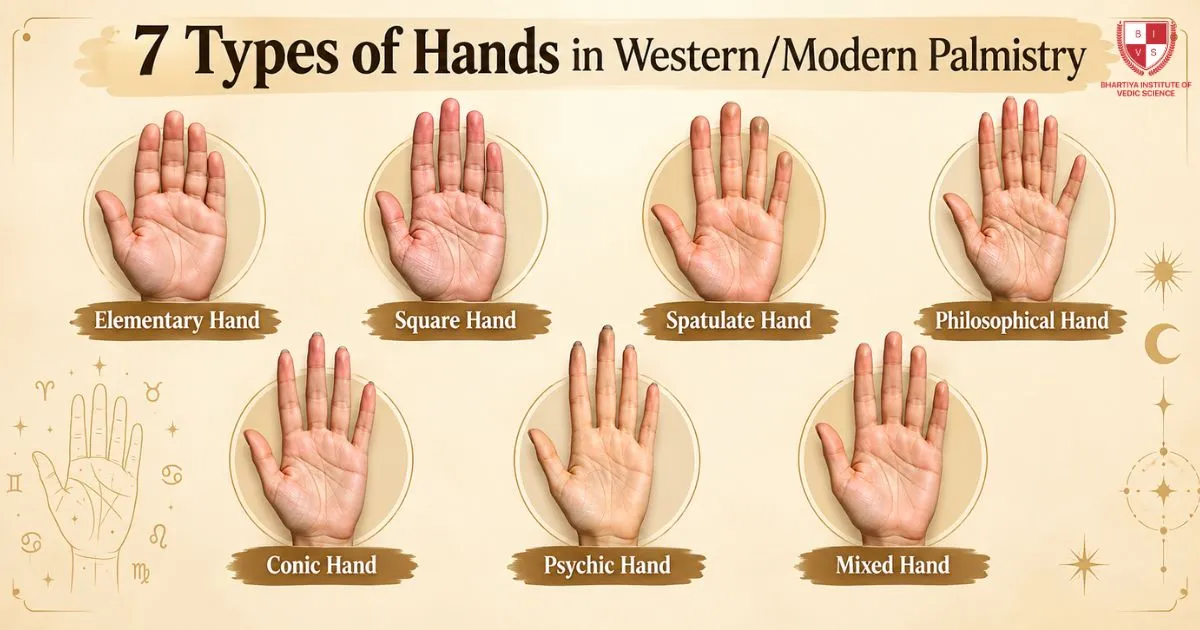
Another popular classification of hands in palmistry is based on 7 types of hands - Elementary, Square, Spatulate, Philosophical, Conic, Psychic and Mixed hands.
While the previous classification was primarily focused on the shape of your palm and fingers, this classification observes the whole hand.
|
Elementary hand |
A broad, thick palm with short fingers. |
|
Square hand |
Noticeably square-shaped |
|
Spatulate hand |
Tapering fingertips |
|
Philosophical hand |
Longer fingers with knuckles |
|
Conic hand |
Narrowing fingers |
|
Psychic hand |
Narrow, delicate fingers |
|
Mixed hand |
One or more characteristics of the above-mentioned hands |
1. Elementary Hand
An Elementary hand is broad and thick with short fingers. The Elementary hand is traditionally associated with simplicity, practicality and straightforwardness. These people most likely prefer getting to the point rather than overcomplicating things.
2. Square Hand
As the name suggests, a Square hand most likely has a square-shaped palm. Square hands are traditionally associated with discipline, organization, responsibility and logic.
These people most likely appreciate getting things done the right way rather than making things up as they go along.
3. Spatulate Hand
The most noticeable thing about the Spatulate hand is that the fingertips become broader towards the ends, almost resembling a spatula.
They are traditionally associated with being active, independent, experimental and fanciful. These people most likely enjoy trying new things out rather than staying within their comfort zone.
4. Philosophical Hand
The Philosophical hand is generally longer with knuckles on the fingers. The Philosophical hand is traditionally associated with being inquisitive, philosophical, reflective and complex. These people most likely appreciate depth rather than simplicity and like to ponder about the deeper meaning of life.
5. Conic Hand
A Conic hand typically has narrowing fingers. They are traditionally associated with being creative, beautiful, imaginative and artistic.
6. Psychic Hand
A Psychic hand is generally long and delicate with long slender fingers. They are traditionally associated with being intuitive, fanciful, idealistic and mystical.
7. Mixed Hand
And lastly, the Mixed hand. One or more fingers might look similar to the types mentioned above.
They are traditionally associated with being versatile and mixed since they exhibit characteristics of other hand types.
Read More: Short Life Line in Both Hands
5 Types of Hands in Chinese Palmistry
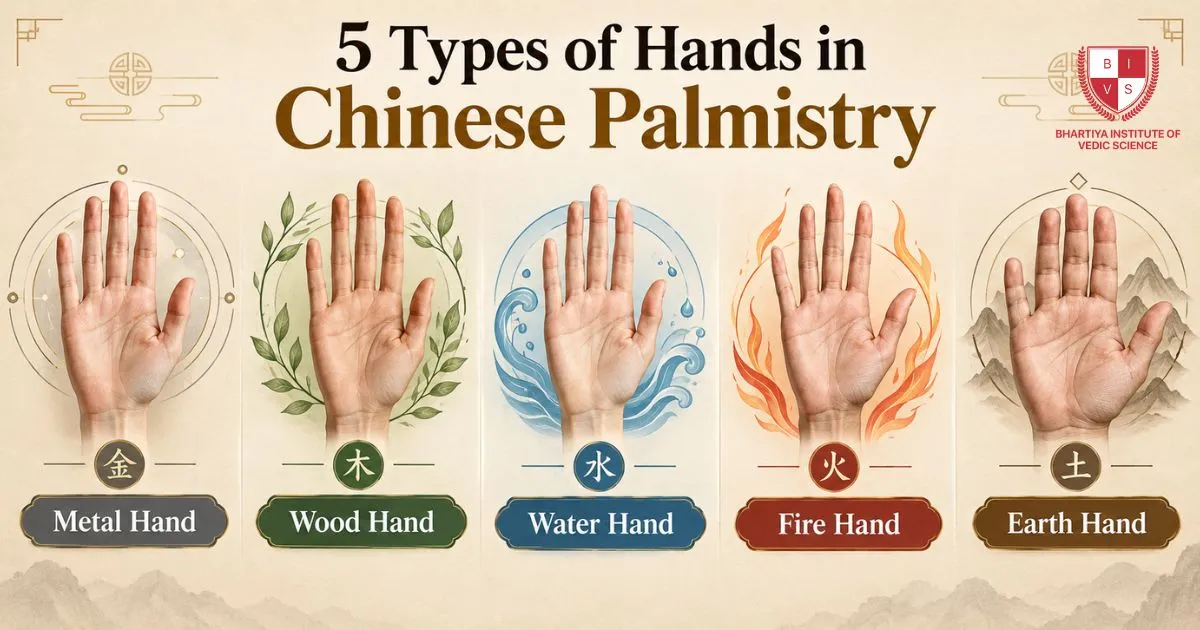
Chinese palmistry classifies hands based on another system which is based on the 5 elements- Metal, Wood, Water, Fire and Earth.
This is a different classification system as compared to the previous one. Metal, Wood, Water, Fire and Earth hands are associated with different characteristics of an individual.
|
Hand Type |
Associated Characteristics |
|
Metal hands |
are associated with being organized and disciplined, |
|
Wood hands |
are associated with growth and expansion, |
|
Water hands |
are associated with being flexible and sensitive, |
|
Fire hands |
are associated with being expressive, |
|
Earth hands |
are associated with being stable and grounded. |
How to Identify:
- A Metal hand is generally described as defined or square and is traditionally connected with structure and discipline.
- A Wood hand tends towards a longer or more elongated appearance and is associated with growth, development and direction.
- A Water hand is generally softer or more rounded in appearance and symbolically connected with adaptability and sensitivity.
- A Fire hand tends towards a more tapered appearance and is associated with expression, activity and intensity.
- An Earth hand appears broad or substantial and traditionally represents stability and groundedness.
- One useful thing to remember here is that Chinese palmistry does not necessarily expect every hand to be a perfectly pure element either. Dominant and secondary qualities may both be considered when analyzing the palm.
Active Hand vs Passive Hand: Which Hand Should You Read?
Now that you know what your hand type is, there is one more thing you need to know before proceeding further. You have two hands, so which one do you read? A popular approach in palmistry classifies hands into active and passive hands.
Active Hand
Your active hand is usually your dominant hand which you generally use to write with. Palmistry classifies your active hand as your current self, decisions you have made and changes you have gone through in life.
So if you are right-handed, your right-hand would be your active hand and if you are left-handed, your left-hand would be your active hand.
Passive Hand
Your passive hand or the non-dominant hand is traditionally associated with your innate self, the qualities you are born with and the potential you carry.
However, your non-dominant hand should not be neglected. Palmistry interprets both hands to gather a complete understanding of the person. Comparing both of them together can give a more detailed insight as compared to interpreting them separately.
Read More: Fish Sign on Palm
How to Identify Your Hand Type Correctly?
By now, you might have a rough idea of what type of hand you have. First of all, observe the shape of your palm. Does it look more square-shaped, narrow, long or broad? Next, observe the length of your fingers. Do they look long or short in comparison to your palm? Lastly, pay attention to the shape of your fingertips. Do they look pointed, squared-off, narrow or wider at the tip?
Finally, examine your hand as a whole instead of looking at individual parts.
And lastly, if your hand looks like a combination of two hand types, do not force it. A combination of characteristics might also be a part of your reading. Now that you know your hand type, let's move on to the next step in the palm-reading process.
Is Hand Shape Enough For A Complete Palm Reading?
No. Your hand shape only gives you the basis of your reading. A complete reading involves analyzing your fingers, thumb, mounts, major and minor lines, signs and symbols. Palmistry becomes interesting once you observe the characteristics of the whole hand rather than studying individual aspects of the hand. The meaning behind a single marriage line or lucky symbol might give you one aspect of your reading but it will not give you the whole story. It is the combination of different parts of the hand that gives you a more detailed and complete reading rather than just identifying a single palm line. That also means that interpreting palmistry from random signs and lines on social media will not give you a complete reading as a complete reading involves multiple aspects of the hand. So let's see what your hand says.
Your Hand Type is Just the Beginning
You start the reading from your hand shape, then move on to your fingers, thumb and mounts, and lastly, your lines and different signs and symbols. When all these aspects are studied together, it gives you a more detailed and complete reading rather than only examining individual aspects of the hand.
If you would like to learn palmistry and discover what different aspects of your hand mean, enroll in the Palmistry Course at Bhartiya Institute of Vedic Science. This course covers hand shape, major and minor lines, mounts, fingers, nails, thumb reading, signs and symbols and complete practical reading of the palm. Instead of learning individual signs, you can learn the whole process of reading a palm. So enroll today and start learning palmistry.