By Jyoti Chauhan, Content Writer · Reviewed by Gurudev Shrie Kashyap, Founder, Bhartiya Institute of Vedic Science
Key Takeaways
- Vedic science is a broad, informal name for the knowledge systems rooted in the Vedas and the texts that grew around them, such as Jyotisha (astronomy and astrology), Vastu, Ayurveda and Yoga.
- The classical frame is simple: 4 Vedas, 6 Vedangas and the Upavedas. The Vedangas are the "limbs" that support the study of the Vedas.
- Jyotisha is one of the six Vedangas, and it is the root of Vedic astrology and the panchang.
- Some subjects taught alongside Vedic subjects, such as tarot, Reiki and graphology, are not Vedic. They come from other traditions.
- You can study Vedic subjects step by step: Sanskrit terms, the panchang, chart reading, then specialised fields.
The phrase "Vedic science" appears in course names, websites and conversations, but few people explain what it actually covers. For some it means astrology. For others it means Ayurveda, yoga or ancient Indian astronomy. All of these are partly right, and none is the whole picture.
This guide sets out what the term means, which subjects belong to it, the classical texts behind it, and a realistic way to study it online. It is written for beginners, and where something is debated or modern, we say so.
What Is Vedic Science?
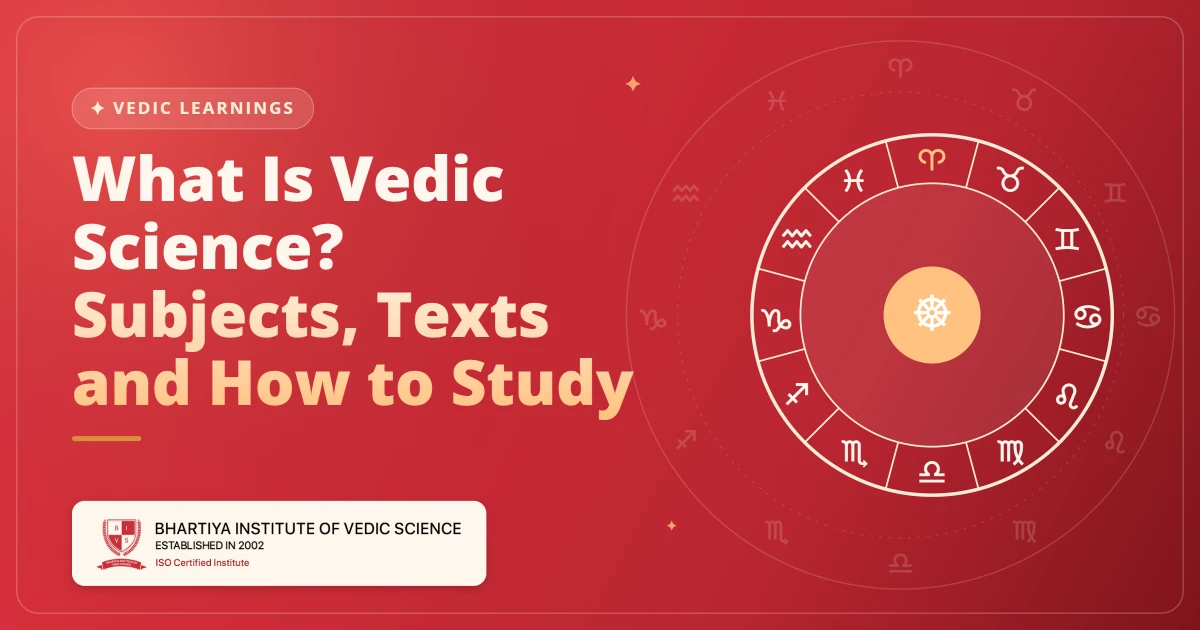
Vedic science is a modern, informal term for the knowledge systems of the Indian tradition that trace their roots to the Vedas, the oldest scriptures of Hinduism. It is not one single subject or a single university discipline. It is a family of subjects that include timekeeping and astronomy, astrology, the science of buildings, medicine, language, ritual and philosophy.
When people say "Vedic sciences", they usually mean the fields below, each with its own classical texts and methods. Because the term is informal, different teachers include different subjects, and you will see lists that differ.
The Vedas: The Base of the Tradition
There are four Vedas:
- Rigveda: hymns of praise and inquiry.
- Yajurveda: verses and prose for ritual.
- Samaveda: melodies and chants.
- Atharvaveda: hymns, spells and practical knowledge, including early ideas on healing.
Around each Veda grew commentaries and technical texts. These supporting subjects are what people loosely call Vedic science.
The Six Vedangas
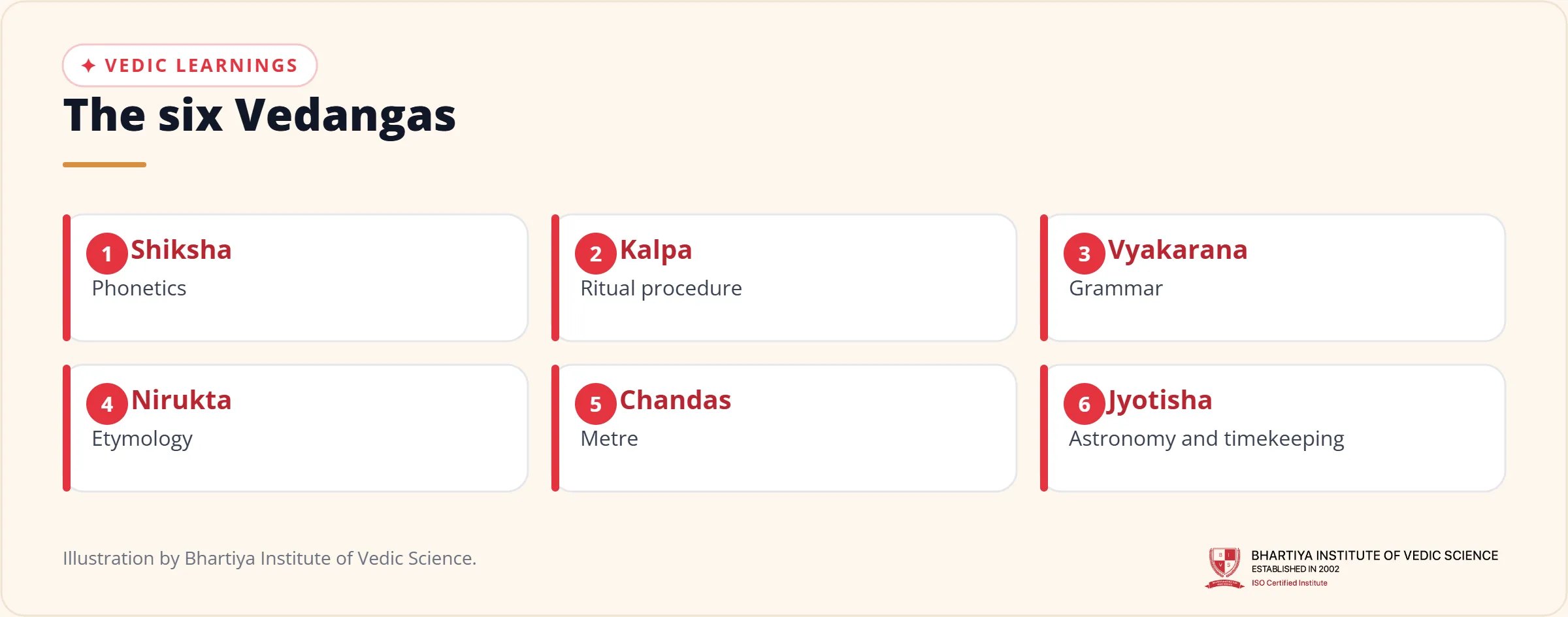
The Vedangas ("limbs of the Veda") are six auxiliary disciplines that developed to help recite, understand and perform the Vedas correctly.
| # | Vedanga | Subject | What it helps with |
|---|---|---|---|
| 1 | Shiksha | Phonetics | Correct pronunciation of the hymns |
| 2 | Kalpa | Ritual procedure | How to perform ceremonies |
| 3 | Vyakarana | Grammar | The structure of Sanskrit |
| 4 | Nirukta | Etymology | The meaning of difficult words |
| 5 | Chandas | Metre | The rhythm of verse |
| 6 | Jyotisha | Astronomy and timekeeping | Choosing the right time for rituals |
Of these six, Jyotisha is the one most closely tied to what we now call Vedic astrology.
Jyotisha: The Vedanga of Time
The Jyotisha Vedanga began as the study of the sky, used to fix the timing of rituals, such as the Sun's and Moon's positions and the calendar. Over centuries it grew into three branches, as later texts describe them: Ganita (mathematics and astronomy), Hora (horoscope astrology) and Samhita (broader omens and natural events).
The oldest surviving Jyotisha text is the Vedanga Jyotisha, although scholars debate its date. Later, the Brihat Parashara Hora Shastra became a standard reference for horoscope astrology. Today, the same tradition gives us the panchang, the almanac of tithi, nakshatra, yoga and karana, which families use for festivals. To see how a day is described, read our guide to panchang basics, and for the astrology that grew from it, see what Vedic astrology is and how to read a kundali.
The Upavedas: Applied Knowledge
Besides the Vedangas, the tradition lists four Upavedas, or "subsidiary Vedas", which cover applied fields. The commonly given list is:
- Ayurveda: medicine and wellbeing.
- Dhanurveda: archery and the art of warfare.
- Gandharvaveda: music and dance.
- Sthapatyaveda: architecture and building, the root of Vastu.
Lists differ slightly between texts, so treat this as the standard teaching and not a universal rule. For the building science, see our guide to what Vastu Shastra is.
A Map of Vedic Subjects Today
| Subject | Classical root | What it studies |
|---|---|---|
| Vedic astrology (Jyotisha) | Jyotisha Vedanga; Parashara tradition | Birth charts, planets, houses, timing |
| Vastu Shastra | Sthapatyaveda | Direction and design of buildings |
| Palmistry (Samudrika Shastra) | Samudrika tradition | Hand lines and body marks |
| Ayurveda | Atharvaveda and later texts | Health and medicine |
| Yoga | Yoga Sutras and Upanishads | Discipline, posture, meditation |
| Sanskrit and grammar | Vyakarana Vedanga | Language of the texts |
Where Numerology Fits
Numerology is a special case. Numbers have always played a role in Indian astronomy and ritual, and the idea that each number belongs to a planet is common in Jyotisha. But the organised system of birth numbers (Mulank and Bhagyank) as taught today is a modern development that combines Indian planetary ideas with Western and Chaldean methods. It is best described as a related subject and not a classical Vedic text. For a beginner's overview, see our numerology guide.
Subjects That Are Not Vedic
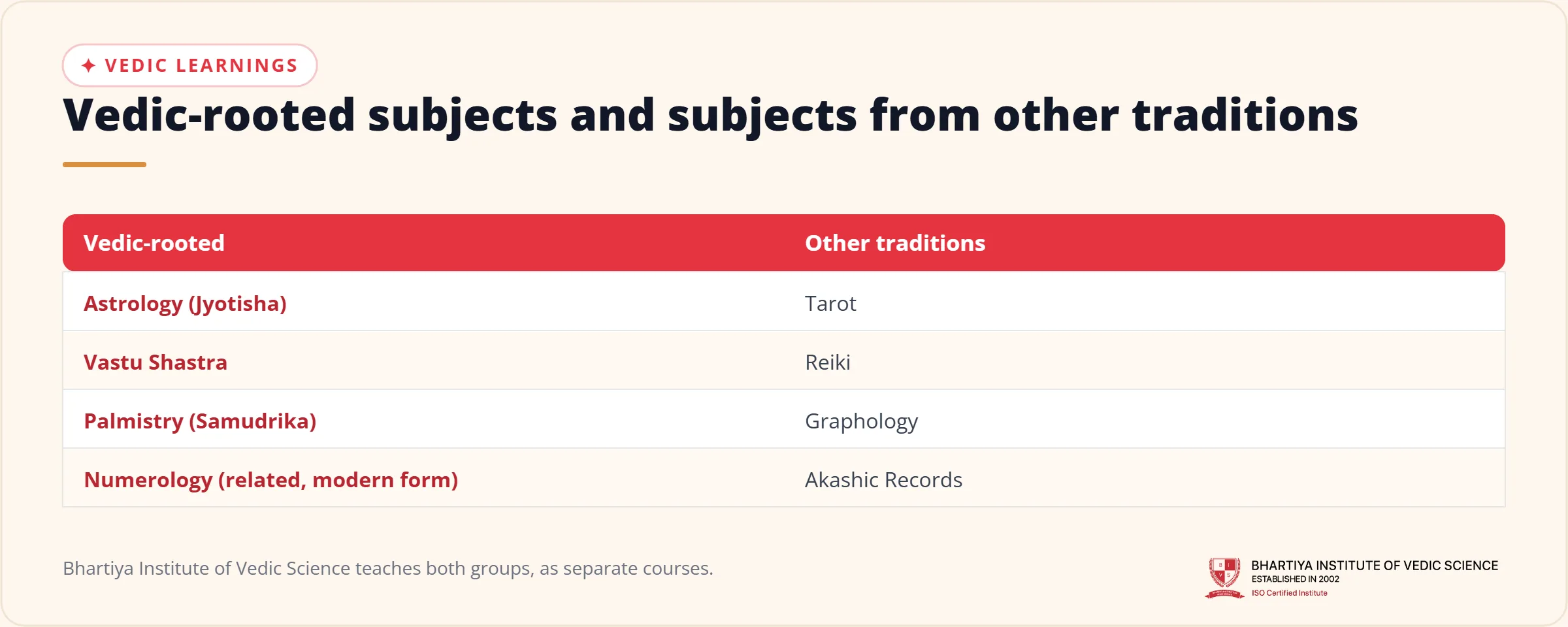
It is important to be accurate here. Some subjects that sit beside Vedic subjects in a modern curriculum come from other traditions:
- Tarot began as a European card game in the 15th century and became a divination tool later.
- Reiki was developed in Japan in the early 20th century by Mikao Usui.
- Graphology is a European study of handwriting that took shape in the 19th century.
- Akashic Records reading draws on a modern spiritual idea influenced by theosophy.
Bhartiya Institute of Vedic Science also teaches these subjects, separately from its Vedic courses, because many learners want to study them together. Calling them Vedic would be incorrect, and a good institute says so.
Is Vedic Science "Science"?
The word science here needs care. Parts of the tradition, such as mathematics, the calendar and astronomy, are rigorous and have contributed real knowledge. Other parts, including astrology, Vastu and numerology, have not been supported by controlled studies, and mainstream science does not accept their predictive claims. A responsible student studies them as traditional knowledge systems, with respect for their history and honesty about what has and has not been tested. They are best used for reflection, culture and personal guidance.
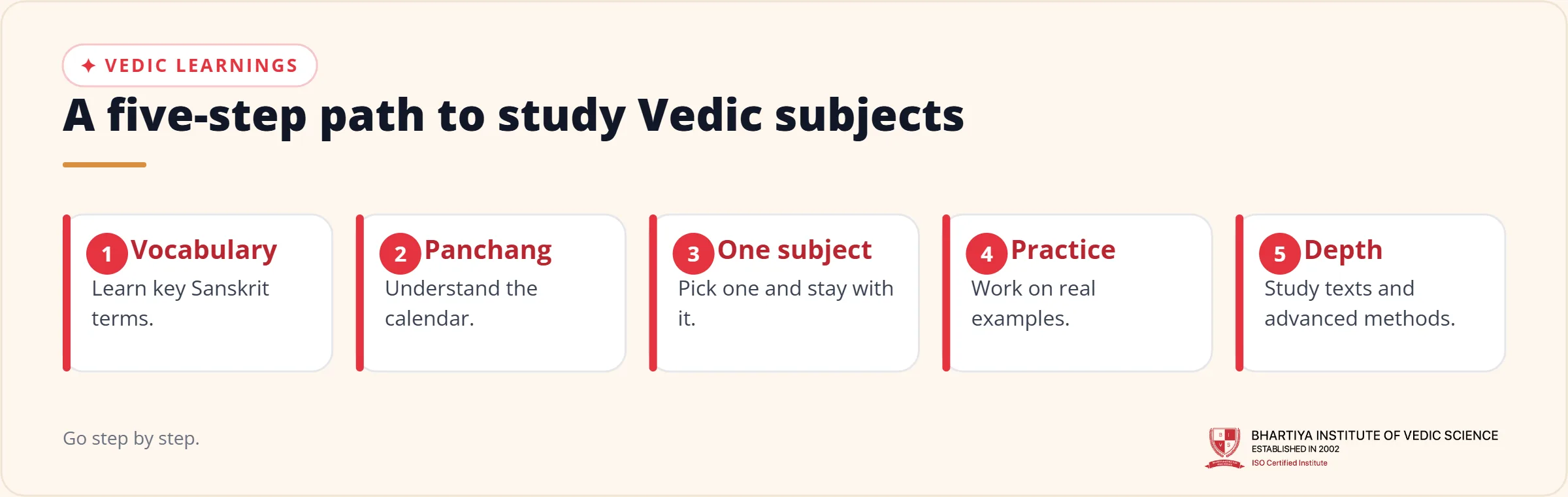
How to Study Vedic Science: A Practical Path
Step 1: Learn the vocabulary
Start with basic Sanskrit terms such as graha, rashi, bhava, nakshatra, tithi and dasha. You do not need fluent Sanskrit, but terms will appear in every subject.
Step 2: Understand the calendar
Learn the panchang first. It is the practical use of Jyotisha and gives context for festivals and timings.
Step 3: Choose one subject
Pick astrology, Vastu, numerology or palmistry, and stay with it for a few months before adding another.
Step 4: Practise on real examples
Work through sample charts, floor plans or palms with a teacher, and keep notes on what you learn.
Step 5: Add depth
Once you have the basics, study the classical texts, divisional charts or advanced techniques.
Key Texts a Beginner Will Meet
You do not need to read these in full, but you will hear the names often, so it helps to know where they sit.
- Rigveda, Yajurveda, Samaveda and Atharvaveda: the four Vedas, the oldest layer of the tradition.
- Upanishads: philosophical texts at the end of the Vedic corpus, concerned with the self and reality.
- Vedanga Jyotisha: a short early text on the calendar and timing of rituals.
- Brihat Parashara Hora Shastra: a major reference for horoscope astrology, attributed to the sage Parashara.
- Surya Siddhanta: an astronomical treatise used for calculating planetary positions.
- Charaka Samhita and Sushruta Samhita: classical works on medicine and surgery.
- Yoga Sutras of Patanjali: the best-known text on yoga practice.
- Mayamata and Manasara: classical works on architecture and Vastu.
Many of these have English translations, but the quality varies, so use a respected translator and, where you can, learn alongside a teacher who can explain the terms.
A Short Glossary for New Learners
| Term | Meaning |
|---|---|
| Graha | Planet, or any heavenly body that influences, in Jyotisha |
| Rashi | Zodiac sign of 30 degrees |
| Bhava | House of the birth chart |
| Nakshatra | One of 27 lunar mansions |
| Tithi | Lunar day |
| Dasha | Planetary period used for timing |
| Muhurat | An auspicious time chosen for an event |
| Shastra | A body of teaching or treatise |
How the Subjects Connect
The subjects are separate, but they share ideas. The five elements appear in Vastu, Ayurveda and Jyotisha. The nine planets appear in astrology and in the planetary meanings used by numerology. The calendar connects astrology with festivals, ritual and agriculture. A student who learns one subject well usually finds the others easier, because the vocabulary overlaps.
That is why many learners start with astrology and then add Vastu or numerology. Our guide to how to learn astrology gives an example of how such a path can look, and the same approach applies to other subjects.
How to Choose Your First Subject
- If you love the sky and timing: start with the panchang and astrology.
- If you are curious about homes and spaces: start with Vastu.
- If you enjoy patterns and calculations: start with numerology.
- If you are drawn to observing people: start with palmistry.
There is no wrong first choice. What matters is steady practice and a teacher who answers your questions honestly.
A Brief Timeline of the Tradition
Dates in early Indian history are debated, so the following is a broad outline and not a precise chronology.
- Vedic period: the hymns of the Rigveda and the other Vedas are composed and passed down orally for many generations.
- Vedanga and Upanishadic period: supporting disciplines such as grammar, phonetics and astronomy are systematised, and philosophical texts appear.
- Classical period: major treatises on astronomy, medicine, architecture and astrology are written in Sanskrit.
- Medieval and later period: commentaries, regional traditions and new methods develop, and knowledge spreads through teachers and schools.
- Modern period: the subjects are printed, translated, taught online and combined with ideas from other traditions.
Why Many People Study These Subjects Today
People come to Vedic subjects for different reasons. Some are drawn by cultural pride and a wish to understand family traditions. Some want a framework for self-reflection. Others hope to guide friends and family, or to build a practice over time. All of these are reasonable, and none requires you to accept every claim of the tradition. A thoughtful student keeps an open mind, asks for the reasoning behind each rule and compares what teachers say with what they observe.
Questions to Ask Before You Enrol
- Who will teach me, and what is their background?
- How many classes are live, and how many are recorded?
- Will I practise on real examples with feedback?
- What happens if I miss a class?
- What support do I get after the course ends?
- Does the institute make honest claims about outcomes?
Studying Online or in a Classroom
Online learning has opened these subjects to people across India and abroad. A good online course offers live classes, doubt sessions and recorded lessons you can revisit. Check three things before you enrol: who teaches, how much practice is included and what support you get after the course. Be careful of any course that promises fixed income or guaranteed clients.
Courses at Bhartiya Institute of Vedic Science
Bhartiya Institute of Vedic Science is an ISO Certified Institute, registered under NCT of Delhi, and has been teaching since 2002. Its live online courses are taught in Hindi and English, with a certificate on completion. As listed on the website in November 2026, the Vedic-rooted subjects include Astrology, Vastu, Numerology and Palmistry, and the institute also offers Graphology, Tarot Card Reading, Reiki and Akashic Records as separate, non-Vedic courses. You can see the full list of topics in the syllabus, and you can try a class first through a free demo call.
Common Misunderstandings About Vedic Science
- "Vedic science means only astrology." Astrology is one branch among many.
- "Everything in it is thousands of years old and unchanged." Many practices, including modern numerology, are newer syntheses.
- "It can predict your future with certainty." No qualified teacher claims this.
- "You need to be fluent in Sanskrit to begin." You do not, although basic terms help.
- "Certificates guarantee a career." Skill, ethics and communication matter more.
What Vedic Science Can and Cannot Give You
Studying Vedic subjects can give you cultural knowledge, a framework for reflection and, with practice, skills you can use to guide others. It cannot give you certainty about the future or guaranteed income. Approach it as a learner first.
Conclusion
Vedic science is best understood as a family of traditional knowledge fields, built on the Vedas and the Vedangas, with Jyotisha, Vastu, Ayurveda and Yoga among its best-known branches. Start with the panchang and one subject, learn the vocabulary and practise steadily.
If you would like to explore with a teacher, you can book a free 15-minute demo call and ask which course fits your goal. Which Vedic subject are you most curious about?
This article is for educational purposes and describes traditional knowledge systems. It is not a substitute for professional medical, legal or financial advice.