By Jyoti Chauhan, Content Writer · Reviewed by Gurudev Shrie Kashyap, Founder, Bhartiya Institute of Vedic Science
Key Takeaways
- To become a Vastu consultant in India, you need classical Vastu knowledge, plan-reading skill, a way to check directions on site, and honest communication. No single degree is required.
- A realistic learning path has five stages: foundations, zones and plans, site practice, case studies and your first consultations.
- In the Vastu course at Bhartiya Institute of Vedic Science, the Advanced level takes about 2 months and the Professional level about 4 months (as of November 2026).
- Vastu consulting is not a licensed profession like architecture. Never advise structural changes without an architect, and never promise results.
- Income depends on skill, reputation and consistency. We do not quote figures, and no course can promise clients or earnings.
Many people first meet Vastu when they build a house. A consultant visits, takes a compass reading, and rearranges the plan in a way that feels calmer and more sensible. Some of those people then ask the next question: could I do this myself, as a profession?
It is possible, but it is a skill profession. It rewards patient study, careful practice and honest conversations, and it punishes shortcuts and big claims.
This guide explains how to become a Vastu consultant in India step by step: what the work involves, the skills to build, how to choose a course, how to start practising and the ethics that protect your clients and your name. If you are at the very beginning, read our guide to what Vastu Shastra is first.
What Does a Vastu Consultant Do?
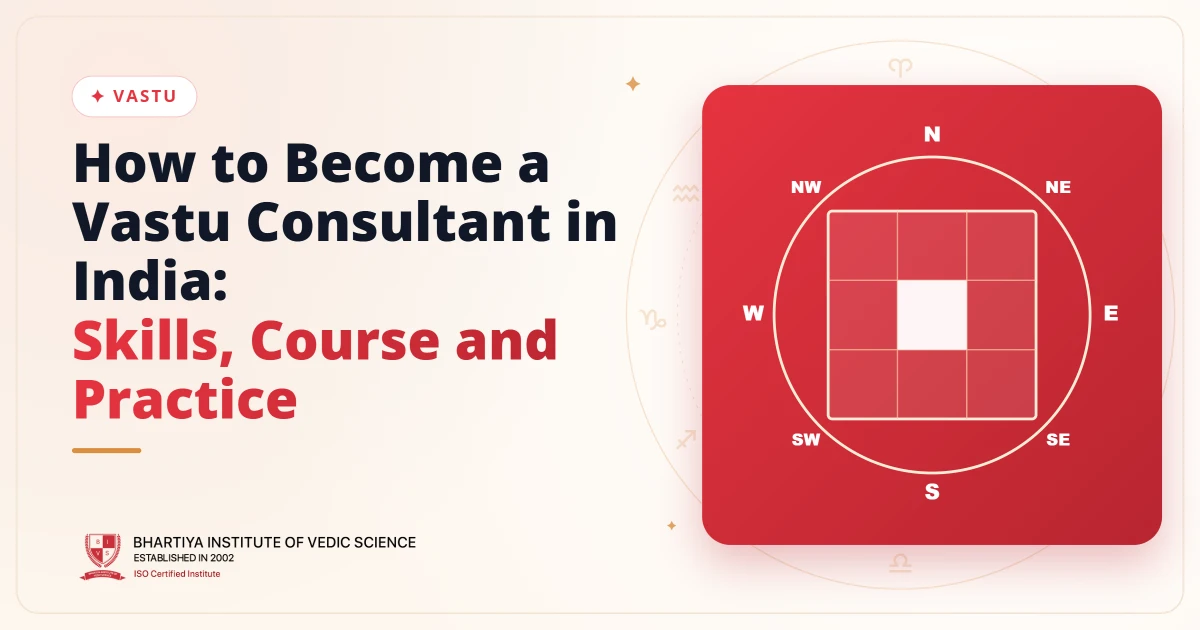
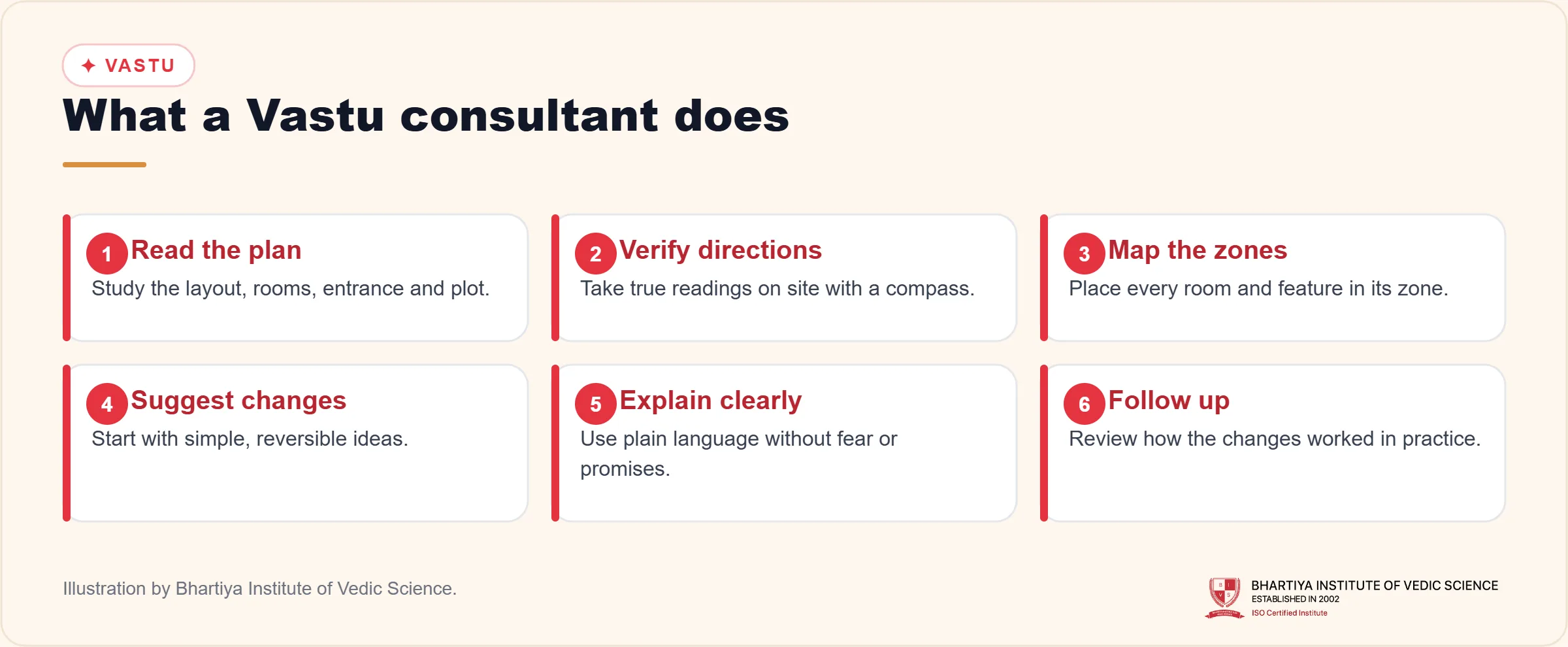
A Vastu consultant studies the layout of a home, shop, office or plot, and advises on how its zones, entrances and rooms can be arranged in line with the principles of Vastu Shastra. A typical consultation involves reading a floor plan, checking directions with a compass, noting the position of key spaces such as the entrance, kitchen, pooja room and toilets, and then suggesting practical changes, in order of ease.
Good consultants spend as much time listening as advising. They ask what the family needs, what can realistically change, and what the budget allows. They also know what they cannot say: they do not diagnose illness, promise wealth or ask people to demolish structures.
Is Vastu Consulting a Good Career?
It can be a satisfying one, but be realistic about it. Demand exists because homes, shops and offices are always being built or changed. At the same time, clients are cautious, trust takes time, and reputation grows through real work. For most people it starts as a part-time practice alongside another job.
It is wise to treat Vastu consulting as a craft. The consultants who last are those who keep learning, keep records and keep their promises small. This article does not give any income figures, because they vary widely and no honest source can promise a number.
Skills a Vastu Consultant Needs
| Skill | What it means in practice | How to build it |
|---|---|---|
| Classical knowledge | Directions, five elements, zones, Vastu Purusha Mandala, entrance padas | Structured study and the classical texts |
| Plan reading | Understanding scale, rooms, walls, slopes and open areas on a drawing | Practise on many sample plans |
| Site verification | Taking true direction readings and measurements | Compass and measuring practice on real sites |
| Construction awareness | Knowing what can and cannot be changed easily | Talk to architects and builders |
| Communication | Explaining advice simply and without fear | Mock consultations and feedback |
| Ethics | Honest limits, privacy and fair practice | A written code of conduct |
Do You Need a Degree?
No formal degree is required to learn Vastu. People come from many backgrounds: homemakers, architects, interior designers, engineers, real-estate professionals, teachers and retirees. A background in architecture, interior design or civil engineering helps with plan reading, but it is not necessary. What matters is a willingness to study carefully and to practise on real cases.
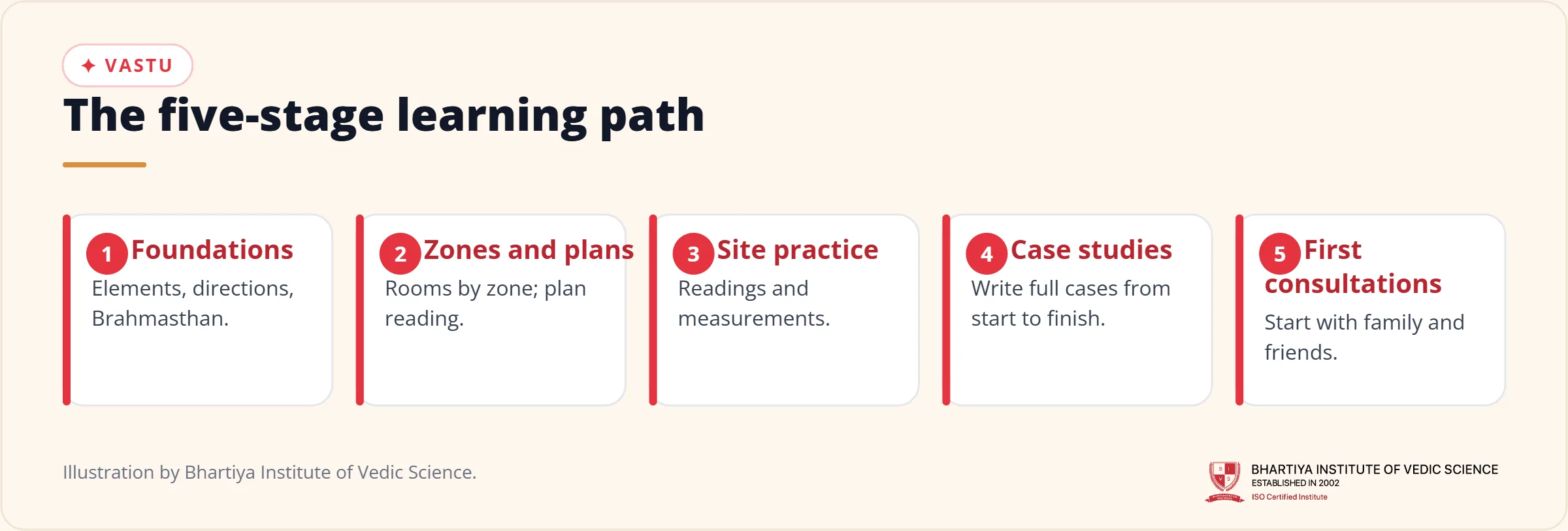
A Five-Stage Learning Path
Stage 1: Foundations
Learn what Vastu is, the five elements (panch tattva), the eight directions and the central Brahmasthan. Read the main ideas in our beginner's guide to Vastu.
Stage 2: Zones and plans
Learn how each zone relates to rooms and activities, and how to divide a plan into 16 zones. Practise with simple room guides such as kitchen Vastu, pooja room direction and main door Vastu.
Stage 3: Site practice
Visit real homes with permission, take readings and compare them with the plan. Learn to measure carefully, to handle a compass correctly and to note what you see.
Stage 4: Case studies
Write up several complete cases, from the first look at the plan to the final list of suggestions. A good example is our guide to a north facing house, which shows how entrance, rooms and colours fit together.
Stage 5: First consultations
Start with family and friends, keep notes and ask for honest feedback. Over time you move to wider circles, with a clear process and clear limits.
How to Choose a Vastu Course
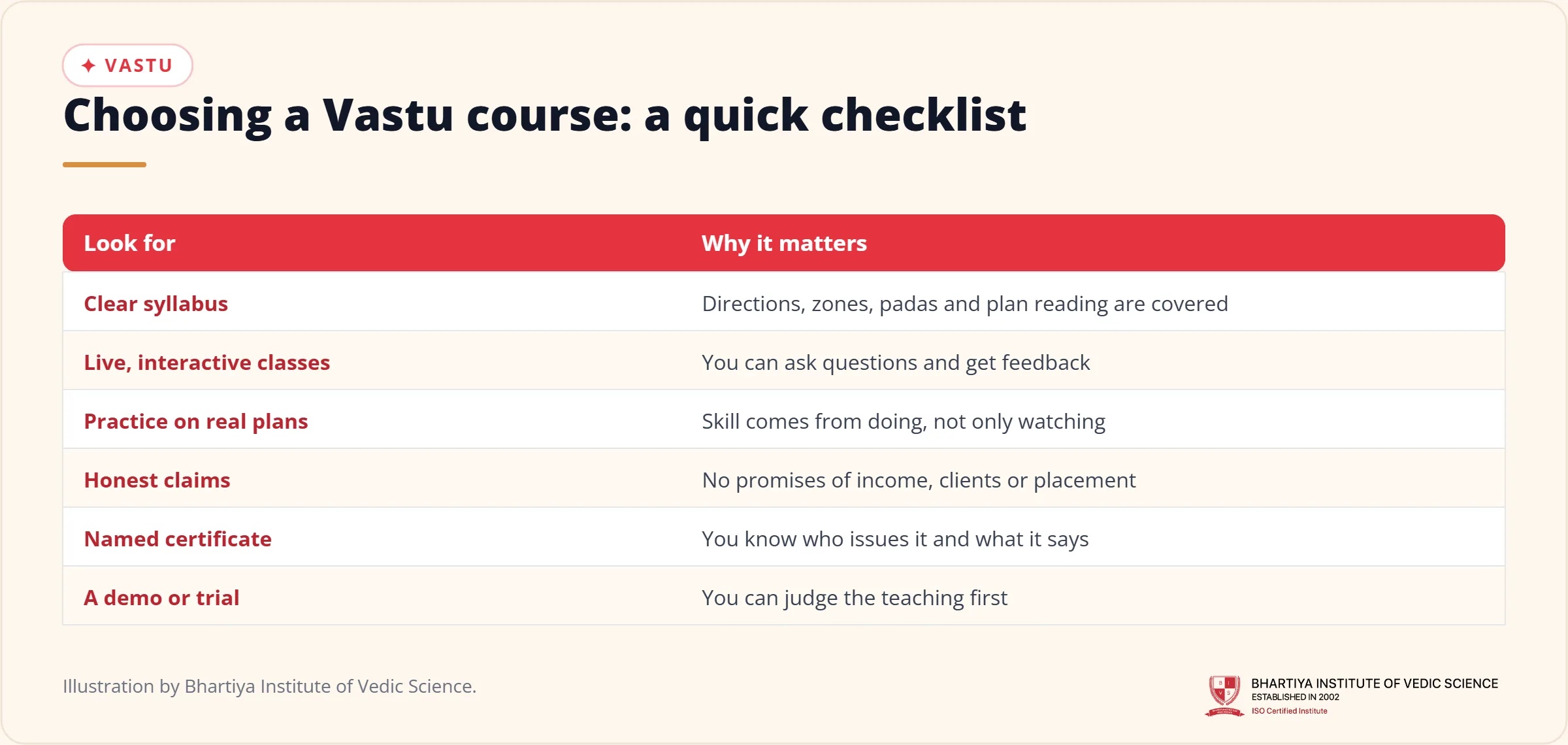
A good course makes the difference between knowing facts and being able to read a plan. Look for:
- A clear syllabus that covers directions, zones, padas and plan reading.
- Live, interactive classes and not only recorded videos, with a way to ask questions.
- Practice on real plans and written case studies.
- Honest claims. Be careful of any course that promises income, clients or placements.
- A certificate that is clearly described, with the issuing institution named.
- A trial or demo so that you can judge the teaching before you commit.
Vastu Course Options at Bhartiya Institute of Vedic Science
The Vastu course at Bhartiya Institute of Vedic Science is taught in two levels, as listed on the course page in November 2026:
- Advanced Vastu Shastra Course: about 2 months.
- Professional Vastu Course: about 4 months.
Classes are live and interactive, with theory and practical sessions, in Hindi and English, with doubt sessions, lifetime access to class recordings and a certificate on completion. Bhartiya Institute of Vedic Science is an ISO Certified Institute, registered under NCT of Delhi, and has been teaching since 2002. You can see how the classes run by booking a free 15-minute demo call. Check the course page for current batch details.
How a Vastu Consultation Works
- Collect information. Get the floor plan, the plot size, the road side and a short list of the family's concerns.
- Verify directions. Take true direction readings at the site and mark the plan.
- Map the zones. Place each room and feature in its zone.
- Prioritise suggestions. Offer simple, reversible changes first, such as rearranging furniture, and mention structural options only as ideas to discuss with an architect.
- Write a clear note. Summarise findings in plain language, without fear and without promises.
- Follow up. Check how the changes worked out practically and update your notes.
Tools of the Trade
- A reliable compass, and the habit of taking readings away from metal.
- A measuring tape or laser measure.
- Graph paper or a plan-marking app.
- A camera or notes app to record the site.
- A written template for your consultation notes.
Homes, Shops and Offices: Different Clients, Different Questions
Most beginners start with homes, because the family wants calm rooms and a practical layout. Shops and offices bring different questions. For a shop, clients ask about the entrance, the counter and the way customers move. For an office, they ask about the position of the owner's seat, the reception and the work areas. The principles are the same, but the practical limits are tighter, because rent, fittings and building rules often cannot be changed. A good consultant learns to work within these limits and to suggest changes that fit the real space.
How to Write a Consultation Note
A clear written note builds trust and protects you. Keep it short, in plain language, and use the same structure every time:
- Details: date, address, plot size, facing and who attended.
- What is working: start with the strengths of the plan.
- Points to review: list each concern by zone, with a short reason.
- Suggested adjustments: in order from easiest to hardest, with a note that structural ideas need an architect.
- Limits: a line stating that Vastu is traditional guidance and not a guarantee.
Questions Clients Usually Ask
Expect the same questions again and again, and prepare calm, honest answers. "Will this bring me money?" is answered with the limits of Vastu. "Do I have to break a wall?" is answered with the simplest option first. "Another consultant said something different" is answered by explaining that schools differ, and by showing your reasoning from the plan. Clients trust consultants who can say "I do not know" and "please check with your architect" when they need to.
A Sample 12-Month Plan
- Months 1 to 2: foundations and zones through a structured course.
- Months 3 to 4: plan reading and site practice at friends' and family homes.
- Months 5 to 6: case studies, a note template and a study group for feedback.
- Months 7 to 9: first consultations with clear limits and written notes.
- Months 10 to 12: review your cases, correct your mistakes and consider the next course level.
This is a sample, not a promise. Your pace will depend on the time you can give.
Ethics and Responsible Practice
Because Vastu touches homes, families and money, ethics are not optional.
- No fear. Never tell clients that a direction will bring illness, loss or misfortune.
- No health or wealth guarantees. Vastu offers traditional guidance, not medical or financial advice.
- Respect the architect. The title and practice of an architect are regulated in India under the Architects Act, 1972, and details are on the Council of Architecture website. A Vastu consultant should not sign off drawings or structural work.
- Be transparent. Explain your process and your fee structure before you start.
- Protect privacy. Keep client plans and details confidential.
- Do not push products. Recommend low-cost, practical changes and avoid selling items.
Building a Practice Over Time
Start with a handful of consultations for people you know and document each one. Ask for feedback and permission before you share any story. Offer a short talk or workshop in your area, write simple explainers on what you have learned, and keep your claims modest. Over a year or two, a reputation built on careful work and fair dealing becomes the main source of new clients. If you are also interested in a number-based profession, see our guide on how to become a numerologist.
Working Alongside Architects and Interior Designers
The most useful professional relationships for a Vastu consultant are with architects, interior designers and builders. They know what is structurally possible, what the local rules allow and what a change will cost. A consultant who can discuss a plan in their language, and who respects their decisions on safety and construction, will be invited back. Make it a habit to present your suggestions as options to review together, not as orders.
Keep Learning After the Course
No course ends the learning. Re-read the classical texts, revisit your old cases after a year, and compare your notes with other practitioners. Attend workshops, study other traditions respectfully and keep a list of questions that your cases raise. A consultant who is still curious after five years is usually the one clients trust most.
Common Mistakes New Consultants Make
- Starting without enough practice. Study several full plans before you advise anyone.
- Over-promising. One broken promise damages a young reputation.
- Recommending demolition. Start with the easiest change and respect the family's budget.
- Using online charts blindly. Check every reading on site.
- Working alone with no feedback. A teacher or study group catches errors early.
What Becoming a Vastu Consultant Can and Cannot Give You
Study and practice can give you a respectable skill, a way to help people arrange their homes with care, and a possible profession over time. It cannot guarantee income, clients or placement, and no consultant can promise outcomes to the people they serve. Always combine tradition with practical advice from qualified professionals.
Conclusion
Becoming a Vastu consultant is a matter of steady study, careful practice and honest conversation. Learn the foundations, read many plans, practise on real sites, and keep your promises small.
If you would like a teacher to guide you through the stages, you can book a free 15-minute demo call or look at the Vastu course. Which stage of the path are you at right now?
This article shares traditional Vastu knowledge for educational purposes. It is not a substitute for professional architectural, medical, legal or financial advice.