By Jyoti Chauhan, Content Writer · Reviewed by Gurudev Shrie Kashyap, Founder, Bhartiya Institute of Vedic Science
Key Takeaways
- The Major Arcana is the set of 22 tarot cards numbered 0 (The Fool) to 21 (The World), each showing a big life theme or turning point.
- They are often learned as the Fool's Journey in three acts: cards 0 to 7, 8 to 14 and 15 to 21.
- Every card has an upright and a reversed meaning, and dramatic names such as Death and The Tower rarely mean literal disaster.
- A Major Arcana card in a spread usually signals a bigger theme than a Minor Arcana card.
- Tarot is a tool for reflection, not a guarantee of future events.
Pull out any tarot deck and the first cards people look for are the dramatic ones: Death, The Tower, The Devil, The Lovers. They carry the biggest names and the most worry. Yet almost every beginner reads them wrongly the first time.
The Major Arcana is the heart of tarot. These 22 cards describe the great themes of life: beginnings, choices, change, loss, hope and completion. Once you know what each one stands for, the rest of the deck makes more sense.
This guide gives you the Major Arcana meanings in a clear table, card by card, with the classic image, the upright and reversed meaning and a reflection question for each. It builds on our beginner guide to tarot card reading and on our guide to the Minor Arcana suits.
What Is the Major Arcana?
The Major Arcana is the group of 22 trump cards in a tarot deck. In the Rider-Waite-Smith deck, which is the model for most modern decks, they run from 0 The Fool to 21 The World. The word arcana means secrets. A Major Arcana card in a reading usually points to a significant theme, a lesson or a turning point, in contrast to the Minor Arcana, which covers daily detail.
The Fool's Journey: Three Acts
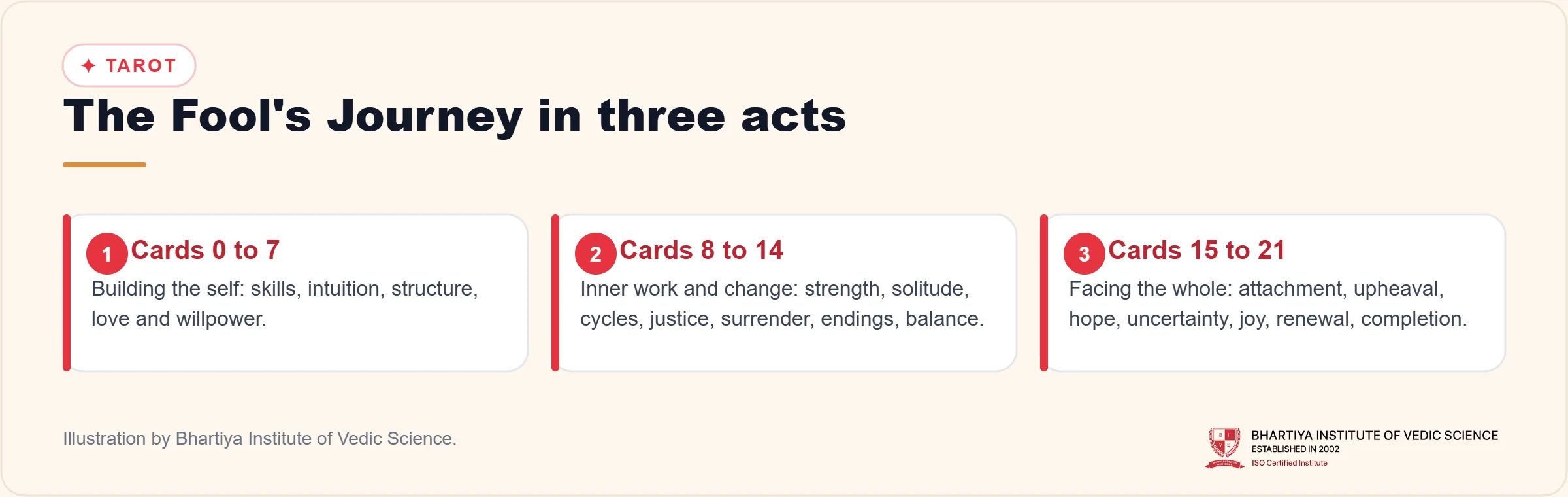
Many teachers read the Major Arcana as a story, called the Fool's Journey, in which The Fool travels through all the cards and ends as The World. It helps to divide the story into three acts:
- Act 1, cards 0 to 7: building the self. The Fool meets skills, intuition, nurture, structure, tradition, love and willpower.
- Act 2, cards 8 to 14: looking inward and meeting change. Strength, solitude, cycles, justice, surrender, endings and balance.
- Act 3, cards 15 to 21: facing the whole. Attachment, upheaval, hope, uncertainty, joy, renewal and completion.
All 22 Major Arcana Cards at a Glance
This table gives traditional keywords in the Rider-Waite-Smith system, where Strength is card 8 and Justice is card 11. Some older decks reverse those two numbers, so check your own deck.
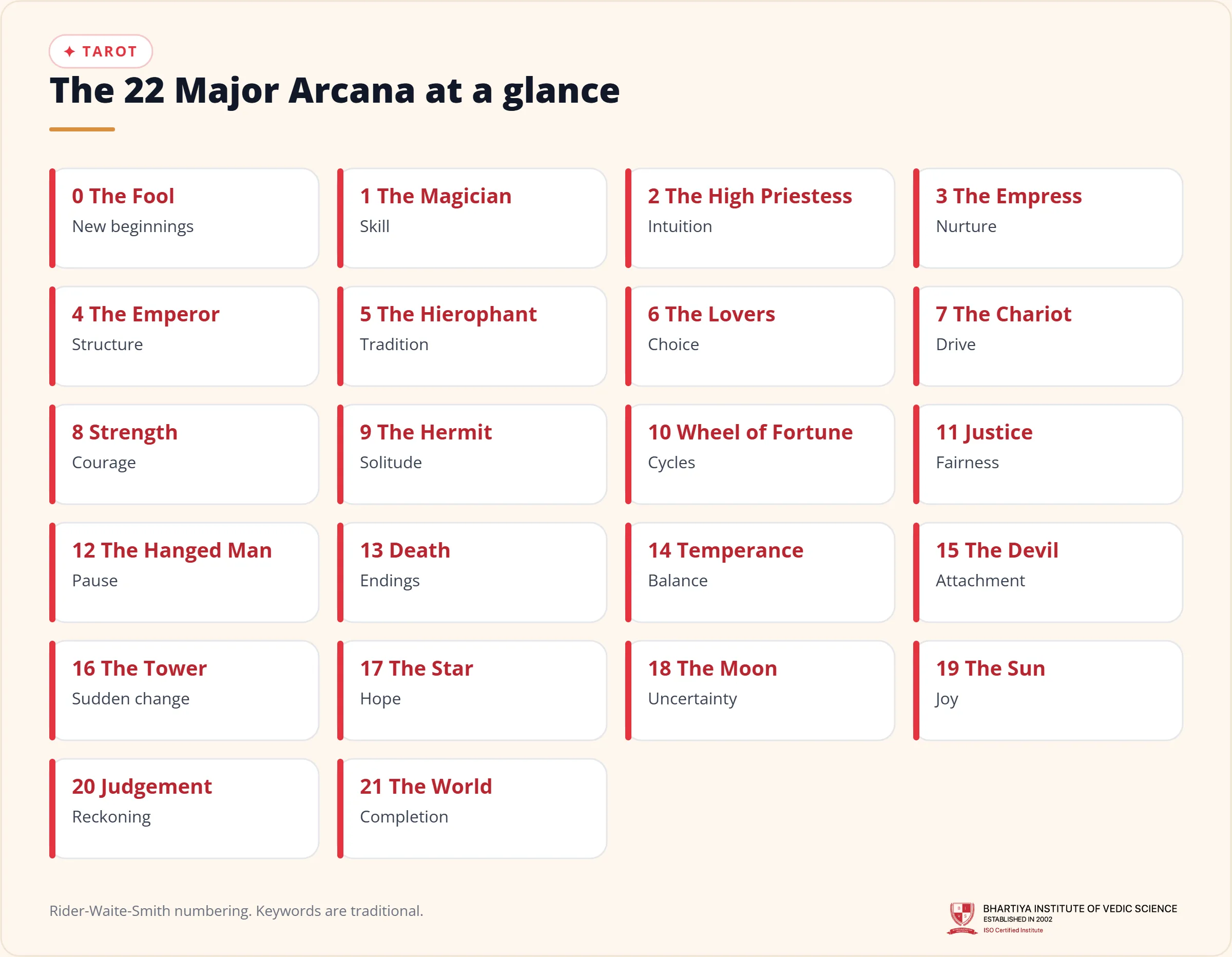
| No. | Card | Upright | Reversed |
|---|---|---|---|
| 0 | The Fool | New beginnings, trust, a leap of faith | Recklessness, hesitation, fear of starting |
| 1 | The Magician | Skill, will, resourcefulness | Scattered effort, trickery, unused talent |
| 2 | The High Priestess | Intuition, inner knowing, patience | Ignoring instinct, secrets, noise |
| 3 | The Empress | Nurture, creativity, abundance | Smothering, creative block, neglecting self-care |
| 4 | The Emperor | Structure, authority, stability | Rigidity, control, weak boundaries |
| 5 | The Hierophant | Tradition, teaching, shared values | Rebellion, outdated rules, learning alone |
| 6 | The Lovers | Choice, values, union | Misalignment, indecision, avoiding a choice |
| 7 | The Chariot | Drive, willpower, direction | Lost direction, forcing things, no control |
| 8 | Strength | Courage, patience, gentle power | Self-doubt, frustration, forcing control |
| 9 | The Hermit | Solitude, reflection, guidance | Isolation, loneliness, refusing advice |
| 10 | Wheel of Fortune | Cycles, change, turning points | Resisting change, bad timing, repeating patterns |
| 11 | Justice | Fairness, truth, cause and effect | Bias, avoiding responsibility, imbalance |
| 12 | The Hanged Man | Pause, surrender, a new view | Stalling, needless sacrifice, resistance |
| 13 | Death | Endings, transformation, release | Clinging to the past, fear of change |
| 14 | Temperance | Balance, moderation, patience | Excess, imbalance, impatience |
| 15 | The Devil | Attachment, habits, restriction | Breaking free, awareness, reclaiming choice |
| 16 | The Tower | Sudden change, truth revealed | Fear of change, delayed upheaval |
| 17 | The Star | Hope, healing, renewal | Discouragement, lost faith |
| 18 | The Moon | Uncertainty, dreams, illusion | Clarity returning, release of fear |
| 19 | The Sun | Joy, clarity, vitality | Dimmed joy, delayed success |
| 20 | Judgement | Reckoning, calling, renewal | Self-doubt, ignoring the call |
| 21 | The World | Completion, wholeness, achievement | Unfinished business, delay in closing |
Act 1: Building the Self (Cards 0 to 7)
These eight cards deal with identity, skills, relationships and early choices. The descriptions below refer to the classic Rider-Waite-Smith scenes, which are explained in words here so you can compare them with your own deck.
0. The Fool
The classic image shows a young traveller at a cliff edge with a small dog. The card is about new beginnings, trust, a leap of faith. A question to reflect on: What would I try if I trusted myself?
1. The Magician
The classic image shows a figure with one hand raised and one pointing down, with the four suit symbols on a table. The card is about skill, will, resourcefulness. A question to reflect on: Which of my resources am I not using?
2. The High Priestess
The classic image shows a seated figure between two pillars with a scroll and a crescent moon. The card is about intuition, inner knowing, patience. A question to reflect on: What do I already know but have not admitted?
3. The Empress
The classic image shows a figure in a field of wheat wearing a crown of stars. The card is about nurture, creativity, abundance. A question to reflect on: What am I ready to grow?
4. The Emperor
The classic image shows a stern ruler on a stone throne with ram heads. The card is about structure, authority, stability. A question to reflect on: Where do I need clearer structure?
5. The Hierophant
The classic image shows a teacher between two pillars with two followers. The card is about tradition, teaching, shared values. A question to reflect on: Whose guidance do I trust, and why?
6. The Lovers
The classic image shows two figures beneath an angel with a tree behind each. The card is about choice, values, union. A question to reflect on: Is my choice true to my values?
7. The Chariot
The classic image shows a figure in a chariot pulled by two sphinxes, one dark and one light. The card is about drive, willpower, direction. A question to reflect on: What direction am I steering towards?
Act 2: Looking Inward and Meeting Change (Cards 8 to 14)
The middle cards deal with inner strength, cycles, fairness, surrender, endings and balance.
8. Strength
The classic image shows a woman calmly closing the mouth of a lion. The card is about courage, patience, gentle power. A question to reflect on: Where could gentleness work better than force?
9. The Hermit
The classic image shows an old figure on a mountain holding a lantern and staff. The card is about solitude, reflection, guidance. A question to reflect on: What do I need quiet time to understand?
10. Wheel of Fortune
The classic image shows a great wheel in the sky with figures at the four corners. The card is about cycles, change, turning points. A question to reflect on: What cycle am I in right now?
11. Justice
The classic image shows a figure with a sword and scales between two pillars. The card is about fairness, truth, cause and effect. A question to reflect on: Am I being fair to myself and to others?
12. The Hanged Man
The classic image shows a calm figure hanging upside down by one foot. The card is about pause, surrender, a new view. A question to reflect on: What changes if I look at this differently?
13. Death
The classic image shows a skeleton in armour on a white horse, with a rising sun behind. The card is about endings, transformation, release. A question to reflect on: What is ready to end so something can begin?
14. Temperance
The classic image shows an angel pouring water between two cups, one foot on land and one in water. The card is about balance, moderation, patience. A question to reflect on: Where do I need more balance?
Act 3: Facing the Whole (Cards 15 to 21)
The final cards deal with attachments, upheaval, hope, uncertainty, joy, renewal and completion.
15. The Devil
The classic image shows a horned figure above two loosely chained figures. The card is about attachment, habits, restriction. A question to reflect on: What habit or belief am I tied to?
16. The Tower
The classic image shows a tower struck by lightning with figures falling. The card is about sudden change, truth revealed. A question to reflect on: What was built on weak ground?
17. The Star
The classic image shows a figure pouring water beside a pool under bright stars. The card is about hope, healing, renewal. A question to reflect on: What gives me hope right now?
18. The Moon
The classic image shows a dog and a wolf howling at the moon, with a crayfish rising from a pool. The card is about uncertainty, dreams, illusion. A question to reflect on: What fear am I mistaking for fact?
19. The Sun
The classic image shows a child on a white horse beneath a large sun and sunflowers. The card is about joy, clarity, vitality. A question to reflect on: What brings me real joy?
20. Judgement
The classic image shows an angel with a trumpet and figures rising from graves. The card is about reckoning, calling, renewal. A question to reflect on: What is calling me to a fresh start?
21. The World
The classic image shows a dancer inside a wreath with four figures in the corners. The card is about completion, wholeness, achievement. A question to reflect on: What have I completed, and what is next?
Upright and Reversed Meanings
A card is upright when it faces you normally and reversed when it appears upside down. Readers treat reversals in different ways: as the opposite meaning, as a blocked or internal version of the upright meaning, or as a prompt to look at the card's shadow side. You can ignore reversals at first. If you use them, pick one approach and stay with it.
Cards Beginners Often Misread
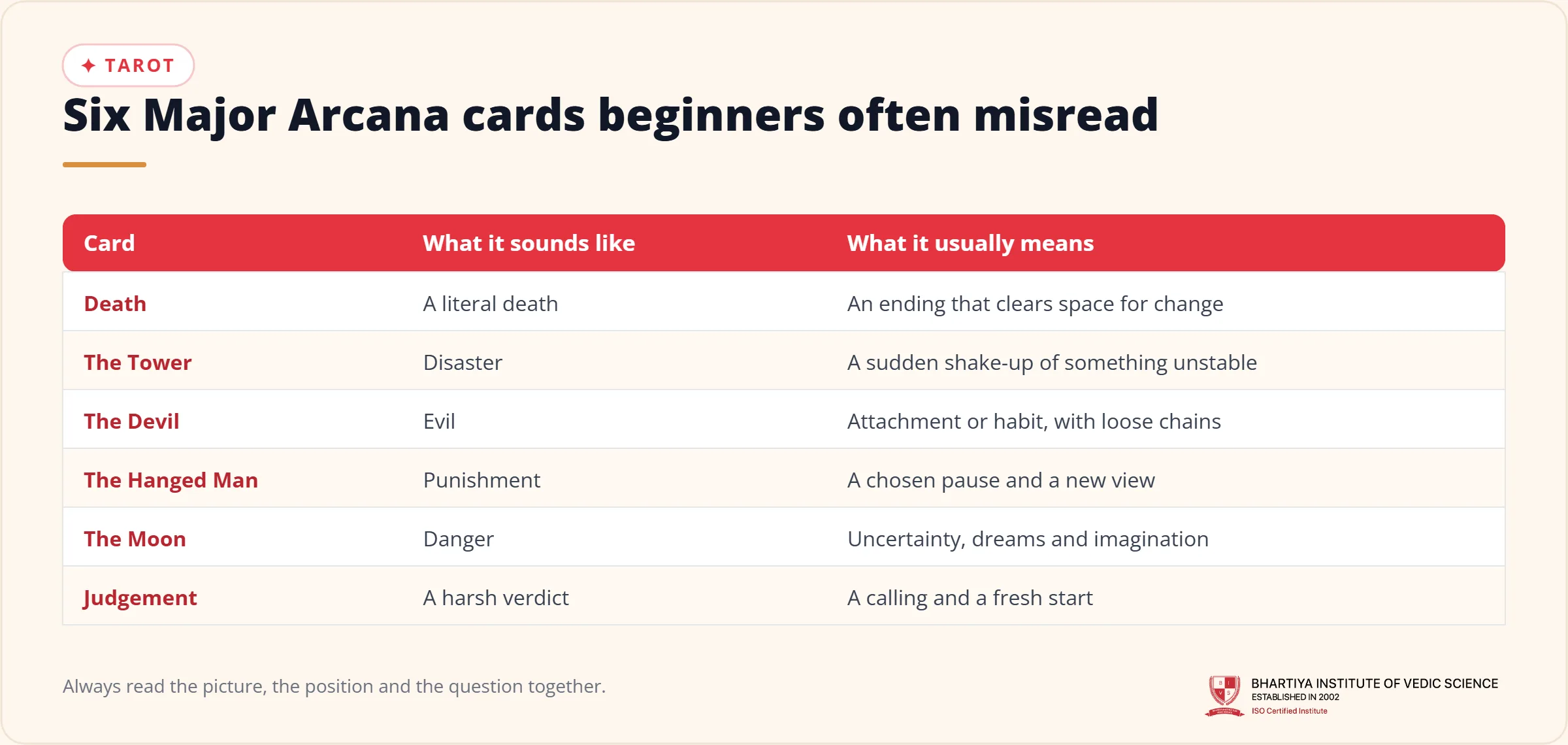
- Death: almost never a literal death. It usually means an ending that clears the way for a change.
- The Tower: a sudden shake-up of something unstable. It can also be a release.
- The Devil: attachment or habit, with the reminder that the chains in the picture are loose.
- The Hanged Man: a pause by choice, not punishment.
- The Moon: uncertainty and the imagination. It asks you to slow down before deciding.
How to Use the Major Arcana in a Reading
- Count them. Several Major Arcana cards in one spread suggest the question touches a major life theme.
- Read position first. A card in the "challenge" position reads differently from the same card in "advice".
- Use the reflection question. Turn the meaning into a question you can answer for yourself.
- Do not predict. Describe the theme and let the person decide.
Where to Go Next
Pair this guide with our article on the Minor Arcana suits to cover the whole deck. If you are curious about tarot as a career, read how to become a professional tarot card reader. For other ways to explore the inner life, see our guide to numerology and our list of 25 questions to ask in an Akashic Records reading.
Learning Tarot With a Teacher
The tarot card reading course at Bhartiya Institute of Vedic Science teaches the Major Arcana and Minor Arcana, spreads and reading practice in live online classes, in Hindi and English, with doubt sessions and certificate on completion. Bhartiya Institute of Vedic Science is an ISO Certified Institute, registered under NCT of Delhi, and has been teaching since 2002.
What the Major Arcana Can and Cannot Tell You
The Major Arcana can highlight a theme and prompt a thoughtful question. It cannot confirm an event, predict death or illness, or replace advice from a doctor, lawyer or financial adviser. Studies have not shown that tarot predicts the future, so use the cards for reflection.
Conclusion
The 22 Major Arcana cards tell one long story of growth, from the open step of The Fool to the wholeness of The World. Learn them in three acts, read the picture before the keyword, and always turn the meaning into a question.
To learn with a teacher, you can book a free 15-minute demo call. Which Major Arcana card do you feel closest to right now?
This article shares tarot knowledge for educational and reflective purposes. It is not a substitute for professional medical, legal or financial advice.