By Jyoti Chauhan, Content Writer · Reviewed by Gurudev Shrie Kashyap, Founder, Bhartiya Institute of Vedic Science
Key Takeaways
- Vedic astrology uses 12 rashis (zodiac signs) of 30 degrees each, measured against the fixed stars. This is the sidereal zodiac.
- Each rashi has a ruling planet (lord), an element and a quality (movable, fixed or dual), and these three together explain most of its traditional character.
- Because of the ayanamsa correction, your Vedic sign is usually about one sign behind your Western sun sign.
- In Vedic astrology the Moon sign (Chandra rashi) is the sign most people mean when they say "my rashi".
- Traits attached to signs are traditional tendencies, not fixed facts. A single sign never decides a person's life.
Ask an Indian family for your rashi and they will usually name the sign your Moon was in at birth. Ask a Western astrology app and it will name the sign your Sun was in. The two answers often differ, which confuses almost every beginner.
This guide gives you the full reference in one place: the twelve zodiac signs in Vedic astrology with their Sanskrit names, lords, elements and traits, and a plain explanation of why the Vedic and Western systems disagree.
If you are new to the subject, our introduction to what Vedic astrology is is a good companion, and our guide to how to read a kundali shows where signs fit in a full chart.
What Is a Rashi?
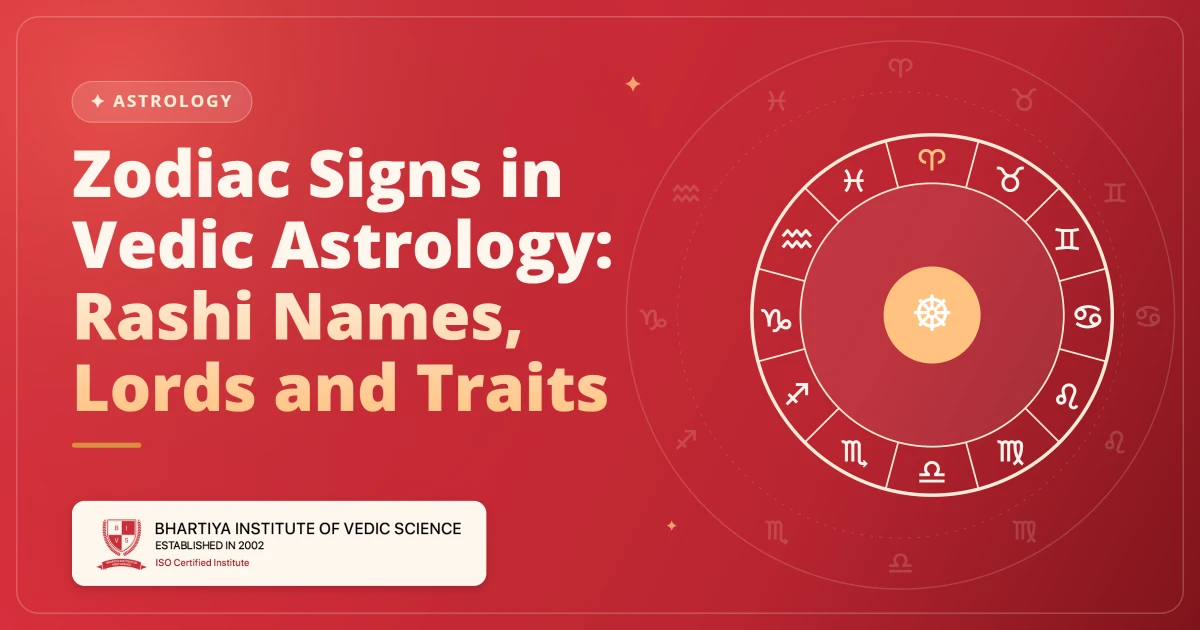
A rashi is one of the twelve equal divisions of the ecliptic, the Sun's apparent path across the sky. Each division spans 30 degrees, and together they cover 360 degrees. The word rashi means "heap" or "group", and in practice it is the same idea as a zodiac sign.
In a birth chart, the planets, the ascendant (lagna) and the houses are all described by the rashi they fall in. A rashi gives a planet its flavour in the way a setting gives a scene its mood. Mars in Aries behaves differently from Mars in Cancer, according to the tradition, because the sign changes the conditions in which the planet works.
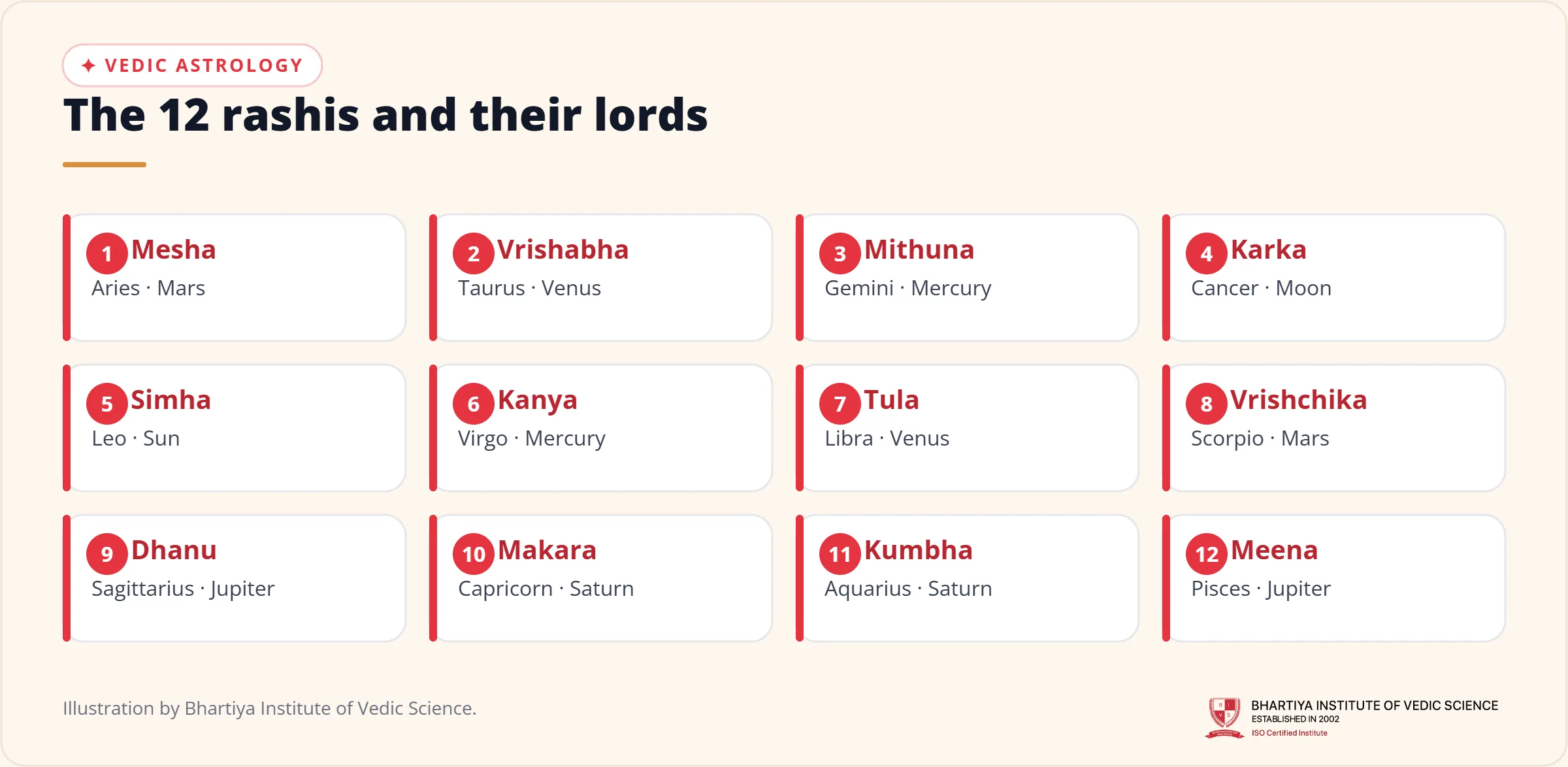
The 12 Rashis at a Glance
| # | Rashi | Western name | Lord | Element | Quality |
|---|---|---|---|---|---|
| 1 | Mesha | Aries | Mars | Fire | Movable |
| 2 | Vrishabha | Taurus | Venus | Earth | Fixed |
| 3 | Mithuna | Gemini | Mercury | Air | Dual |
| 4 | Karka | Cancer | Moon | Water | Movable |
| 5 | Simha | Leo | Sun | Fire | Fixed |
| 6 | Kanya | Virgo | Mercury | Earth | Dual |
| 7 | Tula | Libra | Venus | Air | Movable |
| 8 | Vrishchika | Scorpio | Mars | Water | Fixed |
| 9 | Dhanu | Sagittarius | Jupiter | Fire | Dual |
| 10 | Makara | Capricorn | Saturn | Earth | Movable |
| 11 | Kumbha | Aquarius | Saturn | Air | Fixed |
| 12 | Meena | Pisces | Jupiter | Water | Dual |
Notice that Mars, Venus, Mercury, Jupiter and Saturn each rule two signs, while the Sun and the Moon rule one each. The shadow planets Rahu and Ketu have no signs of their own in the most commonly taught scheme.
Sidereal vs Tropical Zodiac: Why Vedic and Western Signs Differ
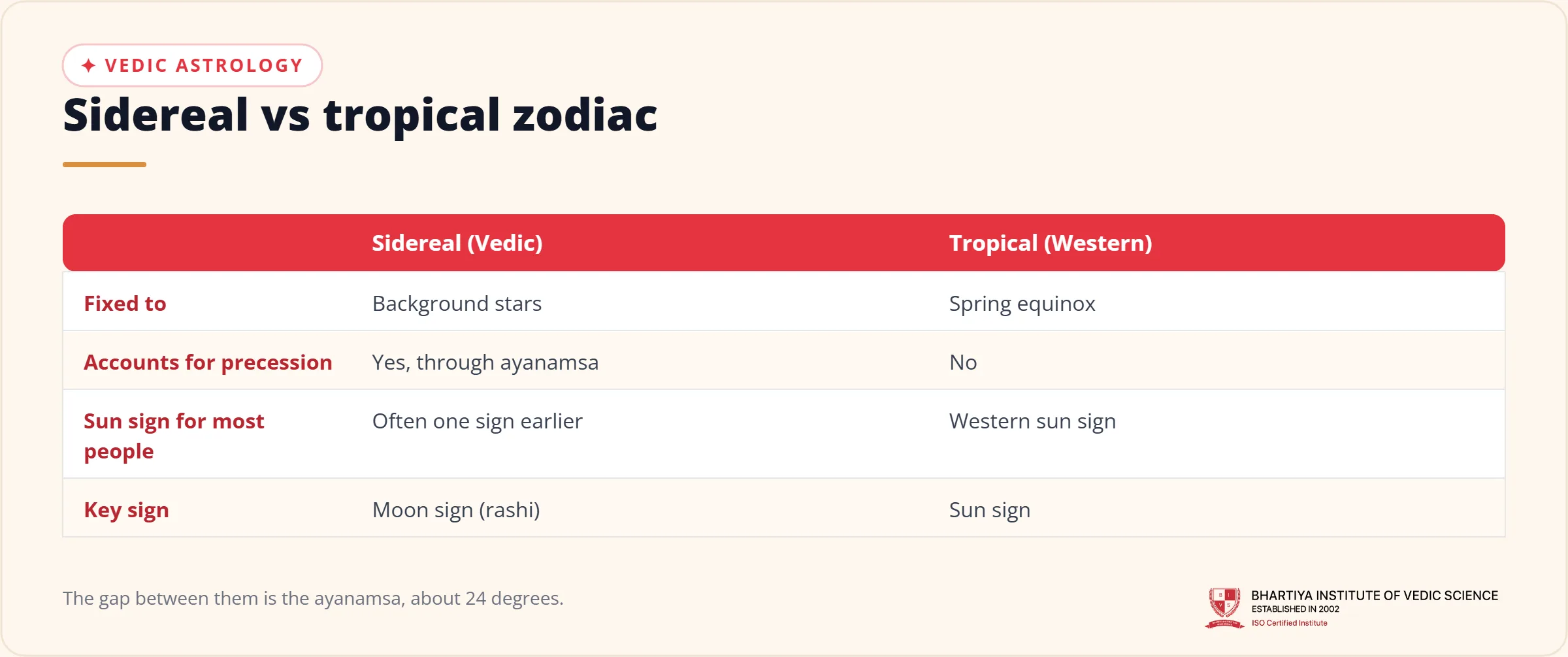
The Western system, called the tropical zodiac, fixes the start of Aries at the spring equinox. The Vedic system, called the sidereal zodiac, fixes the signs against the background stars.
The Earth's axis wobbles slowly, a movement called precession, so the equinox drifts backwards against the stars by roughly one degree every 72 years. The gap between the two zodiacs is the ayanamsa. In recent years the commonly used Lahiri ayanamsa is about 24 degrees. Because a sign is 30 degrees wide, a 24-degree shift moves most people into the previous sign. Someone who is Leo by Western reckoning is therefore often Cancer in Vedic reckoning.
Both systems are internally consistent, and neither is "wrong". They simply measure from different starting points. Vedic astrologers use the sidereal zodiac because they tie their calculations to the stars and to the nakshatras. For more on the nakshatras, see our reference to the 27 nakshatras.
Moon Sign vs Sun Sign: Which One Is Your Rashi?
In Vedic astrology, your rashi usually means your Moon sign, the sign the Moon occupied at birth. The Moon moves through a sign in about two and a quarter days, so it changes signs far more often than the Sun, which takes about a month. That makes the Moon sign more personal for a given birth date, and you need your time and place of birth to find it.
| Sign | Moves through a sign in | Traditionally shows |
|---|---|---|
| Moon sign (Chandra rashi) | About 2.25 days | Mind, mood, emotional habits, naming and compatibility |
| Sun sign (Surya rashi) | About 1 month | Core identity, vitality, sense of purpose |
| Ascendant (lagna) | About 2 hours | Body, outlook, how you meet the world |
The lagna is the third key sign in a chart, and it changes roughly every two hours, which is why an accurate birth time matters so much.
How Elements and Qualities Shape a Sign
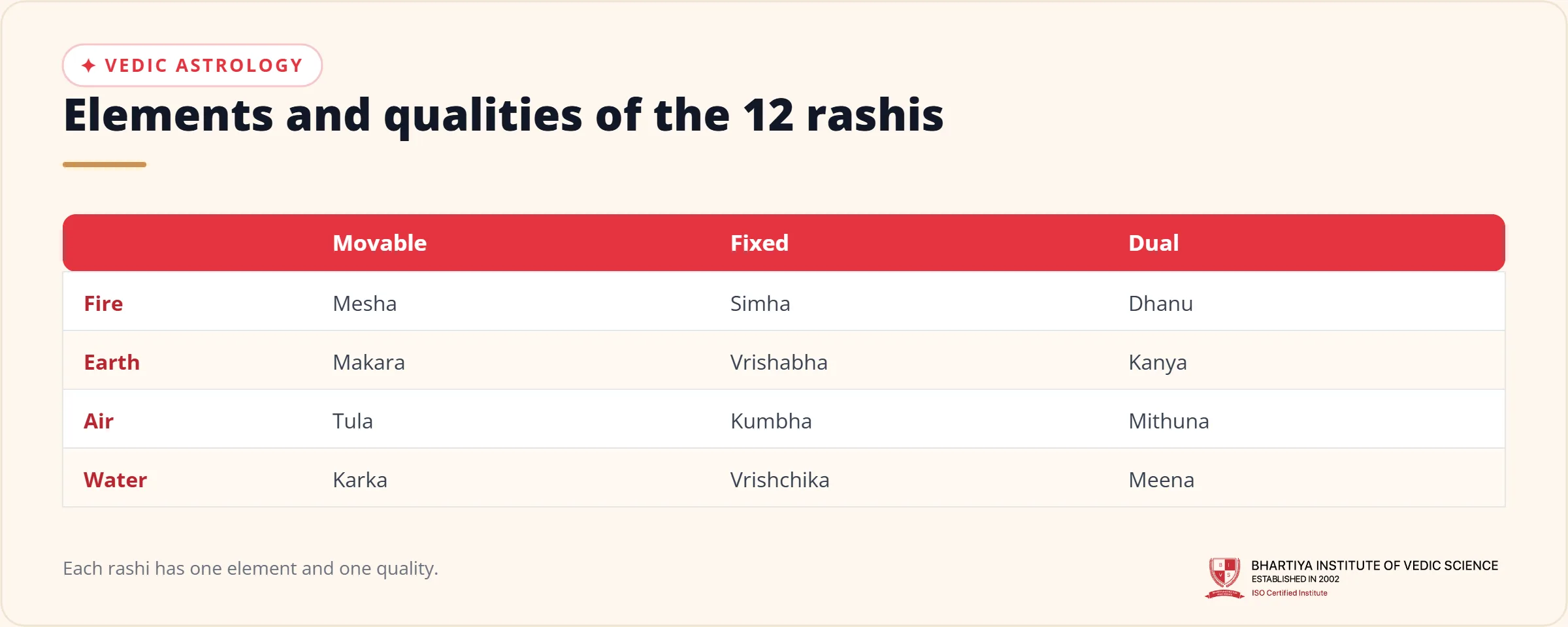
Every rashi belongs to one of four elements and one of three qualities. Knowing these two labels gives you a quick feel for any sign.
- Fire (Mesha, Simha, Dhanu): energetic, enthusiastic, direct.
- Earth (Vrishabha, Kanya, Makara): practical, steady, focused on the material world.
- Air (Mithuna, Tula, Kumbha): communicative, social, curious.
- Water (Karka, Vrishchika, Meena): feeling, intuitive, protective.
The qualities describe how a sign acts. Movable (chara) signs start things, fixed (sthira) signs sustain them and dual (dwiswabhava) signs adapt and connect.
The 12 Rashis One by One
The descriptions below summarise what classical and modern teachers usually say. They are tendencies that depend on the whole chart, and no sign is better or worse than another.
1. Mesha (Aries), lord Mars
The first sign, a fiery movable sign. Tradition describes courage, initiative and a love of beginning things. The same energy can show as impatience, so many teachers suggest patience as the sign's lesson.
2. Vrishabha (Taurus), lord Venus
A fixed earth sign linked with comfort, loyalty, good food and the arts. It tends to be steady and reliable. Resistance to change is the usual area for reflection.
3. Mithuna (Gemini), lord Mercury
A dual air sign associated with speech, learning, wit and variety. Curious minds often prefer movement and conversation, and may need to practise finishing what they begin.
4. Karka (Cancer), lord Moon
The only sign ruled by the Moon, a movable water sign. It is associated with care, memory, family and a strong sense of home. Sensitivity is its gift, and over-worrying is its usual challenge.
5. Simha (Leo), lord Sun
A fixed fire sign ruled by the Sun. It is linked with confidence, generosity and a natural wish to lead. Pride is the tradition's caution.
6. Kanya (Virgo), lord Mercury
A dual earth sign associated with analysis, service, health awareness and detail. It tends to be careful and helpful, and may need to ease self-criticism.
7. Tula (Libra), lord Venus
A movable air sign symbolised by the scales. It is linked with balance, fairness, partnership and aesthetics. Indecision is its commonly mentioned challenge.
8. Vrishchika (Scorpio), lord Mars
A fixed water sign associated with depth, focus, research and endurance. It tends to feel things intensely, and the usual lesson is learning to share trust.
9. Dhanu (Sagittarius), lord Jupiter
A dual fire sign linked with higher learning, travel, teaching and optimism. It is often described as honest and philosophical, sometimes to the point of bluntness.
10. Makara (Capricorn), lord Saturn
A movable earth sign associated with discipline, patience, structure and long-term effort. Reserve and over-seriousness are the traditional areas to balance.
11. Kumbha (Aquarius), lord Saturn
A fixed air sign linked with networks, ideas, reform and detachment. It is described as original and humanitarian, and can seem aloof to others.
12. Meena (Pisces), lord Jupiter
The last sign, a dual water sign associated with compassion, imagination, spirituality and the arts. Boundaries are the gentle lesson usually suggested.
A Short History of the Twelve Signs
The idea of dividing the sky into twelve signs of equal length was shared by several ancient cultures, and the Indian tradition developed its own names, lords and uses for them. The signs appear in the classical Jyotisha texts, including the Brihat Parashara Hora Shastra, where each rashi is described with its lord, element, direction and body part. Later teachers added the nakshatras and divisional charts, but the twelve rashis remained the base of every calculation.
Signs vs Houses: A Common Confusion
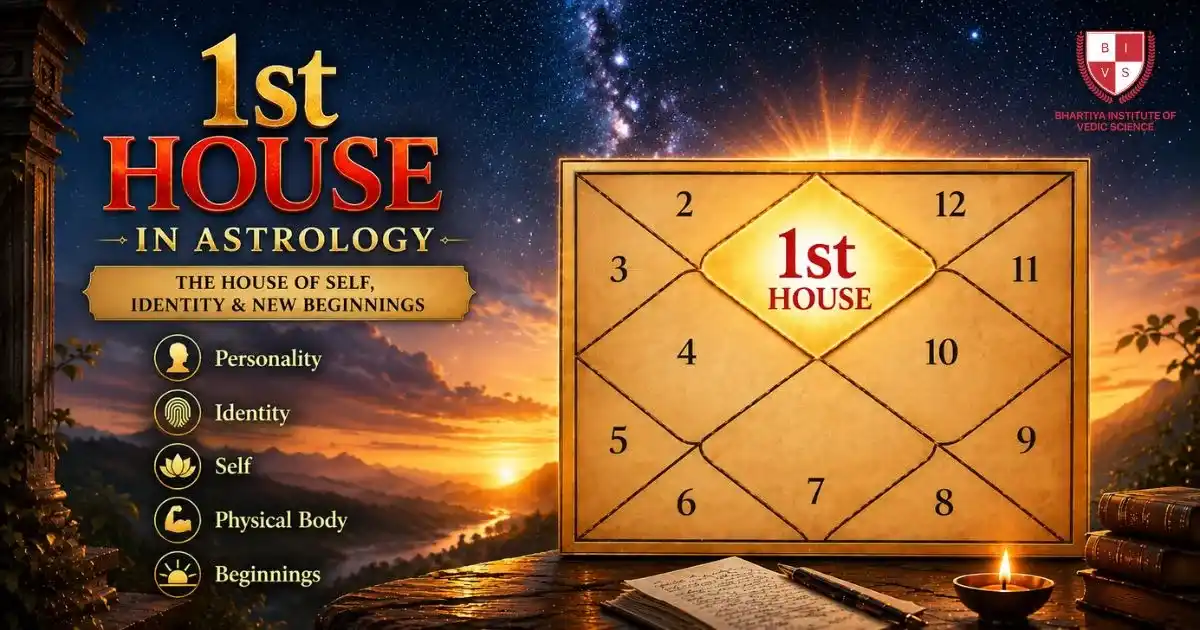
Beginners often mix up signs and houses. A sign is a 30-degree slice of the zodiac. A house (bhava) is a division of the chart that stands for a life area such as career or marriage. In a birth chart, the lagna sign sits in the first house, and the other signs follow in order. Which sign lands in which house depends on the ascendant. For example, our explanation of the 10th house in astrology shows how a house describes career whichever sign falls there.
How Signs Connect to Transits and Sade Sati
Planets keep moving through the signs after you are born, and astrologers call this movement gochar, or transit. A slow planet such as Saturn stays in a sign for about two and a half years. The much-discussed Sade Sati period is defined by Saturn's passage through the signs around your Moon sign, which is one more reason the Moon sign matters. Sade Sati is a long phase that many people pass through, and it is not something to fear.
When Does the Sun Enter Each Sign?
The Sun's entry into a sidereal sign is called a sankranti. The dates below are approximate and can differ by a day from year to year, so check a panchang for the exact moment.
| Sign | Approximate Sun entry | Sign | Approximate Sun entry |
|---|---|---|---|
| Mesha | 14 April | Tula | 18 October |
| Vrishabha | 15 May | Vrishchika | 17 November |
| Mithuna | 15 June | Dhanu | 16 December |
| Karka | 16 July | Makara | 14 January |
| Simha | 17 August | Kumbha | 13 February |
| Kanya | 17 September | Meena | 14 March |
The Makara sankranti on about 14 January is the day Makar Sankranti is celebrated, which is one of the few dates in the Indian calendar that follows the solar, and not lunar, cycle.
How to Find Your Moon Sign
- Collect your birth details. You need the date, the exact time and the place of birth.
- Use a sidereal calculator. Pick a tool that lets you choose the Lahiri ayanamsa and shows the Moon's position.
- Read the Moon's sign. The sign the Moon occupies is your Chandra rashi.
- Cross-check. Compare with a printed panchang or a second tool, because small time errors can move the Moon across a sign boundary.
If your Moon is near the end of a sign, a few minutes of birth-time error can change the answer, which is why serious practitioners rectify birth time before reading a chart.
Common Mistakes When Reading Signs
- Using the sun sign for everything. In Vedic astrology the Moon sign and the lagna matter at least as much.
- Judging a person by one sign. A chart has nine planets, twelve houses and many combinations.
- Mixing the two zodiacs. Do not read a Vedic chart with Western sign traits, or the reverse, without noting the difference.
- Treating traits as labels. Use words like "tends to" and "may", and avoid "always" and "never".
- Fear about "bad" signs. No sign is bad. Every sign has strengths and areas to grow.
Learning to Read Signs Properly
Signs are only the alphabet of astrology. To read a chart with confidence you need to combine signs with planets, houses, nakshatras and dashas, and to practise on many charts. If you would like to study with a teacher, see our guide on how to learn astrology, or look at the astrology course at Bhartiya Institute of Vedic Science, which is offered at an Advanced level of about 2 months and a Professional level of about 5 months. Bhartiya Institute of Vedic Science is an ISO Certified Institute, registered under NCT of Delhi, and has been teaching since 2002.
What the Zodiac Signs Can and Cannot Tell You
Signs can give you a vocabulary for talking about temperament and a starting point for studying a chart. They cannot tell you who you will marry, what career you will have or whether you will be successful. Treat sign descriptions as traditional stories to reflect on, not as predictions.
Conclusion
The twelve rashis are the base of Vedic astrology. Learn their names and lords first, then their elements and qualities, and remember that your Moon sign is the one most Indian astrologers mean when they ask for your rashi. The Vedic sign is usually one sign behind the Western sun sign because the two systems measure from different starting points.
If you would like a guided way to learn charts, you can book a free 15-minute demo call with Bhartiya Institute of Vedic Science. Which sign did you find that you belong to?
Sources and Further Reading
- Jyotisha (Hindu astrology), Wikipedia
- Sidereal and tropical astrology, Wikipedia
- Ayanamsa, Wikipedia
- Axial precession, Wikipedia
- Drik Panchang, for sankranti and panchang timings
This article is for educational purposes and describes traditional astrological beliefs. It is not a substitute for professional medical, legal, financial or psychological advice.