By Jyoti Chauhan, Content Writer · Reviewed by Gurudev Shrie Kashyap, Founder, Bhartiya Institute of Vedic Science
Key Takeaways
- To become a graphologist, you learn to read features of handwriting such as slant, size, pressure, spacing, baseline and signature, and to explain them carefully.
- The graphology course at Bhartiya Institute of Vedic Science is a 2-month live course taught in Hindi and English, open to anyone who has passed class 10 (as listed on the course page in November 2026).
- Research has not supported graphology for hiring or predicting job performance, so ethical practice means using it for self-reflection and personal interest.
- Graphology is different from forensic document examination, which compares handwriting to identify writers and forgeries.
- No course can promise income, clients or placement. Treat any such promise as a warning sign.
Handwriting is one of the few personal things we produce every day without thinking. A shopping list, a signature on a form, a note in the margin of a book. It is easy to see why people wonder whether it says something about the person who wrote it.
That curiosity is where many graphologists begin. But a good graphologist also learns where the field is weak, because honesty about limits is what separates a thoughtful practitioner from a salesperson.
This guide explains how to become a graphologist: the skills to build, the training path, how to practise, what a course teaches, and the ethics and evidence you must understand before you offer readings to anyone. If you are new to the subject, start with our guide to what graphology is.
What Does a Graphologist Do?
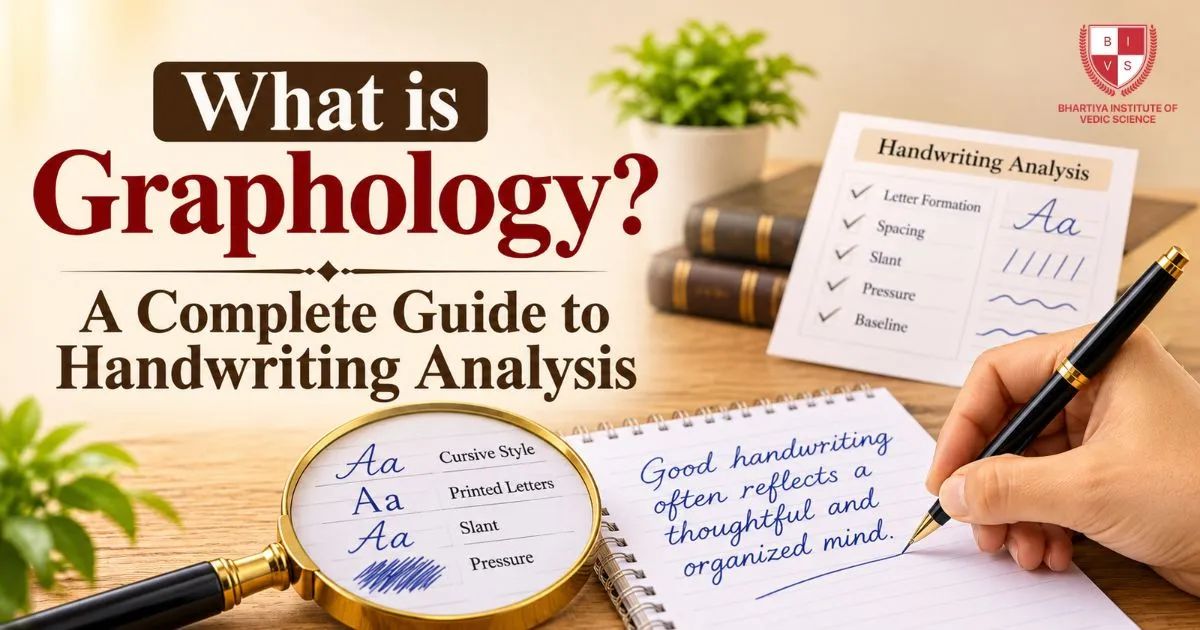
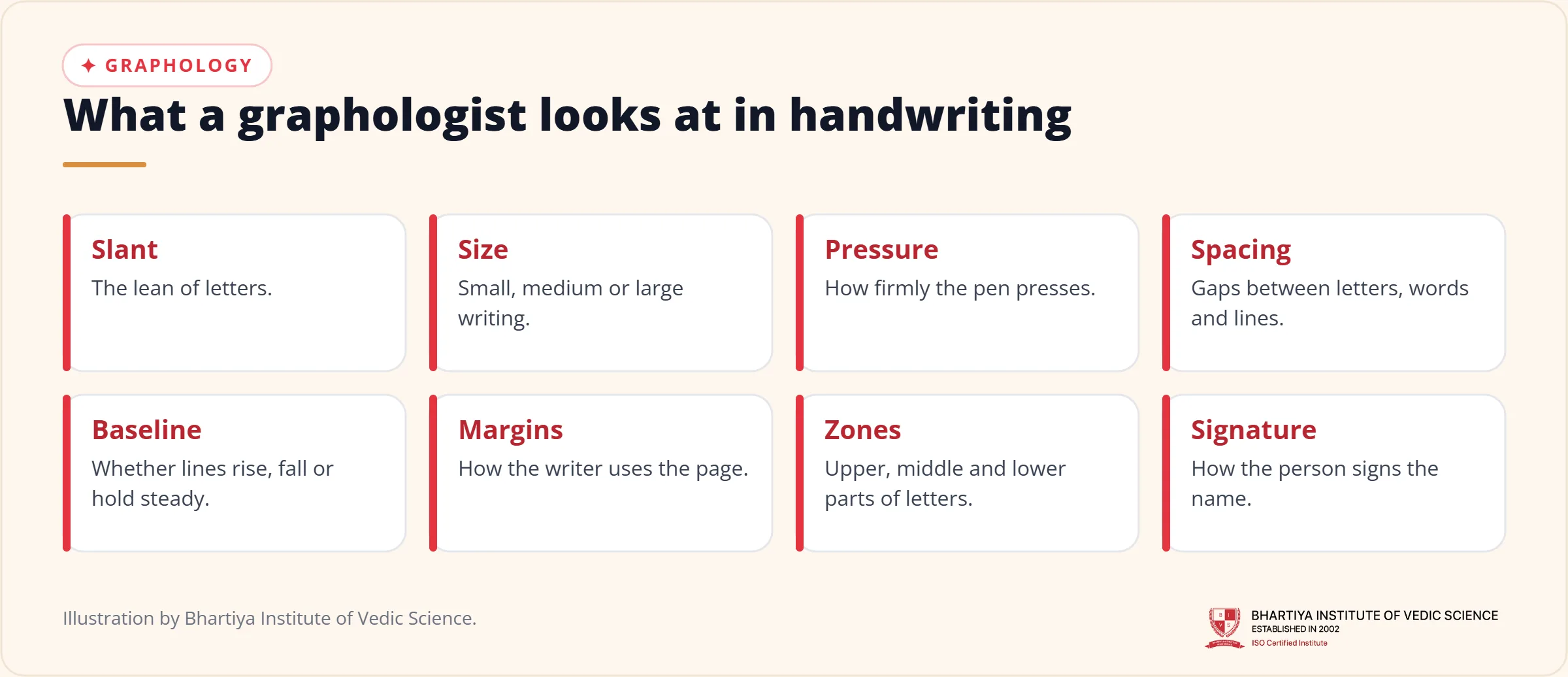
A graphologist studies handwriting to describe traits and tendencies of the writer. In practice, a graphologist examines a sample, notes features such as the lean of the letters, the size of the writing, the pressure of the pen, the spacing between words, the direction of the baseline and the way the person signs, and then writes or explains a profile in simple language.
Many graphologists also teach, write, run self-awareness workshops or combine graphology with other subjects such as numerology or astrology. The work is closer to coaching and conversation than to testing, and the best sessions are those where the client reflects and corrects the reading.
Is Graphology a Career? An Honest View
Before investing time and money, be clear about three facts.
- It is a niche. Demand exists, mostly among people interested in self-awareness, but it is smaller than demand for subjects such as astrology or Vastu.
- Evidence is weak. Studies that tested graphologists against personality questionnaires and job performance did not find reliable validity. We explain this below.
- Income cannot be promised. It depends on your skill, communication, reputation and consistency. We do not quote figures, and no honest institute can.
Many people therefore learn graphology as a personal interest, a creative skill or an addition to other practices, rather than as a main income source. That is a perfectly good reason to study it.
Skills a Graphologist Needs
| Skill | What it means |
|---|---|
| Observation | Noticing small features in a handwriting sample |
| Pattern thinking | Reading features together and not one by one |
| Careful language | Describing tendencies without certainty or fear |
| Listening | Letting the client respond, correct and reflect |
| Ethics | Consent, privacy and clear limits |
| Record keeping | Keeping samples, notes and learning from feedback |
What You Learn in Graphology
A structured course covers the main areas of handwriting analysis:
- Slant: the lean of the letters. See our guide to handwriting slant for a first example.
- Size and spacing: how large the letters are, and how much room the writer leaves between letters, words and lines.
- Pressure and stroke: how firmly the pen presses and how smooth the line is.
- Baseline and margins: whether lines rise, fall or hold steady, and how the writer uses the page.
- Zones: the upper, middle and lower parts of letters, traditionally linked with thought, daily life and drives.
- Letter forms and signature: the shape of particular letters and the way a person signs. Read more in our guide to signature analysis.
- Ethics: how to talk about traits responsibly.
Schools of Graphology
Graphology is not one single method. Two broad approaches are often described. Holistic graphology looks at the overall impression of a page, including rhythm, layout and balance. Graphoanalysis, developed by Milton Bunker, who founded the American Grapho Analysis Society in 1929, breaks handwriting into individual strokes and assigns each a trait. Courses may draw on both, and knowing which approach your teacher follows helps you understand why interpretations sometimes differ.
A Sample Analysis Session, Step by Step
Here is the shape of a typical beginner session, described as an example of method and not as a verified reading of anyone.
- Introduce the aim. Explain that the session is for reflection and that the writer can disagree with anything you say.
- Look at the whole page. Note the overall layout, margins and rhythm before you look at details.
- Measure the main features. Slant, size, pressure, spacing and baseline, one at a time.
- Read the signature. Compare it with the body of the writing.
- Combine and summarise. Write three strengths and two areas for reflection, in careful language.
- Invite feedback. Ask which statements fit and which do not, and thank the writer.
How Long Does It Take to Learn Graphology?
A structured course can teach the foundations in a couple of months. Confidence comes from reading many samples over time, so most learners keep practising for six months to a year after the course before they feel comfortable. Be patient with yourself, and keep a log of every sample you read, including what you got wrong.
The Training Path in Four Stages
Stage 1: Foundations
Learn the vocabulary and the basic features. Practise measuring slant, size and spacing on your own handwriting and that of willing family members.
Stage 2: Letters and strokes
Study individual letter forms, loops, stems and connecting strokes. Compare printed and cursive writing, and note how a script, such as Devanagari, changes what you can observe.
Stage 3: Putting features together
Learn to combine features into a short, balanced profile. This is where beginners usually struggle, because several features can appear to point in different directions.
Stage 4: Practice with feedback
Write profiles for volunteers and ask them to mark what fits and what does not. Keep every result, including the misses.
The Graphology Course at Bhartiya Institute of Vedic Science
The graphology course at Bhartiya Institute of Vedic Science is listed as the Professional Graphology Course, with the following details as shown on the course page in November 2026:
- Duration: 2 months of live interactive classes, with theory and practical sessions.
- Language: Hindi and English.
- Doubt sessions: included, with lifetime access to class recordings.
- Eligibility: anyone who has passed class 10.
- Certificate: issued on completion.
- Topics: introduction and history, core principles, letter and stroke analysis, signature and special patterns, graphotherapy and ethics.
Bhartiya Institute of Vedic Science is an ISO Certified Institute, registered under NCT of Delhi, and has been teaching since 2002. You can see how the classes work by booking a free 15-minute demo call. Please check the course page for current batch dates and the full syllabus.
How to Practise Responsibly
- Collect samples with consent. Ask the writer first, and tell them how you will use the sample.
- Use natural writing. A few lines of everyday writing on plain paper are better than a copied sentence.
- Record the conditions. Note the pen, the paper, the time and whether the person was rushed.
- Write a short, balanced profile. Include strengths and areas for reflection, and avoid fixed labels.
- Ask for feedback. Let the writer say what rings true and what does not, and keep the notes.
Graphology vs Forensic Document Examination
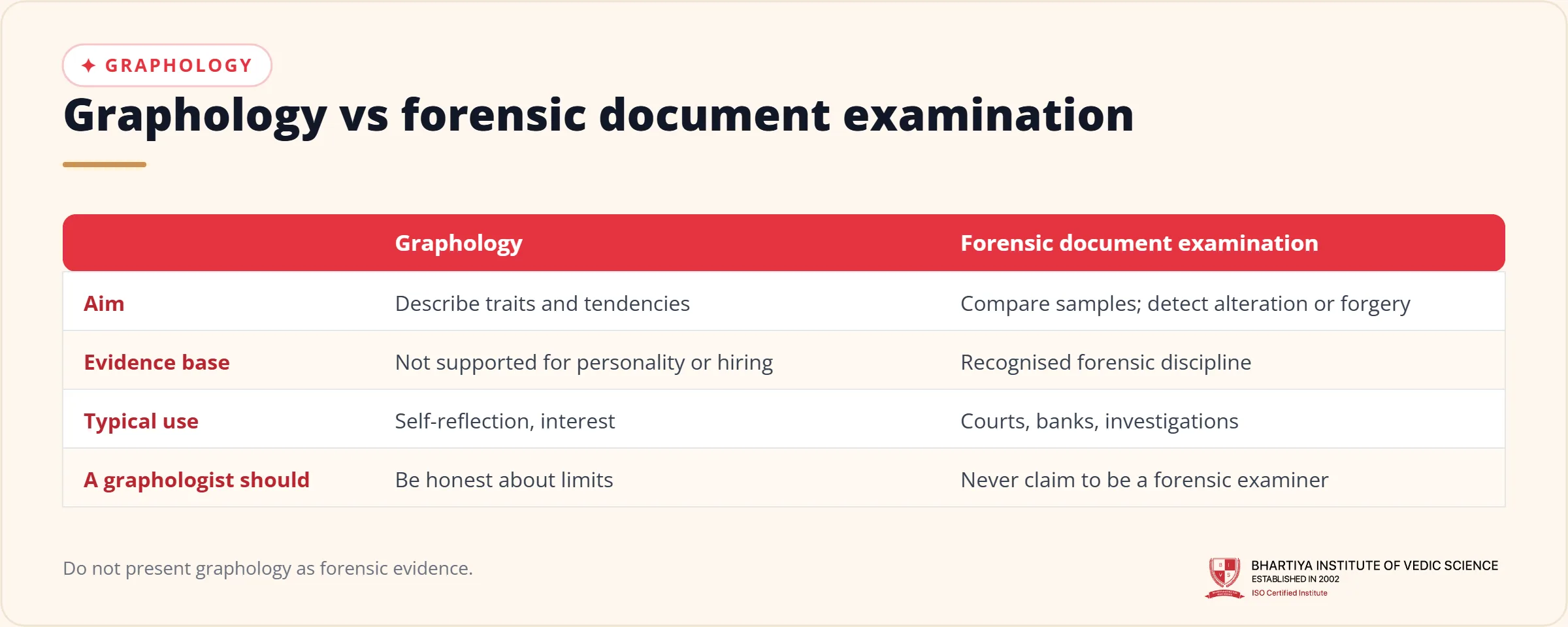
People often confuse the two. Graphology tries to describe personality from handwriting. Forensic document examination compares handwriting samples to decide whether the same person wrote them, or whether a document has been altered. The second is a recognised forensic field with its own training and standards. A graphologist should never present themselves as a forensic examiner or give opinions for legal cases.
The Evidence: What You Should Know
Studies that compared graphologists' conclusions with personality questionnaires, including Furnham and Gunter (1987) and Dazzi and Pedrabissi (2009), did not find that handwriting predicted personality reliably. The British Psychological Society has been reported as giving graphology "zero validity", and the general scientific view summarised in the Wikipedia article on graphology is that it is not supported as a method of assessing personality or job performance.
A responsible graphologist says this plainly. Graphology can be a thoughtful way to prompt reflection about habits and moods. It should not be used to rank, hire, reject or judge anyone.
A Note on Graphotherapy
Some courses teach graphotherapy, the practice of changing handwriting habits as a way of working on a personal trait. It is a self-development exercise, and there is no strong scientific support that it changes personality. If you learn or offer it, present it as an optional reflective exercise and not as a treatment for any condition.
Ethics for Graphologists
- Consent and privacy: never analyse someone's writing without permission, and keep samples private.
- No hiring or screening: do not use graphology to decide jobs, loans, admissions or relationships.
- No medical or legal claims: do not diagnose illness or give legal opinions from handwriting.
- No fear: do not tell a person their writing shows a bad future or a flawed character.
- Honest marketing: do not promise accuracy, results or income.
Building Your Skills Over Time
Start by reading your own handwriting over several weeks, then widen to volunteers. Join a study group, write up each case and revisit it after a month. If you enjoy working with patterns in other subjects, our guides on how to become a Vastu consultant and how to become a numerologist describe similar learning paths, and many graphologists combine subjects.
Common Mistakes New Graphologists Make
- Reading one feature alone. A single slant or loop proves nothing.
- Judging a short or copied sample. Use natural writing in sufficient quantity.
- Using fixed labels. Say "tends to" and "may", and invite the writer to respond.
- Overclaiming accuracy. Avoid percentages and guarantees.
- Ignoring context. Left-handedness, schooling, pen and speed all change handwriting.
What Becoming a Graphologist Can and Cannot Give You
Learning graphology can give you a careful way of observing handwriting, a skill for self-awareness sessions and a topic to combine with other studies. It cannot give you a reliable method of judging people, and it cannot promise income, clients or placement. Make decisions about your career with practical information.
Conclusion
To become a graphologist, learn the features of handwriting step by step, practise with consent, and be honest about the limits of the field. Used as a tool for reflection, graphology can be an engaging and thoughtful subject.
If you would like to study it with a teacher, you can book a free 15-minute demo call or see the graphology course. What would you want to learn from handwriting first?
This article shares graphology knowledge for educational purposes. It is not a substitute for professional psychological, medical, legal or financial advice.